When the Shake-up Comes
In 2000, Diana Buttu joined the Negotiations Support Unit (NSU) of the Palestinian Liberation Organization (PLO) as a legal advisor, hoping to wrest a fair and final agreement to the Israeli–Palestinian conflict out of a negotiations process gone south. Thirty years old, recently graduated from law school, and hopeful, Buttu worked closely with leaders Yasser Arafat, Mahmoud Abbas, and others to reach that goal.
When Israeli forces reoccupied the West Bank in 2002, Buttu happened to be in Israel conducting house-to-house campaigns to speak about the occupation. She was unceremoniously thrust into the role of media spokesperson, answering phone calls from the BBC and CNN while her colleagues waited out electricity cuts in Ramallah.
Born and raised in Canada, Buttu was labeled the “closest thing to a Palestinian makeover” the resistance movement could boast. She left the PLO in 2005, however, disillusioned by what she has since described as a crippling imbalance between the negotiating parties. In a recent article for Haaretz, the 49-year-old disavowed what’s left of the Olso process, writing “to demand that Palestinians—living under Israeli military rule—negotiate with their occupier and oppressor is akin to demanding that a hostage negotiate with their hostage taker.”
Since leaving the PLO, Buttu has remained active as an analyst, professor, human rights lawyer, and frequent commentator on the conflict. She teaches courses on negotiations, conflict resolution, and human rights law at Harvard University.
Cairo Review Associate Editor Leslie Cohen spoke with Buttu on January 16, 2019.
CR: Can you tell me about when you first started working at the PLO in the early 2000s? What was your official capacity serving on the Negotiations Support Unit?
DB: I arrived in the country on the first day of the Second Intifada, so September 29, 2000. At the time, and this is why I was hired, the NSU was looking for lawyers—people who would be able to help with everything from, as they put it, “dotting the i’s to crossing the t’s on a final agreement.” The Camp David negotiations had just fallen apart and for me as somebody who was kind of an outside observer, but also not just an outside observer, I was a little bit shocked when the people who were soon to become my colleagues were telling me that actually there had been progress made at Camp David and that they were continuing with negotiations. Because if you recall this was the time that Prime Minister Ehud Barak came up with the slogan, “the very generous offer that had been rejected.”
So I arrived with the belief that there would be continued negotiations that would pick up from the Camp David negotiations, and that although Camp David was not successful there had been some progress made, that there was some room and basis to continue discussions. I was hired as one of five legal advisors—I was the only woman—to work on the various permanent status issues: borders, refugees, security, Jerusalem, settlements, and water. They were very mixed into one another, but I was working on refugees.
CR: So you were drawing up legal proposals for the negotiating team and the negotiations were sort of stalled but you expected them to pick back up again?
DB: They were still ongoing. When the Second Intifada started there were still a few negotiation sessions in the beginning phases of October, and then Ehud Barak announced that he was halting negotiations with the Palestinians. I want to say that was October 6, or it may have been a bit later. Negotiations then continued under the radar, vacillating between being sometimes secret and sometimes out in the open.
CR: What was your relationship like with the other negotiators, as well as the leadership—Mahmoud Abbas or Yasser Arafat? What was the atmosphere like?
DB: The working relationship—we were five lawyers and probably about twelve main Palestinian political players who were negotiating. The relationship with them was close. In fact, it was oddly close in the sense that they didn’t know me from the person down the street, and yet trusted and confided in and I think sometimes valued, other times didn’t value, the advice that I and others gave. The five lawyers were people who were like me: diaspora Palestinians. One was Jordanian, not Palestinian, just Jordanian. The rest of us were either born and raised in the West or educated in the West. Sometimes people like Arafat or Abu Mazen [Mahmoud Abbas] would look down on [us], as these naive people who hadn’t lived in the Occupied Territories. Or in later years as the faces of legal advisors started to drop off and I was the only one that was consistent, PLO leaders [expressed the sentiment], “Well you’re not even really committed to this because at the end of the day you can up and leave,” which was true. The commitment was there but the up-and-leave part was definitely there, as I could have gone back to Canada. So the relationship was close but it wasn’t without its problems.
CR: Did this tendency to question your commitment manifest in the PLO leaders thinking that your proposals weren’t tough enough?
DB: It manifested in two ways. It was either that we were being too hardline— that was the number one thing that we always heard was, “Yes this is great in law but this isn’t going to work in reality,” so they’d be much more willing to concede, which is always the case, than the lawyers. Or it was the opposite; the PLO leaders would say to us, the legal team, “You don’t realize how important Jerusalem is.”
For me, big issues that were really important were settlements because that signified what Israel’s intentions were toward land and refugees. And yet for the leadership it was more a question of the amount of territory, not necessarily the territory. For them it became: “What’s the big deal about doing land swaps?” And for me it was, “Well, you are accommodating the settlements, you’ve just given them the signal that it’s okay to build and expand settlements and you’ve told the world that it’s okay to do so.”
CR: Did you feel that there was a difference among the leadership, with some PLO leaders more understanding
of your arguments and others trying harder to accommodate the Israelis?
DB: Definitely. On the understanding side, Yasser Abed Rabbo was somebody who got it. Arafat was a mixed bag, because some days it was one way, some days it was another way—I’m not sure what it depended on. The people on the less understanding side of things were people like Abu Mazen. Actually, I can’t really say that. Abu Mazen was a quiet man so he didn’t ever really express opinions, it was mostly that you would see in the aftermath of a negotiations session what he had decided. So he would be one who was a little more accommodating [toward the Israelis]. Nabil Shaath was definitely more accommodating.
CR: When you were advising the negotiators, what were the mistakes being made that were within your team’s power? Within the power of the other side? If you had to identify the things that stymied negotiations, what were the internal factors and what were the external factors?
DB: The best way to answer this I think is by describing a couple of the negotiation sessions. So for one of the negotiation sessions, and this is not an exaggeration, we spent three months, literally three months, negotiating over an agenda, for an upcoming negotiation. And you can imagine the frustration of literally just negotiating what was going to be on the agenda. And that was pointless because when the meeting eventually happens, none of the things that we had discussed or quibbled over back and forth mattered. Zero. People would just talk about whatever they wanted to talk about. So that was a huge time waste. And now I see that it was done because the Israelis were trying to buy time; they didn’t want the information to be leaked when they were trying to pass certain legislation, with coalition problems, and so on. But when you’re trying to send the message to the Palestinian side that you’re really interested in ending the occupation, holding up the negotiation session for three months over an agenda—that’s not going to send the right message.
Another issue; I didn’t need a permit to leave the West Bank and go to Israel because I actually have Israeli citizenship. But the Palestinian negotiators all needed permits to be able to go anywhere. And almost all of the negotiations, or 80 percent of the negotiation sessions, were held in places where they needed permits, like Tel Aviv, Jerusalem, close to the Palestinian border. So, for each of those sessions the Palestinian principals—senior people—needed to get permits. And there were more times than I can even remember that we were stopped at a checkpoint and told that the permits were not valid on our way to a negotiation session. It’s because in the Israeli bureaucracy, the right hand doesn’t know what the left hand is doing. The Palestinian negotiators would be issued permits, but the Israeli soldiers at the checkpoints wouldn’t have the correct information about permit types. I think the longest we were held up for was probably about two hours. Again, needless. That was the type of thing that totally frustrated the Palestinian side.
The other mistakes were because so many of these issues are intertwined—borders, settlements, security, and kind of Jerusalem, tend to be one—but instead of being treated as one they were divided up into these very harsh categories, and then there was never a decision made on anything because they all were linked to one another.
CR: And that would include basically all the final status issues?
DB: Exactly. Subtract two of them—refugees and water—but even water is somewhat linked. So everybody said: “No we can’t make a decision on this issue because that relates to this file.” It would be bounced from one ministry to another, so in the end there were no decisions that were ever made—ever—as a result. Those were kind of the internal factors.
The external factors were things that were even more basic, like there was never a reference to international norms or international law. So, in the Oslo Agreements, it says this will lead to the implementation of UN Security Council Resolutions 242 and 338. To the Palestinians that means something, but to the Israelis that means something else. And still to this day, that gap has never been bridged. So that was something that was one of the external factors that was plain silly that, again, could have been addressed but never was.
There’s a great saying in Arabic, “hagmak zalmak” which means that the person who is the decider, the judge, is also your oppressor, and that was very much the case here. We were never out of a scenario of occupation. Human rights were never put first: there were still deportations happening; home demolitions; there were still people who were being picked up; and all of that influenced the way that the negotiations were happening. It felt as though, while we were negotiating on one level, there’s something totally different happening on another level that was making this situation worse.
CR: And at this time, were there Americans in the room?
DB: Never. The Americans were, in the later years of my tenure—2003 onward—doing a lot of subtle diplomacy, but they were never in the room and neither were the Europeans. And that was a big problem. We never heard from the Europeans in terms of what they would stand by and what they wouldn’t, so in the mind of the Israelis, it was like, “Well, we’ll stand by whatever we agree to; we’re the big kids on the school playground and you’re the little kids.” That was a huge power imbalance that was also external.
Going back to internal [factors], I think one of the big mistakes that both sides made was that the negotiations were behind closed doors, mostly men, in fact entirely men with the exception of a couple of women. On my side, I was the only woman, and on their side, they had one female Israeli general who was there for a short period of time. They never really explained [what was going on] to the public. And things would be said, again on both sides, to the public that didn’t exactly match what was happening behind closed doors. For example, on the issue of the right of return, the Palestinian side kept saying, “We fully believe in the right of return, and we’re going to demand the right of return,” and then behind closed doors, they were talking about limited return. On the Israeli side, they would say things like, “We’re never going to evacuate a single settlement,” and then behind closed doors they were saying “Well, maybe some of the Jordan Valley ones.” When there’s so much secrecy, you begin to mistrust the other side and you mistrust your own side in a lot of ways.
CR: Looking at today when Israel is arguably more hawkish, and people are polarized over this issue, and you have an American administration that’s clearly come down on one side—where do we go from here? Is what Oslo tried to accomplish dead? Is it time to renegotiate a different type of agreement?
DB: Oslo’s dead. The problem is that it’s one of those things that’s been left on life support for some time, but we all know it’s dead. I think people are hoping that it’s somehow going to get off life support and resume life as normal, but that’s definitely not going to happen. The Palestinian side isn’t there; the Israeli side isn’t there; the international scene isn’t there, and I think it’s inappropriate now. Perhaps there was a window in which things could have been done, and weren’t.
I’ll back up for a second. One of the things that I think led to Israel’s withdrawal from Lebanon and this [motivation to negotiate at] Oslo was that Israel at a certain point realized it could not continue to rule over the lives of people, and that it could not continue to invest so much military energy into certain areas. So, whether it was southern Lebanon and the movement to pull out [in 2000] for the self-interested reason that they were losing soldiers, whatever it was, that doesn’t exist today in Israel. This is because, today, it’s an occupation that is being done remotely. You don’t have the day-to-day interaction with Palestinians there once was. It’s mostly behind armored glass, or not even! It’s very much a technological occupation. It’s based on technology, with a lot of the occupation being handed over to either private security contractors or to the Palestinian Authority. So, the scope Israelis once had for seeing Palestinians, for not wanting to rule over Palestinians for the rest of their lives, doesn’t exist anymore because there’s no imperative for it to exist. The vast majority of Israelis don’t go to Ramallah or Nablus. They’re not crossing checkpoints.
CR: They’re not exhausting themselves.
DB: Yes! They’re not working at the checkpoints; they’re not in the streets of Ramallah; and they’re not in Gaza any longer. It’s a different reality than it once was. Once you get put behind a wall, it’s easy to demonize the people on the other side of the wall. That’s just the reality I’ve lived being here. Now, Israelis have come to a feeling that’s like, “Well, this is just the fate that’s been handed to us” and when you do that, it removes your agency, it removes [the recognition that] you are the occupier, you do have the ability to end it. So, I think what we’re going to continue to see for the foreseeable future until there’s a leadership shake-up is occupation by remote control, with Abu Mazen continuing security cooperation and collaboration, because he feels that’s his only “in” to being legitimate in the eyes of Israel and the international community. And then I think we’re eventually going to see a shake-up, longer term, one that is a much more about anti-colonialism and the struggle for civil rights—not just anti-occupation, but a much larger struggle that encompasses Palestinians across the Green Line and beyond.
CR: Do you see evidence of this building, this kind of shake-up building in Israel and in Palestine right now?
DB: Absolutely. On the shake-up side, a group has formed called the One Democratic State Campaign, talking about a holistic approach, a one-state approach that does have people supporting it who are Israelis, who are in the West Bank, the Gaza Strip, Palestinians in Israel, the diaspora as well, and a much bigger picture. And it offers the vision that is much more than just about drawing a line. That’s one sign.
The other signs are that, interestingly, public opinion polls, to the extent that you can believe them, are showing among Palestinians in the West Bank and Gaza that one- third support the One Democratic State. You know, not the “Islamic State,” not the “get-rid-of-theIsraelis-state,” but one single democratic state. And yet, there is not a single political party on either side of the Green Line advocating this. So, there is definitely movement; it’s not happening at a pace that is, I think, fast enough, but largely because many people only see the reality that they’re living, and the reality that they’re living in these little “bantustans,” and so that their lives are, oddly, normal. There is something normal about living inside of [a bantustan], because things inside it work, like you can go to cafes, restaurants, things that work on the inside, but it’s the second you have to leave and interact with the outside world that you realize, “Wow, this is so wrong.”
CR: Do you believe that this idea of a single democratic state would somehow square the rights of both Israelis and Palestinians? If we’re some distance from that solution, because the “shake-up” isn’t here yet, what are you and other activists doing right now that you think is going to be important?
DB: To the first question (do I believe in the one-state solution), the answer is yes. To the second, there’s activism on two levels right now. The first level which I think is probably the most important— the one that I’m involved in the most—is what we would call co-resistance. Coresistance is Palestinians and anti-Zionist Israelis working together to try to challenge the occupation and bring light about it to others. One group I haven’t done a lot of work with but that I respect very much is an organization called Taayyush, which means coexistence, and they have been going into these places that are cut off, trying to help Palestinians and protest with them—whether it’s opening up agricultural gates, or bringing them supplies, or trying to prevent Palestinian houses from being demolished. That’s the work that I think is important right now, although my work is more on the legal side. It’s not just these people coming together, as in the style of the 90s when it was: “Let’s just hold hands and sing songs together and get to know one another,” or what they called at the time “people-to-people” mechanisms. It’s not just: “Oh, I like you and we have this shared future.” It’s actively working to bring about the shared future.
The second level is one that I haven’t been working at as much, but I will, which is trying to educate people more about what a possible future could look like. Oddly, there is a political party here called Yesh Atid (There Is A Future) and they don’t present a vision for the future! The component that I think is missing in a lot of this, alongside co-resistance, is trying to explain what we’re going to look like afterward, and what is it that we believe in as activists, as people who don’t want to see this occupation go on, as people who see that this isn’t just a question of occupation, but of the way that Israel’s been structured. When I look at seventy years of history, Israel’s lacked military rule for maybe nine months. So trying to present a vision of what the future could look like that isn’t one of supremacy or Israel being an occupier, but instead where it’s recognizing that there are people who are of this place. That’s work I hope to be doing more of in the coming months.
CR: To most people we’re in a very bleak time. Yet you don’t sound pessimistic, you sound like you think that there is still possibility here. Where do you draw that from?
DB: So, there’s short-term and there’s long-term. Long-term yes, short-term, very pessimistic. And that short-term pessimism is fueled by my day-to-day interactions here. I live in Haifa, so I’m living in a city that’s predominantly Israeli, better than a lot of other cities but still Israeli. And there still is a level of racism that is prevalent here, and I worry about my son’s future, and his day to day, and I worry about the moment that he realizes what’s happened here.
Long-term I’m optimistic, only because I think there’s so much money and energy that goes into keeping people apart, and there isn’t this constant flow of money and energy that can do this. And on a lot of levels, people do want to live in dignity and will continue to struggle for that. One of the things that’s the source for that optimism for me is, I look at people who were raised here, people who are my generation and their kids, and there’s been so much of an attempt to get rid of Arabic as a language and to get rid of the Palestinian identity among Palestinians inside Israel. And yet, the Palestinian identity is stronger than ever. There’s more Arabic being spoken, more books are being written, more poetry. The national identity of Palestinians is much stronger, despite all of the attempts to erase it. The optimistic future for me is that I look at this reality and think, “Wow, if all of that energy and money had gone into positive things, rather than negative, just imagine where we’d be.”
Witnesses of Peace
In 1978, Jimmy Carter initiated the Camp David summit as an attempt to put an end to the longstanding Arab–Israeli conflict. The result was direct negotiations between Egyptian President Anwar Sadat and Israeli Prime Minister Menachem Begin. Hailed as peacemakers, Sadat and Begin jointly won the Nobel Peace Prize for their roles in the treaty, but it was not easy. Thirteen days of secret negotiations at the Camp David retreat in the wooded hills of Catoctin Mountain Park near Maryland produced everything from suspicion to boycotts to unfulfilled promises. How did the insiders and diplomats who witnessed the Camp David proceedings experience those events?
As Carter’s Middle East advisor, William Quandt said at a talk at the American University in Cairo that Carter realized early on that the only way to break the political deadlock was to bring Begin and Sadat to the negotiating table. Subsequently, Quandt flew to Israel to invite Begin to the talks. However, Begin was highly suspicious, Quandt said, because he knew that Carter had a good personal relationship with Sadat and was closer to the Egyptian position, especially on issues of borders, East Jerusalem, and the West Bank, than the Israeli one.
When both leaders finally met on September 6, 1978—the second day of the Camp David talks—Carter genuinely believed that “Sadat will be generous in his commitment to peace [and] Begin will recognize that he needs to return Egyptian territory,” Quandt remembered Carter saying. Carter’s plan was to get Begin and Sadat to talk face to face and for him to act as a facilitator. “That model completely failed within the first day,” Quandt said. Sadat brought an Egyptian proposal that he insisted on reading out loud. According to Quandt, “Begin went crazy. Carter’s job was to keep Begin from interrupting.” Sadat and Begin did not sit together again till the end of negotiations, and Carter acted as a go-between.
Reconciling both sides was an arduous task: Begin took a hard-line position on most issues, especially concerning returning territories Israel had seized in the West Bank and the Palestinians’ demands for an autonomous, sovereign state. “Every time we tried to put in something that was tangible, Begin wouldn’t accept it and we would have to water it down,” explained Quandt. The structure of the talks shifted when the Israeli attorney general, in an attempt to dodge another intransigent Israeli proposal, suggested to Quandt that Carter’s counsel write up a draft of their own to be used as a basis for negotiations. Twenty-three drafts later, the accords were signed.
But one point went amiss: Begin promised Carter he would make a decision about whether or not to stop settlement construction in the occupied West Bank territories—a cursory remark that Carter understood as a promise for a complete settlement freeze. Quandt admitted that a huge U.S. failure was convincing both parties to sign the accords before the Americans could verify that commitment.
On Egypt’s negotiating team, Nabil Elaraby, who was present as a legal advisor, agreed with Quandt that the accords could have gone better. He stated that Israel’s reluctance to budge on any of their conditions made it impossible to negotiate just and sustainable peace accords. “The Camp David documents were definitely inadequate, but Israel managed to frustrate all attempts to carry out whatever was left of it,” he maintained.
According to Elaraby, toward the end of the negotiations, the problem was as much what Israel didn’t say as what it did. Elaraby explained how on the last day of Camp David he tried to convince Sadat not to leave the accords with so many loose ends.
Elaraby raised three main concerns with Sadat. First, he was worried that there was no mention in the document about removing the settlements from the regained Sinai Peninsula. He was also opposed to the document containing references to Palestinian self-determination and future. “From a legal point of view, we are the third party; we cannot accept for the Palestinians what they do not accept,” Elaraby explained.
Elaraby also wanted clarity on the issue of sovereignty over Jerusalem. He recounted how Sadat refused to listen to his critiques, “He said, ‘you look at the trees while I look at the forest.’” As a result, the accords went through unchanged and the only result was that the Egyptian foreign ministry made the unanimous decision to boycott the assembly signing.
Ultimately, the outcomes of the accords did not achieve all that Carter had hoped. From 1977 to 1981, the number of settlements in the occupied West Bank increased. Egypt was suspended from the Arab League, and war broke out in southern Lebanon. While Camp David brought tacit peace between two nations, it did not address many issues that were at the root of the conflict between Egypt and Israel.
Both speakers blamed Sadat and Begin for the failure of the talks to establish a lasting peace in the region. Quandt stressed this fact, noting that while the outline for Egyptian–Israeli peace was a significant achievement, much of the “tortured prose” that resulted from the thirteen days was not worth the effort that went into trying to get Begin and Sadat to agree. “We should have been more honest about what we had achieved, and I think the backlash against it would have been no more than what we already got in the Arab World.”
Lose Your Privileges or Gain a Homeland?
As a leading Palestinian agitator and communist, Hassan Asfour, 69, has a history of political activism that eventually landed him a principal role at Oslo’s secret talks in 1993. Because of his Communist Party affiliations, Asfour moved from one Arab country to another. He left Jordan in 1969 for Iraq. He was expelled in 1975 to Syria, where he was arrested and spent sixteen months in jail. In 1977, Asfour was deported to Lebanon where he resided until the 1982 Israeli invasion and siege of Beirut.
He eventually landed in Tunisia and became active in the Palestine Liberation Organization (PLO). First Asfour was assigned by the Palestinian Communist Party in 1984 to coordinate the communists’ relationship with the PLO’s main political party, Fatah. Then, in 1987, Asfour was assigned to manage an organizational branch of the PLO. He became part of Yasser Arafat’s inner circle and was handed the job of coordinating the Palestinian delegation’s Madrid conference visit in 1991. Following Madrid, Asfour became one of only two PLO leaders to be selected as the Palestinians’ principal negotiator in crafting the Oslo Accords. Asfour next joined the post-Oslo Israeli–Palestinian talks as Secretary of Negotiations, a post he held until 2000.
Despite the success of being part of the PLO negotiation team which gained significant concessions from the “enemy” (Israel), Asfour cannot ignore the mishaps that he feels caused Oslo’s “clinical death.” Seeing no future for the peace process and faulting the Palestinian National Authority (PNA) leadership, Asfour is an open critic of the PNA, and its incumbent president Mahmoud Abbas. Today, he runs and edits a Palestinian opposition website from Cairo, Amad Media, where he writes a regular opinion column.
Cairo Review Reporter-Researcher Mohamed Gameel spoke with Asfour on January 14, 2019.
CR: What do you remember from Oslo’s negotiations? How did they start?
HA: It was our enemy negotiating with us—an enemy who believed itself to be superior to the Palestine Liberation Organization. Israelis thought they were dealing with a besieged organization and wanted to take advantage of that to impose their own designs on the Palestinian Occupied Territories. Conversely, we dealt with Israel as an occupier that was required to negotiate with an organization it could not defeat or demolish. Consequently, we knew our position was a strong one. Eventually, the negotiations led to many agreements that were redrafted and renegotiated by PLO members. The PLO became an officially recognized signatory in peace agreements. Another milestone was Israel’s recognition of the West Bank and Gaza Strip as Palestinian, both in terms of land and identity. This was a radical shift from the initial plan [of previous Palestinian delegations] that aimed to give these territories only an administrative status.
I believe that the Oslo Agreement killed the Biblical Zionist theory surrounding Judea and Samaria, and this was one of the main reasons behind Yitzhak Rabin’s assassination. Until today, people do not understand what it means for Israelis or Jews to recognize the West Bank and Gaza Strip as Palestinian land. Rightist Israelis’ Biblical dream of modern-day Israel is based on the premise that their origins lay in the lands of Judea and Samaria. Well, when someone, as our negotiating team did, comes along and takes Judea and Samaria from them, their historical dream is over. The whole Biblical Zionist project reached its end at Oslo. Unfortunately, a lot of powers did not want this agreement to happen. Not because they did not want to find a solution with Israel, but because they did not want the PLO to be part of any agreement.
CR: Why?
HA: There were many on the ground in Palestine and Israel who wanted to sabotage the process. There were parties that did not support Oslo—either rejected the agreement, did not grasp it, or even conspired against it. We faced all three. The Arab countries were the same. They had the same logic. All parties attempted to fail Oslo, and finally, the Zionist movement succeeded in taking down Oslo by assassinating Yitzhak Rabin.
CR: Do you think that Oslo ended with Rabin’s assassination?
HA: Theoretically, no. Practically, yes. Whoever killed Rabin could not make peace and could not accept the Oslo Agreement. However, theoretically, the agreement lasted until Camp David [in 2000]. Camp David II marked Oslo’s end. Afterward, the Second Intifada broke out. There was no peace then. Two countries with a peace agreement can’t fight each other for four years and still say they have an agreement. Then [in 2004] Israel killed Yasser Arafat to bring to power another person who was allied to them. Clearly, in this case, there is no chance for a peace agreement.
CR: To back up a bit, did Yasser Arafat act alone in deciding to go to Oslo or was it the PLO’s decision?
HA: No, it was Yasser Arafat’s decision. Only a small group of people knew about it: Arafat himself, Mahmoud Abbas, Ahmed Qurei, Yasser Abed Rabbo, Mohsen Ibrahim, and myself. I describe the group as the five-plus-Mohsen, meaning five Palestinians plus one Lebanese member.
CR: How did the 1982 Lebanese War and then the 1987 Palestinian Intifada shape the decision to go to Oslo?
HA: The 1982 siege of Beirut that lasted around three months, from June to September, caused the PLO to relocate to Tunis. I believe that the war played a pivotal role in making the PLO leaders more pragmatic than before. But the major event that contributed to entering the Oslo negotiations was the 1987 intifada. Before the intifada, Hamas had emerged as a PLO rival, an alternative representative of Palestinians. Along the same lines, during the Madrid [Peace] Conference, Israel tried to bypass the PLO. The Israelis worked to take advantage of the PLO’s alliance with Saddam Hussein and Iraqis’ subsequent defeat in the First Gulf War and deal with the PLO as part of the defeated. The Israeli intent was to lay siege to the PLO.
Yet, Arafat knew how to process and defeat these Israeli maneuverings. For Israelis, names and ideological affiliations were not the problem. Yasser Arafat was. As long as Arafat maintained his position as leader of the Palestinians, he was able to break Israeli designs at toppling the Palestinian freedom movement. Of course, the 1987 intifada played a huge role in this.
CR: How were roles divided during negotiations? What was your role?
HA: There was no division of roles. Our Palestinian negotiation team was only made up of two persons and a translator, so three in total. Qurei was a leader in the Fatah party, and I was the secretary of the PLO’s negotiating committee. I am not a member of Fatah, and this was in essence a secret mission. Although in situations like this, it was hard to engage members outside Fatah, selecting me was based on the fact that I was keeping track of all the day-to-day updates on negotiations.
CR: What were the points that gave you pause during the negotiations?
HA: The entire way the Israelis viewed us was shocking. We were negotiating with a team that was denying our very existence—Israel believed in eliminating our identity and dealing with us merely as a demographic. Therefore, it was vital to reinforce all the basic concepts: that we were negotiating for Palestinian land; that Israel is an occupier; that we are a nation; that we have a leadership which fights for us and a leadership that is able to gain more international recognition than Israel.
These were our cards. Although our overall circumstances appeared weak, we had tremendous strength. Our only real weakness was our lack of pan-Arab support. In general, Arabs were not entirely on our side. Yet had all Arab nations been 100 percent behind us, then we would have had enormous power.
CR: Was there any role or contribution from Egypt?
HA: No, but toward the end of the negotiations, we asked Egypt to provide us with a legal advisor just to review the text of the agreement. Someone was sent to us from the Egyptian Ministry of Foreign Affairs who had worked with the Egyptian negotiators on Camp David. The legal advisor revised the text’s language to make it more in line with legal wording, only in the last round of the negotiations. Other than that, the Egyptians were not involved.
CR: At what point during the negotiations did you feel you and the Israelis would reach an agreement?
HA: It was in July 1993. We started the negotiations in January 1993, but I felt something would happen when we heard mention of a mutual recognition between the PLO and the state of Israel. Mainly, we began the Oslo negotiations to support the Madrid-Washington delegation in 1991 after the Gulf War. In principle, when the negotiations kicked off, we had agreed to negotiate on behalf of the PLO because the PLO was not an official party at the time. At some point, this changed. It became acceptable for Israel to negotiate with the PLO on the status of a new Palestinian state, not just as a Palestinian delegation. At that point, I had an inkling that something was about to happen and that there was a possibility that the PLO would win the right to become a signatory and that the agreement would happen.
CR: In retrospect, what do you believe went wrong with the Oslo Accords and what could have been corrected—a strategic or tactical mistake?
HA: People think about the accords without distinguishing between the two separate Oslo agreements. In 1993, in Oslo I, we agreed on a Declaration of Principles. I believe, it was the best-possible deal we could get considering the balance of power between the PLO and Israel. However, it was possible for us to get more. For example, Israel offered us Gaza without settlements, meaning that it would have been possible for Israel to withdraw from the Gaza Strip in the first stage of the agreement. Unfortunately, some of us refused. Later, we paid a high price for this rebuff. If we had gotten Gaza without settlements, we could’ve limited the presence of the Israeli military there. Had we taken the Israelis up on their Gaza offer it would have been entirely possible to get the Gaza Strip almost free from Israeli forces.
The survival of settlements made Israelis focus on security dimensions during the later 1994 Cairo Agreement concerning border crossings. Consequently, the Gaza Strip was divided and Israel acquired the Gaza valley. Israel remained in the Gaza Strip until their withdrawal in 2005. In my view, all of this was a strategic mistake. The withdrawal could have happened in 1993. And the fact that it didn’t occur in the Cairo Agreement, I consider a political crime.
The second mistake was that a clear formula had not been reached regarding how the PLO leadership should deal with the new PNA.
CR: After the Oslo Agreement, how did the PLO and later the Palestinian National Authority deal with opposition to Oslo inside and outside Palestine?
HA: Opposition in Palestine is part and parcel of the Palestinian political movement. There is always opposition—that’s permanent. The opposition will always remain sharp and controversial, and sometimes, the minority accuses the PNA leadership of betraying the Palestinian people. Sometimes, the opposition divides Palestinians. Yet, after Oslo, there was no split between the Palestinian leadership and the opposition. Earlier, however, splits had occurred, more than once.
In 1974, for example, a semi-split took place when a rejectionist group called Al-Raffd Front opposed any form of negotiation with Israel. Later, in 1982 and 1983, there was a split within the Fatah party and a divide within the Palestinian arena in general. Another subdivision happened during the convening of a parliamentary session of the Palestine National Council in Amman in 1984.
But again, at the time of Oslo there was no split; there was only opposition with some parties such as Hamas dismissing the agreement. For example, [suicide] operations that were carried out by Hamas aimed to badly affect Palestinian negotiations. In one way or another, the Hamas attacks succeeded because some countries were backing them up such as Iran, Syria, and Jordan. Additionally, the Israeli right wing was facilitating these attacks. The Israeli right had an interest in assisting Hamas’s military operations to use them as an excuse to say that the Oslo Agreement provoked security threats against Israel. Before the agreement, there were no such suicide missions. Palestinians blowing themselves and Israelis up all started after Oslo. They were intentionally carried out by the Muslim Brotherhood and their supporters, such as Hamas. All of those who were against Oslo supported those operations.
CR: Is it right to say that the Oslo Accords failed?
HA: Yes, they failed because Israel did not want them. Specifically, the Israeli right wing did not want them. The message was made clear by Rabin’s assassination. Then, when [Benjamin] Netanyahu was elected, it was made even more clear to us. If a nation elects the person who refused the agreement and assassinated Rabin, how could it implement the Oslo Accords?
CR: Why did Rabin accept the agreement in the first place?
HA: A set of factors made him accept. Rabin reached a belief that Israel could not continue occupying another nation. He believed that it was not possible to preserve Israel while Israelis occupied and killed another people. Additionally, the 1987 intifada made a positive difference in the world. An image of Palestine started to form in people’s minds globally. I remember during Oslo’s negotiations, one of the Israeli negotiators told us that before the First Intifada half of Israelis did not know that Israel occupied the West Bank; they thought it was theirs. They could not conceive how Israel could occupy another nation.
The intifada raised Palestine’s profile even further; bones cracking and children suffering were just a few examples that caused a perception change around the globe, and most importantly, inside Israel. The first intifada, then, was a victorious moment for Palestinians, which lasted until the intervention of political Islam and Hamas. Unfortunately, the resulting terrorism connected to political Islam distorted what the Palestinians had accomplished, and it was a great service to the Israelis.
CR: Why did the League of Arab States or the United Nations not follow up on the implementation of the Oslo Agreement?
HA: Why? Can the Arab League do anything?
CR: Well, what about the United Nations?
HA: The United Nations can’t do anything either. The United Nations had the partition resolution in 1947. Then Resolution 194 in 1948. Ultimately, the UN was one of those organizations that conspired against Oslo and Rabin and supported the Israeli right wing. Also, the United States was specifically opposed to Oslo.
CR: Who specifically in the United States administration was opposed to Oslo?
HA: Dennis Ross and his group. Basically, Ross was the main figure in this team. He led the hostilities against Oslo. Warren Christopher was the secretary of state at that time.
CR: Has the absence of a final vision for a possible solution led to the agreement’s failure?
HA: We did not have time to fail. Rabin was assassinated in November 1995, just a year and half after we started implementing the agreement.
CR: Was it necessary to have a plan for a lasting solution from the beginning?
HA: A lasting solution! That was impossible. For a direct solution we needed an entirely different power balance. Even Egypt could not reach a lasting solution with Israelis. According to what I know, until today, the Camp David Accords impose terms and conditions on Egypt.
CR: Well, what is the future of the Israeli-Palestinian negotiations?
HA: There is no future for negotiations. I am convinced that there cannot be a political solution unless Palestinians admit that Jerusalem is part of the Jewish narrative and Judea and Samaria are the West Bank. If Palestinians admit that, there will be a settlement, albeit a limited one.
CR: So, is there any hope for a solution in the near future?
HA: No, not for a comprehensive political solution. But some parts could be solved. It is possible to resolve certain matters related to Gaza. Self-governance could be implemented in the West Bank but only if it is divided up geographically. But a Palestinian state in the sense that was agreed on, certainly not. It is an impossibility now.
CR: What is missing for the sides to be able to return to negotiations?
HA: Nothing! Everyone who speaks about resuming negotiations is backing a deceitful slogan such as the two-state solution. Resuming negotiations and seeking a two-state solution are the biggest political hoaxes. Unfortunately, everyone is promoting them without truly understanding what they mean. The facts are that there is an established state—Israel—that is occupying another nation. Unfortunately, the two-state solution has been offered up by George Bush in 2002 and everyone chanted it. Everyone who mentions the two-state solution is a political parrot for American branding.
From the beginning of the American two-state proposition, I was one of the people to oppose it. I wrote to reject it publicly and was the only Palestinian to refuse it, the only person from the Palestinian National Authority to officially reject Bush’s plan.
CR: So, the solution remains unclear.
HA: The solution is clear. There is a Palestinian state [according to] the United Nations. The United Nations has recognized the state of Palestine within the 1967 borders. No more discussion. Why do we have to set out for more negotiations? We should declare our state and consider our land occupied if so. The non-implementation of the United Nations resolution by Abu Mazen [Mahmoud Abbas] is only a means to obliterate the Palestinian cause.
CR: Do you think that it is necessary to restructure the Palestinian Authority?
HA: The problem is that there is no authority. Gaza is standing alone. The Palestinian National Authority cannot do anything and has no connection with Gaza. In the West Bank, the authority has limited functionality, which is declining. It has become a police-like authority. Now, the Palestinian Authority does not provide the Palestinian people with national services. It is a disaster on all levels, functionally, economically, socially. It does not operate on the institutional level: there is no parliament. Rather, there is a president who issues decrees.
CR: Is there any hope for a new election?
HA: No, of course not. At least, for the time being, it is not foreseeable.
CR: Why?
HA: Because Abbas does not want any confrontation with Israel. If he should do anything, it should be to declare the Palestinian state and announce the need for elections. By declaring the state, he would be implementing a United Nations resolution, not taking a one-sided decision. One hundred and sixty-eight countries in the United Nations have recognized Palestine as a legal nation state, more than those who recognize Israel. But if he does declare a Palestinian state, Abu Mazen [Abbas] will lose his privileges with Israel and might even get arrested as a result. I would like to ask an arrested president: lose your privileges or win a homeland?
CR: How can Fatah and Hamas be reconciled?
HA: There is no reconciliation. Reconciliation is not an option. It is an illusion. In Abu Mazen’s era, there is no reconciliation. Also, there is no reconciliation after Abu Mazen because there is an occupation. Israel will occupy what remains of the West Bank, create cantons, assign an emir to each canton, and make a union among those cantons, the Union of the Autonomous Emirs! Gaza will be an independent state!
CR: Is the “Deal of the Century” real?
HA: I call it “Trump’s Regional Deal,” and the deal’s outlines are not clear. However, at its core, it is based on a deal struck between Abbas and Ariel Sharon in 1995. The deal consists of full Israeli withdrawal from the Gaza Strip, giving Gaza full autonomy. On the other hand, the West Bank will gain a special status that is a bit more than a self-ruling entity and a little less than a state; that is how they described it. There is nothing in between.
CR: Can the United States act as a mediator in future negotiations after moving its embassy in Israel to Jerusalem?
HA: The United States’ role as a mediator is over. In my opinion, any talks about negotiations would be a mistake with the Americans. The only acceptable negotiations are between the states of Palestine and Israel under the United Nations sponsorship to decide on some issues such as the relationship between the two countries, the nature of coexistence, the best possible way to apply the right of return, and a comprehensive peace agreement. All this is possible, but anything without implementing the UN resolution becomes political surrender.
CR: If there is such an agreement, is it possible for other Arab countries to make peace agreements with Israel such as Lebanon or Syria?
HA: They already have agreements; each country in its own way, of course, without diplomatic representation. In one way or another, Syria and Lebanon have agreements with Israel. The Blue Line for example, which is the border demarcation between Lebanon and Israel, is an agreement. The majority of Arab countries have some sort of agreement with Israel. A Palestinian– Israeli agreement might encourage normalization of relations.
CR: Are other Arab countries willing to expand relations with Israel in case it ends the occupation?
HA: There are Arab countries that already have excellent relations with Israel while it occupies our land, disregards our cause, and Judaizes Jerusalem. Some Arab states do not see any problem with that. Palestine is not the driving engine for the majority of Arab countries and not an incentivizing factor in their decision-making. The biggest lie is that the Palestinian cause is the pulsing heart of Arabism. Maybe it was before 1967, but not after.
CR: Practically, how do you implement the UN resolution?
HA: Just by declaring the state of Palestine, even if the resolution is not enforced. Why does the Palestinian Authority insist on being just an authority? They have to declare a state named Palestine that is occupied by Israel. What else can Palestinian leaders do besides that?
CR: Is it possible to go back to the Oslo Accords after adding or amending some articles?
HA: This is no longer possible—Oslo is over. All of Oslo was a waste of time and a political deception. In my opinion, the only thing we must do is declare the state of Palestine.
Keeping the Hope of Peace Alive
Our common region—the Mediterranean and the wider Middle East—is going through a long and difficult transition. The war in Syria is not yet over and Libya is still torn by violence and instability. While there are new hopes for a de-escalation in Yemen, the road to peace is still long. The concept of a two-state solution for Israel and Palestine is being dismantled piece by piece and tensions have risen again on the border between Israel and Lebanon. In an unstable situation, regional powers are competing to shift the Middle Eastern balance of power in their favor—and this only adds to instability. Too often confrontation and militarization prevail over the search for win-win solutions. The risk of new escalations and new conflicts continues to be high, and we all know that a conflict in the Middle East could easily devolve into a large-scale war with global implications.
Against this backdrop, improved relations between Israel and the Arab World would bring a much-needed breath of fresh air. We, Europeans, support a full normalization of these relations, and we are already engaging with both the Arab World and Israel to promote practical cooperation on issues of common interest—from regional security to climate change adaptation. We are ready to accompany both parties every step in the direction of a more cooperative regional dynamic.
Yet, we are also aware that the full normalization of relations between Arab states and Israel requires a two-state solution for Israel and Palestine, following the path marked in 2002 by the Arab Peace Initiative. Our position is founded not on preconceptions, but on experience and a realistic assessment of the situation on the ground. The relevance of events in the Holy Land is immense for millions of Muslims, Jews, and Christians. Tensions around the holy sites often spark tensions in the rest of the region. Conversely, reconciliation between the Israelis and the Palestinians would be the solid foundation for an Arab–Israeli peace.
Preserving the Two-State Solution
Twenty-five years after the Oslo Accords, the two-state solution has not come any closer to fruition. On the contrary, the possibility of the two states living side-by-side in peace and security is fading away on the ground, and it is fading away in the hearts and minds of Israelis and Palestinians. And yet, the two-state solution remains the most viable, just, and realistic option on the table. Some believe that it is time to give up on the two-state perspective and explore other possibilities.
Europeans have made a different choice. We believe that abandoning the two-state solution would bring greater chaos to the Holy Land and the entire Middle East. The next escalation of violence in Israel and Palestine could spiral out of control, and it would have tragic consequences in a region as unstable as today’s Middle East.
We do not want to face another Gaza war. We do not want to witness the collapse of the Palestinian Authority. We do not want to see hate prevail among young people in the Middle East. Our first duty then is to keep the two-state perspective alive, and in doing so, to preserve the possibility of new and meaningful negotiations toward peace.
In July 2016, the Middle East Quartet—which comprises the European Union (EU), the United States, Russia, and the United Nations—identified three trends undermining the viability of the two-state solution on the ground. First, terrorist attacks and incitement to violence. Second, the continuing Israeli policy of settlement construction and expansion, designation of land for exclusive Israeli use, and the denial of Palestinian development. Third, the illicit arms build-up and militant activity in Gaza, the continuing absence of Palestinian unity, and the dire humanitarian situation in the strip.
Two and a half years on, these trends have not reversed and in some cases have worsened. Terrorist attacks continue to be a common feature in the daily lives of many Israelis. Settlement construction has not stopped, and the threat to demolish the Palestinian village of Khan Al-Ahmar has become emblematic of the unequal rights in access to the land—Europeans have made clear that the demolition, and the construction of new settlements in the same area, would deal a blow to the viability of a future state of Palestine, and to the very possibility of a two-state solution. The situation in Gaza continues to be explosive, and the risk of new escalations is still too high: over a decade of Hamas rule, repeated rounds of violence, the impact of the Israeli closure, and the Palestinian political divide have all taken their toll. The situation in Gaza is not a natural disaster. It is a man-made disaster, the result of politics, or rather the lack of good politics.
Consequently, faith in the prospect of the two-state solution is also dwindling among Palestinians and Israelis. For the first time since Oslo, polls show that support for the two-state solution has fallen below 50 percent of the Israeli and Palestinian populations. I was a university student at the time of the Oslo Accords and the dream of Oslo shaped my beliefs and my political engagement—so it is painful for me to watch the two-state solution being dismissed by so many. The two-state solution remains the only way to guarantee the Palestinians’ right to freedom, self-determination and human development and the Israelis’ rights to security and peace.
The Palestinians have been living under occupation for over fifty years. Every day they must cross checkpoints to go to work, to school, or to pay a visit to their families. Most young Gazans have never in their lives been out of a territory barely larger than the city of Brussels. Palestinians from Jerusalem, the West Bank, and Gaza are increasingly cut off from each other. Most Palestinians are denied the most basic rights like the right to build on their land or the right to free movement. Palestinians certainly have the right to their own state, just like the Israelis.
On the other side, the Israelis have the right to live free from fear, in peace with their neighbors. Violence against Israelis has risen again in recent months. Communities in southern Israel continue to be the target of constant attacks by Hamas and other militant groups in Gaza. I saw it with my own eyes, in Ashdod: the pain of families whose houses had been destroyed by a shell fired from Gaza. Israeli statesmen like Menachem Begin, Yitzhak Rabin, and Shimon Peres knew perfectly well that sustainable security for the Israeli people requires peace with the Palestinians and with all Arab nations.
Oslo’s vision is still valid today, although many have forgotten its core principles and goals. In difficult times like these, there is a need to go back to basics, and explain once again the rationale of the two-state solution.
The Two-State Rationale
The two-state solution is first of all about democracy: it is the only realistic way to ensure that both the Israelis and the Palestinians can democratically select their representatives and their governments, and fulfill their national aspirations of self-determination and sovereignty. This is not about creating “ethnically pure” states. As early as 1947, UN General Assembly Resolution 181 referred to the idea of two independent states for two peoples, but with full equal rights for all their respective citizens—whatever their faith and ethnicity. None of the alternatives would guarantee the same rights for Palestinians and Israelis. A single bi-national and democratic state, from the Jordan River to the Mediterranean, is hard to imagine—and it is not what most Israelis and Palestinians want. On the other hand, a one-state solution with unequal rights would be undemocratic, unjust, and unstable.
The two-state solution is about peace and security. The Palestinian security forces—set up thanks to the Oslo Accords—are policing most of the West Bank and cooperate regularly with Israeli security forces. For over ten years, the EU has contributed to making Palestinian security forces more professional and effective by training police officials and judges. Yet, the current situation is clearly unsustainable in the long run. The consolidation of the Palestinian security forces can only be part of a process leading toward the state of Palestine. If the two-state perspective were to collapse, so would the legitimacy and the raison d’être of Palestinian security forces. No one wants to go back to a situation where the Palestinians cannot take care of security in their own land. The consequences would be devastating not just for the Israeli and Palestinian people, but for the region as a whole.
The two-state solution is also about economic growth. A Palestinian state is essential to guarantee full access to natural resources, a more autonomous economy and, at the same time, greater integration with the rest of the region. There can be no sustainable development without statehood. This would also be in Israel’s interest—for trade, for economic cooperation, and of course, for regional stability.
The two-state solution is about a just, viable, and agreed solution to the issue of the Palestinian refugees. It is about doing justice to the legitimate aspirations of two peoples. The Palestinian people have the right to their state, alongside a strong and secure state of Israel. Denying the existence of a Palestinian identity and a people’s aspiration to self-determination cannot be the way forward.
Last but not least, the two-state solution is about peace in the holy city of Jerusalem. Jerusalem is the cradle of three faiths and our ancestors believed that it was the center of the world. Today, Jerusalem can be a reason for division and even war. Or, it can be the most powerful symbol for peace and reconciliation. The fate of Jerusalem can only be decided through direct negotiations between the parties, based on the pre-1967 borders. There is no alternative solution that would be both viable and sustainable, meet the aspirations of the two sides, and address their legitimate concerns. For these reasons, we continue to believe that Jerusalem should be the future capital of the two states.
The continued conflict around the holy sites is a source of instability, mistrust, and even hatred in the region. Europeans believe that regional cooperation on practical projects can contribute to easing tensions and creating the space for dialogue. However, it is hard to envision a full normalization of Arab–Israeli relations in the absence of Israeli–Palestinian peace, or worse, without a viable two-state perspective. Egypt and Jordan are the only two neighboring states in the Arab World to have official diplomatic relations with Israel. Egypt had the courage and the vision to lead the way—the peace treaty signed with Israel forty years ago in Camp David has lasted without interruption since it went into effect, and the two governments developed an important strategic partnership. Egypt is also working to facilitate intra-Palestinian dialogue, toward the resumption of the Palestinian Authority’s full responsibilities in Gaza. Jordan signed a peace treaty with Israel in 1994, after the Oslo Accords. The King of Jordan is the custodian of the Holy Sites in Jerusalem and plays a fundamental role in keeping tensions low in the holy city. Both Egypt and Jordan know better than anyone else how vital it is to preserve the two-state solution—the demise of Oslo’s dream would have heavy and direct consequences on both countries. Without two states, a normalization of relations between Israel and the Arab World is practically impossible. On the contrary, the Arab Peace Initiative has already promised a full normalization of relations in exchange for peace between Israel and Palestine. As such, the two-state solution is also about regional reconciliation and global peace.
What Europe Can and Cannot Do
The fact that it has taken so long to achieve the two-state solution does not mean that the path is wrong. In twenty-five years, no convincing alternative has emerged. The current lack of progress should not be reason to give up. On the contrary, Europeans are ready to use all our instruments—diplomatic and financial—to turn Oslo’s vision into reality. We are currently reviewing the modalities of our engagement on the ground in support of a two-state perspective. The objective of this review is to ensure that all the EU’s activities and instruments—our diplomatic engagement, our financial assistance, and our civilian missions—are as efficient and as effective as possible to advance the goal of establishing two states. The EU is Israel’s leading trading partner and the largest donor for Palestinians. We are aware of our role, and we feel the responsibility to keep Oslo’s dream alive.
When the United States announced it would stop funding the United Nations Relief and Works Agency for Palestine Refugees, we immediately took action. Without UNRWA, the possibility of a negotiated two-state solution would suffer yet another blow. Thanks to UNRWA, half a million Palestinian children can go to school every day, millions of patients can receive healthcare, and thousands of people have access to jobs. This is essential infrastructure for the future of the Palestinian state, and it gives hope to millions of Palestinians. A sudden stop in the agency’s services could spark violence and unrest, in a region that cannot afford further destabilization.
Preserving the two-state perspective does not mean preserving the status quo. There is an urgent need to reverse the negative trends identified by the 2016 Quartet report. Some argue we should just wait for better times. However, that is not an option. If the situation does not improve, it will get far worse. It is like riding a bicycle: if you do not move forward, you fall. Millions of Israelis and Palestinians need change—but the solution cannot be to go back to the pre-Oslo reality. The solution cannot be perennial occupation, insecurity, and conflict.
The EU has always stated this position in the clearest way possible—and I believe that, in recent months and years, the EU has become an even more important point of reference for the international community, and particularly for the Arab World. In times of uncertainty, we are perceived as a reliable, credible, and predictable partner. Our support for the two-state solution is here to stay. I also believe that the United States is essential for any process to succeed: no solution is possible without the United States’ strong support. At the same time, it is equally clear that the United States cannot bring about a solution in isolation from the rest of the international community. In short, there can be no peace without the United States, and there can be no peace with the United States alone.
I continue to believe in the importance of the Middle East Quartet, and I have worked to closely engage key Arab states—including Egypt and Jordan—in the Quartet’s work. The EU, the Arab World, and the whole international community have an important role to play. Together we must preserve the viability of the two-state framework. We must condemn hate speech as well as illegal settlement construction. We must improve the situation in Gaza and protect communities in the south of Israel. We must accompany and incentivize the process of Palestinian reconciliation. We must continue to support cooperation between Palestinian and Israeli security forces, and work to prevent all terrorist attacks. We must invest in economic opportunities for both peoples and in new projects for cross-border cooperation. We must refuse unilateral action on outstanding issues that can only be settled through direct negotiations between Israeli and Palestinian leaders. And we must engage with both sides, working with them to recreate the space for meaningful negotiations toward the two-state solution.
Ultimately, no one can impose peace on the Israelis and the Palestinians. We can support the two sides, but it is not for the international community to decide on their behalf. It would not be just; it would not be democratic; and it would not lead to a sustainable peace. The leaders of Israel and Palestine have a responsibility not only toward their people, but toward our region and the world. Forty years ago at Camp David and twenty-five years ago in Oslo, we saw leaders with the courage to pursue peace and reconciliation. Most of them had spent previous parts of their lives fighting and waging war against each other. They were soldiers, who became peacemakers. Some of them paid for their courage with their lives. Anwar Sadat dared to do what no other Arab leader had ever imagined: recognize the state of Israel, and get in exchange not only returned land, but peace. He put peace ahead of his popularity, and even before his own personal safety. Forty years on, Egypt and Israel still reap the fruits of Sadat’s and Begin’s audacity.
Oslo’s dream was even more audacious. Oslo had as its goal not just to end the conflict but to create the conditions for long-lasting peace, security, and development. Sometimes I wonder whether my generation will be the one that gives up on Oslo and on peace in the Middle East. The answer has not yet been written. Some will tell us that the last twenty-five or forty years have been wasted and that the courage and the sacrifice of those leaders were in vain. Yet, that is only up to our generation. We can destroy what was achieved in years of hard work. We can repeat the mistakes of the past and go back to darker times. Or, we can preserve the agreements of the past and try to build on them. In times of darkness, keeping the fire alive can be the bravest thing to do and the best service to peace.
No-Peace Solution
Camp David was a watershed moment in Middle East diplomacy. It brought an end to nearly thirty years of hostilities between Egypt and Israel and led to the withdrawal of Israeli forces from the Egyptian territories captured in the 1967 Six-Day War—the first instance in which Israel withdrew from Arab territory occupied in that conflict. However, a separate peace with Egypt came at the expense of the negotiations’ larger goal: that of establishing a framework for peace in the Middle East in accordance with the 1967 Security Council Resolution 242 and commencing a process to resolve the question of Palestine.
Today, the Palestinians are still without a state and Israel continues its policy of occupation unabated. The ambiguity surrounding the agreement at Camp David generated confusion and disagreement over how to interpret its various provisions, leading to delays and, ultimately, dooming its full implementation. Without clear and coherent provisions on the critical issues at the core of the Arab–Israeli conflict such as self-determination, the withdrawal of Israel from Palestinian territories, and a mechanism to ensure that the obligations delineated in the agreement were upheld, the progress and promises made at Camp David remained unfulfilled.
In 1978, I joined the Egyptian delegation at Camp David as director of the legal department at the Egyptian Foreign Ministry. I was entrusted with ensuring that the outcome of the summit met the rules of international law and corresponded with Egypt’s legal obligations. I had raised some serious objections and reservations about the substance of both documents produced at Camp David. The negotiation process was contentious and, at times, appeared on the verge of collapse to the extent that throughout the almost two-week period, the Egyptian and Israeli delegations did not meet face to face. Instead, work was conducted bilaterally in separate meetings with the U.S. delegation.
Only in the last few days did President Jimmy Carter hold direct trilateral meetings with President Anwar Sadat and Prime Minister Menachem Begin. These meetings were held to present us with two texts drafted by the U.S. delegation comprised of two essentially separate documents: “A Framework for the Conclusion of a Peace Treaty between Egypt and Israel” and “A Framework for Peace in the Middle East.” The first document provided the basis for what would become a formal peace treaty, the Egypt–Israel Peace Treaty, signed on March 26, 1979. Under the terms of this treaty, President Sadat achieved his goal of an Israeli withdrawal from the Sinai Peninsula. In return, Egypt granted safe passage to Israeli ships through the Suez Canal, and both parties agreed to establish normal diplomatic relations.
Although President Sadat was hailed as a peacemaker by many in the West, the reaction in the Arab World was searing. There were vocal protests against what was perceived as an abandonment of the Palestinian right to self-determination and the perpetuation of the Israeli occupation. This discord extended to and reverberated within the corridors of the Egyptian Foreign Ministry with Foreign Minister Mohamed Ibrahim Kamel resigning at Camp David in protest (although his resignation was announced at a later date) and the Egyptian delegation, including myself, boycotting the signing ceremony at the White House.
At Camp David, the Egyptian delegation had concluded that the agreement did not sufficiently achieve two pillars which formed the basis for peace in the region, namely the restitution of all the territories occupied in the military conflict and the realization of the right of the Palestinians to self-determination, which was the Palestine Liberation Organization’s demand at the time. The delegation had serious concerns regarding the text’s ambiguity on the issue of Israel’s withdrawal from the Sinai Peninsula. Although the draft called for the withdrawal of Israeli forces from Sinai, no reference was made to the status of the settlements. Egypt insisted on the withdrawal of all the Israeli settlements in Sinai which was only later accepted by Israel. Thus, the Egyptian delegation considered the draft of this section of the text unacceptable.
I conveyed these points of contention first to the foreign minister, who agreed with me, and then to President Sadat. After reflection, Sadat said, in English, “You are not a statesman,” to which I replied, in English, “Mr. President, I am here as a technician.” He pondered for a few minutes and then said in Arabic, “All of you in the Foreign Ministry do not understand me. You look at the trees while I look at the whole forest.” He continued, “I have listened carefully to what you have said and I do not accept your advice, particularly as I have assurances from President Carter.” President Sadat did not specify what assurances those were. I asked President Carter when he visited Egypt a few years ago and he replied that he conveyed assurances from Prime Minister Begin.
Similar to the Egypt–Israel framework, the document addressing Palestine, “A Framework for Peace in the Middle East,” contained specific flaws that rendered it inadequate and unacceptable. Camp David did break the negotiation deadlock and established a process for future negotiations; however, it either included ambiguous or insufficient provisions related to the aforementioned pillars of peace, Palestinian self-determination and the withdrawal of Israeli forces, or ignored critical issues, such as the status of Jerusalem. If judged solely on the merit of its textual content, the accord falls short of the requirements of a permanent peace settlement as defined in the relevant United Nations resolutions, specifically UN Security Council Resolution 242 (1967) and 338 (1973). These shortcomings did little to bridge the gap between the parties and helped to erode trust as future peace negotiations repeatedly continued to fail. Further, the absence of Palestinian representation during the initial negotiation process rendered the section of the accords on Palestine and Palestinian rights inadequate. Egypt, as a third party, could not accept less than what the Palestinians would accept.
It was indeed a positive step that both parties agreed that the final status of Gaza and the West Bank should be based on all the provisions and principles of UN Security Council Resolution 242, which entailed withdrawal from Gaza and the West Bank and recognition of the legitimate rights of the Palestinian people. However, the Camp David document failed to mention “withdrawal” (only alluding to it indirectly) or reference the nature and extent of the withdrawal of Israeli Armed Forces, or specify a date for the completion of the process. Instead, the text only emphasized future peace and normalization between the parties, essentially putting the cart before the horse. By not establishing the parameters for the withdrawal of Israeli forces from the territories they had occupied or fixing a date for withdrawal, the agreement failed to uphold the basic principle of withdrawal from the Occupied Territories as enshrined in Resolution 242.
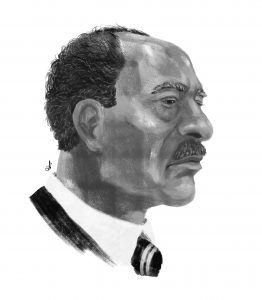 For the second point, the draft did not make direct reference to self- determination, despite consensus that the final status negotiations must “recognize the legitimate rights of the Palestinian people and their just requirements.” The document laid out a framework for peace that consisted of a transitional period of no more than five years and the election of a Palestinian “self-governing authority” before the start of final status negotiations. The document’s provision to establish a self-governing authority for Palestinians in the West Bank and Gaza is made in lieu of an explicit reference to self- determination. The essence of the agreed formula was the transfer of authority from the Israeli military to the Palestinians. Yet, as articulated within the document, Palestinian “autonomy” was to be superficial at best. The governing authority’s powers and limits would be determined by Egypt, Israel, and Jordan—with Israel maintaining sovereignty over security. Further, Palestinians were not set to negotiate on their own behalf until the beginning of the final status talks—although, Egypt and Jordan could choose to include them in their delegations during the transitional periods.
These stipulations on the nature of the Palestinian self-governing authority and Israel’s continued sovereignty over security effectively rendered the promise of “autonomy” meaningless by abandoning the Palestinians’ right to self-determination. It is inconceivable that an agreement to confirm the application of Resolution 242 could be misconstrued and read as limitations on the exercise of the most fundamental and sacred of these rights: the right to self-determination. In point of fact, no amount of verbal distortion could misinterpret such clear-cut and unqualified UN commitments. The exercise of the right to self-determination is the only logical conclusion that can be derived from the binding commitments arrived at through Camp David.
The nature of the agreement reflects the balance of power among the parties at Camp David and the Palestinians, who were not present. The U.S. delegation failed or refused to apply necessary pressure on Israel to level the playing field and elicit breakthrough concessions. As such, much of the document was drafted according to Israeli priorities. The Israeli delegation succeeded in shifting the focus of the talks from achieving a comprehensive conflict-ending peace to a more modest “framework” agreement, which laid out the broad outlines of a U.S.-led peace process while leaving the details of the actual treaty to be worked out later following a transitional period. The Camp David Accords did not outline the endgame or the core issues of the conflict such as land, Jerusalem, and withdrawal from the West Bank.
While some issues were addressed, the ones that were more problematic for Israel were left vague or excluded. For instance, the future of the city of Jerusalem was notably and intentionally left out of the agreement. Although President Carter exchanged letters with both President Sadat and Prime Minister Begin prior to the summit on the issue of Jerusalem, any commitments they made did not appear in the final agreement. This was due, in part, to Israeli objections on the topic during the summit. The document’s failure to address these issues and its non-binding nature only highlighted the gaps between the parties while denying them of any stake in the agreement. For an agreement to be credible, it must not only mention these core issues but actually identify how each is to be resolved.
Israel, then, capitalized on the ambiguity of the agreement and the absence of a binding process to obstruct and prolong its implementation. The Israelis seized upon the concept of a transitional period agreed to at Camp David to postpone the hard decisions over issues such as borders and security. This enabled Israel to evade its obligations under the accord and frustrate the broader peace process. These efforts proved so successful that, just a little over a year after Camp David, a November 16, 1979 article in the New York Times stated, “Israel is turning the offer of ‘autonomy’ to Palestinian Arabs into a sham . . . . They are provoking even moderate West Bank leaders into hostility and binding them to the Palestinian Liberation Organization. How the Israelis expect to negotiate with people they seem determined to humiliate is almost beyond understanding.” Moreover, while Camp David broke the negotiation deadlock, because of the contentious atmosphere of the summit, it shifted priorities and rewrote agendas so that an agreement might be obtained between parties, regardless of whether it actually brought the parties closer to a settlement. The geopolitical context in the years following the signing of Camp David and the continued relegation of Palestinian rights to the sidelines made it difficult to extract the necessary concessions that can work toward a comprehensive and permanent peace settlement.
Camp David’s Aftermath
The successful conclusion of the Egypt–Israel peace treaty represented the high-water mark for the peace process during the Carter administration and in the years to come. Following the summit, U.S. attention waned amid volatile regional developments, including upheaval in Iran and the outbreak of war in Afghanistan. The continued absence of meaningful support for the framework, both from Palestinians and other countries in the region, complicated the continuation of the peace process laid out in the agreement. Amid these challenges that worked to constrain the progress toward peace, the United States seemed to place greater value on process over substance, similar to what had occurred at Camp David.
While at times there seemed to be occasional glimmers of hope for peace, as seen with the initial optimism surrounding the Oslo Accords, Israel consistently endeavored to frustrate and prolong the peace process. When in power, whether under Rabin, Peres, Barak, or Olmert, the Labor government expressed a willingness to compromise. However, these assertions were merely rhetorical and no concerted action was ever taken to work toward genuine peace. In over fifteen years of negotiations, I witnessed various Israeli delegations impede efforts to reach a comprehensive peace settlement. Often, this was achieved through strategically stalling and prolonging the negotiation process to delay implementing their obligations and alter facts on the ground in their favor.
A master at this strategy, Prime Minister Benjamin Netanyahu has steadily allowed the expansion of settlements in the West Bank and implemented laws discriminating against non-Jews. In contrast to the steps the United States took at Camp David to establish itself as a major player in the peace process, Washington under the Donald Trump administration has seen whatever credibility it might have had as a mediator severely damaged. The current administration’s recognition of Jerusalem as the capital of Israel and its demand to liquidate the United Nations Relief and Works Agency or UNRWA reflect a more blatant bias toward Israel that is counter-productive to peace. Moreover, such actions violate numerous Security Council resolutions and are prohibited under international law. The continued absence of progress toward a comprehensive resolution of the conflict will only harden Israeli and Palestinian antipathy and distrust toward each other.
A New Approach to Peacemaking
Although President Carter’s ambitious goals for Camp David went unmet, the summit was nonetheless a pivotal moment in the history of the Arab–Israeli conflict. If the provisions of the accord had been faithfully developed in the years following Camp David, Palestinians in Gaza and the West Bank could have reaped immediate benefits: the Israeli military occupation would have been terminated and Palestinian rights would have been recognized, as defined by the agreement’s reference to UN Resolutions 242 and 338. Instead, decades after the transitional period and final status negotiations outlined in the Camp David framework were to have occurred, no Palestinian state has been established and the burdens of Israeli occupation increase every day. This serves as a useful reminder that the seeds of these issues were planted at Camp David.
At present and in light of Israel’s policy of obstructionism and the Trump administration’s obvious bias, the Camp David Accords represent an echo of the past, rather than a model for future peace. Stalled negotiations present an opportunity to rethink a deeply flawed and outdated approach to Arab–Israeli peacemaking. Perhaps it is time to abandon the U.S.-led peace process that Camp David set up in favor of a more proactive approach and a process that is binding, continuous, and anchored in justice and the rule of law. If a just peace settlement is to be achieved, one that realizes the right of Palestinians to live in an independent Palestine, it will require a comprehensive agreement that outlines a detailed picture of the endgame and tackles the hard decisions that Camp David neglected to address.
The Players of Camp David
At once both a distant dream and a vivid memory as if only several days have passed, I see in front of me the scene of the meeting between Prime Minister Menachem Begin and President Anwar Sadat on the evening of September 17, 1978: the final moments of the Camp David conference. The two were meeting in Prime Minister Begin’s cabin, reciprocating Prime Minister Begin’s earlier visit to President Sadat’s cabin. They were in a good mood, as our sages say, “There is no joy as when doubts are solved.” And indeed, the doubts had been solved. The decision was made, the chips had fallen into place. Before them was the agreement we had worked on for thirteen days and twelve nights. I was the youngest member of the Israeli delegation. I specifically and vividly recall the chilly night ten months earlier on November 19, 1977, when we stood at Ben Gurion Airport welcoming President Sadat to Israel, his visit warming our hearts. That pioneering moment is deeply embedded in my consciousness.
Camp David was followed on March 26, 1979 by a treaty of peace between Israel and the world’s largest Arab country, Egypt. I will not deny that many of us on the Israeli negotiating team had, on the day of the agreement, deep doubts regarding the evacuation of the Sinai villages and the terms of Palestinian autonomy. But although there have been a few sad cases of human lives lost between Israelis and Egyptians since the treaty, by and large, the Camp David agreement should clearly be perceived as a great achievement. Remember that by 1978, Israel and Egypt had been at war five times since the founding of Israel in 1948—that is, five wars in thirty years. The fact that over the past forty years there has been no war between both countries is in itself sufficient to view Camp David as a step of major historic importance.
There is a well-known debate among schools of historiography—does an idea shape history, or is history shaped by personalities? The “truth” most probably lies in the space between the two schools of thought. But my life experience has taught me that personalities and personal relations occupy an important part of the story. This finds its significance in major political decisions, and in other contexts—in the way political and diplomatic negotiations are conducted. At Camp David, personal decision-making was the order of the day.
Our Israeli delegation to Camp David included twelve people. Sadly, nine of them are not with us anymore. I will mention the deceased and their titles then briefly: Prime Minister Menachem Begin, Foreign Minister Moshe Dayan, Defense Minister Ezer Weizman, Israeli Ambassador to the United States Simcha Dinitz, Prime Minister Begin’s Military Secretary General Ephraim Poran, the legal advisor to the Foreign Ministry Dr. Meir Rosenne (later ambassador to France and the United States), Head of Planning in the Israeli Defense Forces Major General Abraham Tamir (later director general of the Prime Minister’s Office and the Foreign Ministry), Prime Minister Begin’s Chef-de-Cabinet Yechiel Kadishay, and Military Secretary to the Minister of Defense Colonel Ilan Tehila. We were also joined at times by Hanan Bar-On, deputy chief of mission at our Washington Embassy (later deputy director general of the Foreign Ministry). On our support staff was, inter alia, Eliora Carmon, who was later killed in the terror attack on our embassy in Buenos Aires in 1992.
Those of us who are alive are the former president of our Supreme Court, then the retiring Attorney General Aharon Barak; Prime Minister Begin’s spokesperson Dan Pattir; and myself, then Assistant to Foreign Minister Dayan and Assistant Director General of our Foreign Ministry.
The Egyptian delegation, besides President Sadat, included Dr. Hassan Tuhamy, a somewhat unusual Deputy Prime Minister who met Dayan in September 1977 in Morocco, and whom I met at a later clandestine session held in Morocco as well. It was at a meeting between Dayan and Tuhamy in Marrakech on December 2-3, 1977, shortly after President Sadat’s visit, where Dayan informally submitted our ideas to the Egyptians on three main issues—the Sinai Peninsula, the West Bank and Gaza, and the Golan Heights. Dayan wrote the position paper in Hebrew and I translated it into English from his handwritten notes. Tuhamy simply cut the paragraph stating that the Golan was a Syrian issue that Egypt would not deal with.
Other important Egyptian delegation members included Dr. Boutros Boutros-Ghali, then Minister of State for Foreign Affairs and later Deputy Prime Minister, finally becoming the Secretary General of the United Nations. Boutros-Ghali always called me abu el-banat which means the father of daughters, an applicable title as I am indeed the father of four daughters. The foreign minister of Egypt, Mohamed Ibrahim Kamel, was there too. It was said that Kamel knew Sadat from being held together in British prison in the forties; he was appointed at the Ismailia Conference on December 25, 1977, as his predecessor Ismail Fahmy resigned when Sadat visited Israel. Upon the conclusion of the Camp David conference, Kamel himself resigned, expressing unhappiness about the result. His bureau chief was Ahmad Maher, later Egypt’s ambassador to Washington and then Egypt’s foreign minister. Osama El-Baz, the senior advisor to President Sadat and later to President Hosni Mubarak, fulfilled an important role in the last days of the summit when he sat with President Jimmy Carter and Aharon Barak throughout the drafting stage of the agreement. There were also Ashraf Ghorbal, the Egyptian ambassador to Washington, and Nabil Elaraby, the legal advisor to the Foreign Ministry who later held a series of senior positions.
The American delegation included President Jimmy Carter; Secretary of State Cyrus Vance, a senior jurist and a pleasant, honest person even when you did not agree with him, which happened on more than one occasion; and National Security Advisor Zbigniew Brzezinski, who held a similar viewpoint to Vance’s but was less friendly to us—even though Prime Minister Begin, of Polish origins like Brzezinski, tried to engage in dialogue with him. There were of course the professional diplomats: Assistant Secretary of State Harold Saunders, Ambassador Alfred (Roy) Atherton (later ambassador to Egypt), Ambassador to Egypt Hermann Eilts, Ambassador to Israel Sam Lewis, and Dr. William Quandt of the National Security Council. Interestingly, the American delegation did not include a legal advisor, while our delegation had three (Barak, Rosenne, and myself), and the Egyptian delegation had many, including Ghali, El-Baz, Elaraby, and more. Vance fulfilled the American legal role, and only later, in the negotiations on the Egypt–Israel peace treaty that followed the accords, did Herbert Hansel, the legal advisor of the State Department, join the team.
Positions and Personalities before Camp David
Prime Minister Begin had been the commander of the Irgun Zvai Leumi (IZL), one of the underground organizations fighting against the British Mandate, and was a lawyer by profession and training. He had been in the opposition twenty-nine years before becoming prime minister in June 1977. He was a true democrat. I was impressed with how open he was, how much information he wanted from all of us on his team. While at Camp David, a few times a day the entire Israeli delegation consulted in Begin’s cabin—Camp David consists of cabins that have nice botanic names—and each of us would report to him about the interactions we had over the day with the Egyptians and the Americans. Oftentimes discussions ensued about the directions of the peace talks, and the prime minister, to his credit as an open-minded democrat, encouraged each of us—including myself, the youngest and a junior—to give their input. Begin listened intently to his advisors; and I even had the courage at these meetings to press my views on occasion. After listening to all of us, the prime minister gave us his summary and decisions.
A word about Prime Minister Begin. He was a Holocaust survivor, having lost most of his family to the Nazi beast, in their town of Brest (now Belarus). He spent time in a Soviet prison for his Zionist beliefs. Later, he became the commander of the IZL fighting for national freedom against the British. He was known to be humble and modest, living in a basement apartment. Begin treated me and my wife, Miriam, warmly and invited us on a number of occasions for Saturday afternoon tea with him and his wife.
On November 19, 1977, President Sadat received a warm welcome from the Israeli people, Prime Minister Begin, the Israeli government, and from the parliamentarians in the Israeli Knesset. Yet, following Sadat’s visit, little progress was made in the way of peace between Israel and Egypt. There were a few meetings, however. Notable among the meetings was a visit by Begin to Ismailia on December 25, 1977, and a senior ministerial meeting in July 1978 in Leeds Castle, England. However, at the end of the summer, President Carter realized that negotiations were not progressing, and decided to convene the Camp David conference. It should be noted, though, that discussions at Leeds Castle informed some of the negotiations later at Camp David.
It was not easy for us to prepare for the conference, though there was a team headed by the director general of the prime minister’s office Dr. Elie Ben-Elissar (later Israel’s first ambassador to Egypt). Part of the reason the Israeli team was not able to sufficiently prepare was that the format, length, and purpose of the conference were not clear ahead of time. More importantly, perhaps, detailed preparation was avoided because of the possible leaks to the press. In a negotiation, if it is known what your maximum offer is going to be, it is likely to cause much harm to your position and negotiating power.
That is not to say that one should encourage unprepared conferences. In fact, I have attended several in which the lack of proper preparedness was harmful. My experience shows that where there is thorough preparation, the work of the negotiating delegations is greatly eased. It is important, though, to maintain ambiguity concerning “bottom lines.” I should add that on the eve of the Camp David conference, Dayan conducted a series of meetings with Palestinians from Judea and Samaria—the West Bank—and the Gaza Strip, to listen to their views concerning the conference and the prospects for peace. In any case, as we entered Camp David we did not assume that the conference would lead to an agreement. I remember a meeting in a safe apartment in New York—to maintain secrecy—that preceded the conference. The private Israeli team meeting did not give me the impression that the prime minister and the other ministers assumed we would return with an agreement. We were expecting a three- to four-day conference, hoping to leave it “dry,” that is, that Israel will not be blamed for a failure. Yet even at the New York meeting Ambassador Dinitz stressed that the United States intended to push for an agreement.
Later on, as the days went by, it became clear on the one hand that there was a real chance of reaching an agreement and on the other hand, that if the conference ended without an agreement, it would cause damage for the prospects of peace, and cause a major crisis in the Israeli–American relationship. First and foremost, the prime minister and the ministers understood that at the conference they had an historic opportunity, which should not be missed.
The challenge was complex; the Israeli delegation, and in particular Prime Minister Begin, Foreign Minister Dayan, and Defense Minister Weizman, faced complicated ideological questions regarding the land of Israel, the Palestinian issue and related security challenges, and Sinai. Ideological questions also presented themselves, it seems, to President Sadat, first and foremost the written and signed recognition of Israel, which he had already explicitly demonstrated in his unprecedented visit to Israel, but its translation into a treaty of peace was above what a major part of the Arab World was ready to tolerate in those days.
Israel came to the conference hoping to achieve peace with the largest and most important Arab state. The idea of peace with our Arab neighbors was embedded in our Declaration of Independence of 1948 which states, “We extend our hand to all neighboring states and their peoples in an offer of peace and good neighborliness, and appeal to them to establish bonds of cooperation and mutual help with the sovereign Jewish people settled in its own land. The State of Israel is prepared to do its share in a common effort for the advancement of the entire Middle East.” So from our inception, we, Israelis, have always extended a hand of peace to our neighbors, and the meeting with Sadat thirty years after our Declaration of Independence was the first chance Israel ever had to actualize this part of our national basic declaration.
In my humble view, there was a clear difference between the Egyptian priorities and the American position. President Sadat, while not abandoning the Palestinian issue, desired first and foremost to reinstate Egyptian sovereignty in Sinai, which was under Israeli control since 1967. Despite the surprise attack launched jointly by Syria and Egypt on Israeli forces on October 6, 1973— known in Israel as the Yom Kippur War and in Egypt as the October War— the fighting nevertheless ended with the Israeli Defense Forces 101 kilometers from Cairo. Still, it was important to Sadat that he be perceived by Egyptians as having won the war. Indeed, when I visited Egypt later in 1977 for the Ismailia Conference of December 25, we found that to Egyptians, Sadat was honored as the batal el-ubur, the hero of the crossing of the Suez Canal, and signs carrying this title were to be seen everywhere. Yet, in practice, the war was far from achieving its intended result; four years later all that Sadat’s Egypt had been able to negotiate with us was a 1975 interim arrangement which provided for the potential withdrawal from Sinai by Israel and the reopening of the Suez Canal.
Therefore, Sadat seemed to have concluded well before the Camp David meeting that war was not the way forward and another path should be pursued in order to get Sinai back. Meanwhile, following the Sinai disengagement agreements in 1974 and 1975, Egypt began to rebuild the Canal cities, a move Dayan believed might signal a wish for peace, because a new war would cause the demolishment of these cities.
Regarding Sadat’s diplomatic perspective on the Palestinians, the Palestinian issue was certainly important to Egypt. As a leading Arab country, Egypt was keen on Palestinian rights and statehood. Yet, in the minds of the Egyptian negotiating team, the Palestinian question came second to regaining control of Sinai. Last but not least, I should add, I do believe that President Sadat wanted to reach peace.
Meanwhile, the United States approached the subject from another angle. President Carter took office in January 1977 with a mission to help the Palestinians attain a homeland. He aspired to reconvene the Geneva Conference of late 1973 in which the Palestinian issue was openly discussed and to somehow include the Palestine Liberation Organization in a peace with Israel. However, by the end of 1977, after Sadat’s visit to Israel, Carter understood that the Palestinian issue must be tackled together with Egyptian–Israeli peace.
High Drama at Camp David
Dayan, a well-known war hero and an experienced statesman, who became somewhat of a controversial figure following the Yom Kippur War, was a pessimist by nature. He dedicated days and nights to promoting the prospects for peace and was heavily invested in the quest for an agreement. He also wished, in my view, that his public life would be crowned by a peace treaty, not by the Yom Kippur War. Weizman, a former air-force commander (like Vice President Mubarak) was personally liked by President Sadat, and this created a positive atmosphere. And let us remember, as Dayan and Weizman were generals who fought for Israel, this further legitimized to the Israeli people their position that now was a time for peace.
The interplay between these personalities was key in shaping the outcome of the summit. Oftentimes discussions ensued about the directions of the peace talks. While there may have been differences of character between the ministers and at times small differences of view, there was basic trust and a strong sense of shared mission. I know that for Begin the decision-making was far from easy, both because of ideological conviction and because of a sense of deep national and social responsibility. But he was an avid reader of history, and rose up to the promise of peace.
The summit lasted for thirteen days and twelve nights (Prime Minister Begin used to say “for thirteen days and thirteen nights”). Practically, it had two parts: the first, from Tuesday, September 5, 1978, until Sunday, September 10, 1978, was the warming up stage. The Americans first let the parties submit their thoughts. Israel submitted a draft of the peace treaty. Egypt argued that Israel should be denuclearized. The second part, starting Sunday, September 10, began after a joint excursion to the American Civil War battlefield of Gettysburg, Pennsylvania, not far from Camp David, where President Abraham Lincoln gave his immortal Gettysburg Address 114 years earlier, in another time of war, of declarations, and of hope for peace.
When we returned to Camp David, the substantial negotiations began and lasted eight days in which there were twenty-three drafts of the accords. The negotiations were difficult. They became especially tense during the last four days of the conference, when a major part of the talks took place in the presence of President Carter, Aharon Barak, and Usama El-Baz. Carter chose to do so surpassing, in a way, the political echelon, rightly assuming that it was going to be difficult to conduct negotiations on the actual text of an agreement with Sadat (who ostensibly was not a “text person”) and Begin (who perhaps may have been somewhat too much a “text person,” and lover of the written word).
Contrary to a certain conventional wisdom, Sinai was not promised to the Egyptians as a precondition to Sadat’s visit to Israel in November 1977. Even at the Morocco meeting with Tuhamy in early December 1977, after the visit, Foreign Minister Dayan made no such commitment. As far as I remember, the Israeli negotiators focused on security, that is, the retention of forces in Sinai, and on maintaining the Jewish settlements (and airfields) in Sinai. The effect on the last point was unsuccessful; Dayan even went in person to Sadat to try and convince him that the settlements should stay under Israeli sovereignty, underlining the humanitarian difficulties of evacuation. But to no avail.
Regarding Jewish settlements in the Sinai Peninsula, Prime Minister Begin found it difficult to decide on this matter, as his heart was against doing away with flourishing villages; yet, he understood that peace was at stake. According to what Begin told us, he convinced President Carter that the settlements should stay within a United Nations-supervised area and Carter spoke to Sadat, but he too, was unsuccessful. Sadat would have none of it. The settlements in Sinai had to go. It may have been Dayan’s advice to Begin to bring the Sinai settlements matter before the Knesset for approval, which eased the decision-making for the prime minister. It was important to Begin to underline that the decision on the evacuation of the Sinai settlements was taken by the Knesset and not by him and the delegation at Camp David.
A year later, I wrote an essay on the peace negotiations with Egypt. It was after Dayan’s resignation in October 1979, and the prime minister was acting foreign minister. I sent him the draft, which he basically liked, but strongly asked me to change a sentence about the settlements issue, stating that there was no promise to President Carter that we would withdraw the Jewish settlements in Sinai, but only that we were to bring the subject for a full vote at the Knesset. It was President Carter’s assumption, the prime minister said, that he would vote against this stipulation. Begin suggested that the Knesset should hold votes on the Camp David Accords and on the settlements issue separately. The opposition, however, insisted on uniting the votes, and the prime minister decided that the overriding consideration was to support peace.
The other difficult subject in our negotiations was, of course, the Palestinian issue. There was no way to finalize the bilateral Egyptian part without a substantial move on the Palestinian front, for which Dayan in particular had prepared himself in his meetings with Palestinian notables leading up to the Camp David summit. It should be mentioned that the prime minister had prepared an autonomy plan for the Palestinian Arabs in the territories to which Dayan and Barak, if I recall correctly, injected the Jordanian element, that is, the need to have Jordan as part of the negotiation on the final status of the territory, as stipulated indeed in the accords. Begin presented it to President Carter and later to President Sadat in Ismailia.
Yet, at Camp David, the autonomy language, which appears in the complicated lengthy document entitled “Framework for Peace in the Middle East,” went beyond Begin’s plan and the issue of Palestinian autonomy was shrunk to a five-year period with permanent status negotiations to begin in the third year. Begin’s ultimate agreement to the Camp David Accords’ stipulations on negotiations with Palestinian leaders was likely predicated on Begin’s belief that the autonomy had to be negotiated in the next five years and would permanently resolve the Palestinian issue and Israeli interests would thus be protected. Some of us, myself included, doubted this and time would prove that the Palestinian question was much harder to respond to than we had hoped at Camp David.
During Camp David, there were those of us who believed that the prime minister was not fully satisfied with the direction to which the negotiations led, mainly concerning the Palestinian autonomy plan. One Saturday night immediately after the summit, the prime minister conducted a consultation at his residence, and I expressed doubts on one of the points concerning the Palestinian issue. Begin had a picture of his late mentor Ze’ev Jabotinsky on the wall, and I felt as if he was admonishing him. When we left, I was reproached by Weizman, who said, “Do not spread salt on the Prime Minister’s wounds.”
Yet, I must stress, that contrary to the common notion that Begin regretted his signature concerning the Palestinian issue, this was far from the truth. In a September 1982 telephone conversation with the prime minister after I had mentioned that the fourth anniversary of the Camp David Accords was a few days away, Begin said: “Ely, we did a good thing for our nation and country.”
I should add, concerning the famous debate that marred the Begin–Carter relationship until the end of Carter’s term regarding Begin’s commitment at Camp David to freeze construction of the settlements in the West Bank and Gaza; Carter was wrong and Begin was right. Begin argued that he was committed to freeze construction for three months (which actually became six) until the attainment of the treaty of peace with Egypt. Meanwhile, Carter spoke about a freeze throughout the negotiations on the Palestinian issue until there was a permanent status agreement with the Palestinians. Yet, even President Sadat, right after Camp David, said “What is wrong with three months?” The facts are fully corroborated by President Aharon Barak, who attended the relevant meeting.
Internal Agonies and Decision-Making
I saw Begin have his doubts, even though I did not belong to his close circle. I saw his final decision, which I believe he was satisfied with in the end. It is a pity that the prime minister did not write his memoirs as he ostensibly hoped to. But I believe that Begin’s considerations regarding the future of Arab–Israeli relations included the following: on the one hand, there was the historic and revolutionary step of peace with the largest and strongest Arab state. On the other hand, there was the ideological price of returning Sinai to Egypt. Giving away Sinai was not easy for the prime minister. He had risen to power believing in the concept of the Complete Land of Israel or Eretz Israel, which placed Judea, Samaria, and Gaza (the West Bank and Gaza) within Israel’s borders; Sinai was a “softer” ideological concept, but there was nevertheless an attachment to the area in which the Torah was given to the Jewish people.
Therefore, the Camp David Accords placed two of Begin’s core values—pursuit of peace and maintaining the land of Israel—at odds with one another. Begin’s convictions were historically rooted and ideologically driven and he hoped to see his ideas on the Land of Israel reflected in the Palestinian autonomy model that he had originally helped shape. Despite the difficulty, the prime minister ultimately supported the Camp David Accords, declaring that they were a major strategic achievement for Israel. Looking back now forty years, I agree that he was right, and this could hardly be disputed.
Among the factors shaping the dynamics of the Israeli delegation in Camp David was that Dayan, Weizman, Barak, and others in the delegation were not of Begin’s ideological mold, and did not share his affinity to Jabotinsky (1880– 1940). Jabotinsky was the founder of the Zionist Revisionist Party, Begin’s party from his youth in Poland. He was a warrior, a very able writer, and was followed by a large number of Jews in Europe. The sovereignty on Eretz Israel was part of his ideology, but it was combined with liberalism and human rights, which were also part of Begin’s beliefs. In fact, it was only Begin himself, his wife, and
Kadishai who were real Jabotinskities. These differences in backgrounds in the Israeli team were evident on the second Friday night of Camp David; as we were approaching the end of the meal Begin said, “Let us sing ‘underground’ songs together!” These were songs from his period as the Irgun commander in the pre-state years, fighting against the British. But he had no singing partner except for his wife and Kadishai.
But from Begin’s as well as Dayan’s point of view, the biggest achievements at Camp David were the attainment of peace with Egypt, as well as the fact that the agreement concerning the Palestinian issue did not mention a Palestinian state and self-determination. The Israeli Defense Forces were to remain in the West Bank and Gaza, guarding the security of Israel, and the accords did not include Jerusalem—a subject which almost torpedoed the conference on the last day.
An important point is that the accords state that every change is subject to mutual agreement—there was to be no coercion. As mentioned, there were hopes from our team that the shaping of Israel’s eastern boundary would ultimately be with Jordan, which has not yet materialized.
The ability to reach an agreement was also greatly augmented by the absence of media from Camp David, coupled with a ban on spokespersons’ briefings, except for the American spokesperson, who focused on anecdotes and “color” stories rather than substance. Otherwise, pressures from both sides could have doomed the agreement.
The great achievement of Camp David is the fact that the accords were reached despite the huge differences between the personalities that met there, mainly Begin and Sadat. It should be noted, though, that despite the differences of backgrounds, cultures, and careers, both men had a common trait—besides their leadership, and love for their nations to which they dedicated their lives— it was the tendency toward drama, toward the grand picture of history. Yet, beyond this point, it would be difficult to find two people with such divergent backgrounds.
I believe that until his meeting with President Sadat, during the 1977 historic visit, Begin met few Arabs outside of those who are citizens of Israel. The Arab culture was not part of his natural environment. He grew up in Poland between the two World Wars, and had a classical and legal education, well rooted in Jewish culture and history, and later his personality developed with a special focus on the memory of the Holocaust, where he lost his family. Begin also believed deeply in the democratic ideas of human and civil rights and the rule of law. Sadat, meanwhile, began as a military officer, and climbed up the political ladder until he became president in 1970 after the passing of Gamal Abdel Nasser. He was an Egyptian patriot.
Even though the actual meetings between Begin and Sadat during Camp David were few, I vividly remember their warm meeting in the early evening of September 17, before signing the accords. Having attended their very last meeting, in August 1981, in Alexandria, I also recall how it was conducted in good spirits, seemingly a climax before the terrible and tragic anticlimax five weeks later with President Sadat’s assassination. President Carter, unlike his two interlocutors, did not have to bear a responsibility regarding the fate of his people. The peace process was, however, a matter of strategic importance to the United States. Like countless other Israelis, I am critical of many of President Carter’s writings and speeches over the years concerning Israel. Yet, he deserves credit for the effort he had put into this conference: you cannot underestimate the effect of having a sitting U.S. president disconnect from most other matters for thirteen days, fully engaged in the process, working from a yellow legal pad.
Let me add that Prime Minister Begin was a person who unequivocally respected and kept his word. Hence, there was no basis whatsoever for the apprehension expressed during the next few years, that he was not going to fulfill his side of the promise of withdrawal from Sinai. However, he was not well acquainted with the Arab World, and—indeed—negotiations such as Camp David had no precedent.
I would like to make another important point regarding negotiations: respect. All people want to be respected. Respect—honor—is a pillar of many cultures. It is strongly rooted in our own region’s cultures. Begin and Sadat, despite some ups and downs over the years, shared a respect for one another.
The Camp David Accords were followed by the Egyptian–Israeli peace agreement, signed by the two leaders at the White House on March 26, 1979. The negotiations for the final peace treaty started in October 1978 at the Blair House—the presidential guesthouse in Washington opposite the White House—and while the main stipulations were almost fully ready by November, several issues, in particular the relationship between the treaty with Egypt and the Palestinian autonomy plan, and between the Defense Treaty of the Arab League and the peace treaty to be signed, necessitated another few months and a visit by President Carter to the region in March 1979 to finalize. It was done through agreed minutes, which when read look rather enigmatic, but never had to be invoked. The main provisions of the treaty included, inter alia, the military arrangements which divided Sinai into three areas with gradual limitation of military forces, a symbolic area on one side for the establishment of an international—later multinational—force, and normalization of relations, including resident embassies. And of course, the boundary was defined, and disputed points later went to arbitration.
I still remember the festive dinner at the White House on March 26, 1979, the day the treaty was signed. I was seated at the table with an Egyptian parliamentarian, a former military officer who lost a leg in the Yom Kippur War, and I served as his translator from Arabic to English and vice versa, while celebrating with the American guests the unique event of peace. Next to me was the late editor of Yediot Ahronot, a major Israeli newspaper, who practiced with me how to approach the leaders in order to ask them to sign an autograph for his newspaper, an endeavor in which he finally succeeded.
Looking Back
The Camp David Accords was an example for peace between Israel and an Arab state, and it also laid the foundations for Arab–Israeli peace at large, stating that the framework may serve as a model for future implementation with Israel’s other neighbors. Although over the years there were many in the Arab World who wanted to dismiss the accords, in my view they are still valid today. I remember saying to some American negotiators, in particular Secretary of State James Baker, who tried to convince Israel to make concessions quoting parts of Camp David somewhat taken out of context, that the accords were not a fruit salad from which you could pick a plum or an apple; they consisted of a principled whole.
Camp David from its inception was a symbol and a milestone, but also controversial in Israel and in the Arab World. As such, the accords and their success have always been in the eyes of the beholder. Yet it must be remembered again that forty years have gone by with no wars between Egypt and Israel. In the thirty years before, there were thousands of casualties on both sides. On a personal level, two of my cousins and many of my friends were killed. There is regret—and personally I feel particularly sad that the many bilateral agreements on which we worked hard between 1979 and 1982 (and I was heavily involved in them as an Assistant Director General of the Ministry of Foreign Affairs in charge of the implementation of the treaty, and later as Legal Advisor to the ministry) were only partially fulfilled, and that the civilian relations between the two countries have not properly developed.
I still remember the devotion and enthusiasm with which our people worked on those agreements, many of which unfortunately still only remain on paper. For officials in our government, working on this sort of agreement was a source of joy. Let me mention here that in February 1980, I was proud to welcome at Ben Gurion Airport the first Egyptian ambassador to Israel, Saad Murtada.
Our embassy in Cairo functions, but not at the same capacity as other Israeli embassies in the world. I believe the atmosphere at the Egyptian embassy in Israel is better. Unfortunately, the civilian part of the treaty never approached what was anticipated and Egyptians and Israelis are not as close as the Camp David Accords hoped we would become. The attitude of the Egyptian media toward Israel over the years leaves much to be desired. Education for peace is needed. Nevertheless, the strategic part of the accords and the treaty is with us, and in this the strategic interests of both parties find their expression, including the struggle against terrorism, and thank God for that.
My last conversation with Dayan took place two days after President Sadat’s assassination in October 1981, and about a week before his own passing away. It revolved around Sadat’s death in which Dayan said he felt apprehension as to whether the peace process with Egypt was going to continue. I was reminded of an earlier talk Dayan and I had in September 1979, during which Dayan told me that Sadat possessed extraordinary courage and optimism.
Even today, forty years after Camp David, we have not yet reached a comprehensive peace; but the half-full glass is better than an empty glass, and to date there have been substantial achievements in the area of peace between Israelis and Arabs. For example, it was my honor and privilege to head the Israeli delegation to the treaty of peace with Jordan signed in October 1994 under the leadership of the late Prime Minister Yitzhak Rabin, who was himself assassinated in November 1995. I was also present at the 1991 Madrid Peace Conference, led on our side by Prime Minister Yitzhak Shamir. There were also beginnings of agreements with the Palestinians and a partial interesting agreement with Lebanon in 1983, as well as efforts to achieve peace with Syria. I took part in many of them.
As an Israeli, I would like to hope and believe that the “no more war” declaration from the Sadat and Begin encounter will one day materialize beyond our relations with Egypt and Jordan. We Israelis have much respect for Egypt, a country with a special history and culture that has contributed greatly to the world. Egypt is a pillar in the Middle East and beyond, and we look forward to continue living in peace and quiet with our great neighbor.
This essay is partially adapted from a lecture delivered in Hebrew at the Menachem Begin Heritage Center in Jerusalem.
The author would like to thank Lia Weiner for her kind assistance.
Reflections on Camp David at 40
When President Jimmy Carter and his foreign policy team began to address the Arab–Israeli conflict in early 1977, they had several important reference points in mind. First was the vivid memory of the 1973 October War and the threat it had posed to international security as well as economic prosperity. No one wanted to see a repeat of such a dramatic and dangerous conflict. In addition, there was the beginning of a serious diplomatic process begun under the careful guidance of Henry Kissinger, secretary of state for both Presidents Richard Nixon and Gerald Ford. Three agreements on the disengagement of military forces had been reached, two between Egypt and Israel, and one between Syria and Israel, which set the stage for Carter’s own diplomatic efforts in the Arab–Israeli arena. Finally, the United States had good working relations with most of the key parties in the conflict, other than the Palestinians, and Carter was eager to deepen those relations in pursuit of peace in the Holy Land, something that was particularly appealing to him as a devout Christian.
All of this meant that the team around the president, which included several participants in the Brookings Report of 1975, were predisposed to support a U.S.-led effort to achieve a comprehensive solution to the Arab–Israeli conflict, including some form of self-determination for the Palestinians—the main goals identified by the report. Carter signed on to this broad strategy, but also wanted to make sure that he was personally acquainted with the key leaders. During the first several months of his administration, he met with leaders from Israel, Egypt, Jordan, Saudi Arabia, and Syria. Without directly meeting any Palestinian representatives, he sent a strong signal to them by speaking openly of the need for a Palestinian “homeland.”
There is no reason to doubt that Carter and his advisors saw the strategic benefits of a comprehensive Arab–Israeli peace. The question in their minds, however, was whether or not it was achievable. Based on Carter’s early meetings with regional leaders, as well as those of his secretary of state, Cyrus Vance, the goal did not seem beyond reach. For example, during a somewhat stiff meeting with Israeli Prime Minister Yitzhak Rabin in March 1977, Carter pressed for Israel’s view on the future of the West Bank. Rabin, who was facing a hard election in May of that year, said that he was not about to reveal his bottom line in public, but that he could tell Carter his only interest in the West Bank was security, not Israeli sovereignty. I was at this meeting, and recall thinking that if that were really Israel’s position, there would be a chance that the “land for peace” formula of UN Resolution 242 could be realized.
Setting the Stage for Camp David
Even during our most hopeful moments early in 1977, we knew that there would be difficult times ahead in trying to reach a comprehensive Middle East peace. Already some of Carter’s domestic aides were warning him about the reaction of the American Jewish community to some of his early statements, especially his call for a Palestinian homeland. There were also obvious problems of getting the Arab parties to agree on how to proceed toward actual negotiations. Egypt’s president Anwar Sadat was eager to move quickly and without too much encumbrance from the demands of the other—and in his mind lesser—Arab leaders. In his view, Egypt would set the pace and they should follow. The practical issue of how, or who, would represent the Palestinians was unresolved.
The United States also tried to communicate with the leadership of the Palestine Liberation Organization (PLO) through various Arab intermediaries, since the government was prohibited by former U.S. commitments to Israel, as well as more recent legislation, from having direct contacts with the PLO. The result of these communications was confusion, as each Arab intermediary gave its own spin on the PLO position. Eventually Carter sought out a trusted American—Landrum Bolling, an educator and peace activist—to deal directly with PLO leader Yasser Arafat, but the result was not particularly encouraging, and came at a time when optimism about moving forward with the comprehensive approach was fading in Washington.
The main reason for the shift away from Carter’s initial hope that progress could be made on a broad Arab–Israeli peace was the election in May 1977 of Menachem Begin as Prime Minister of Israel—an event unforeseen in Washington. Since the founding of the state of Israel in 1948, American statesmen had only dealt with leaders of Israel’s Labor Party—David Ben-Gurion, Levi Eshkol, Golda Meir, Yitzhak Rabin, and others—and Begin’s Likud (formerly Herut) party was seen as an extremist remnant of Zionism’s militant early days. No leading official in Washington at the time seemed to know Begin or his closest advisors. And when we began to read up on him and his views, the result was not encouraging.
Begin was clearly a man of strong convictions, especially about the integrity of all of the so-called “Land of Israel.” He had been a member of the wall-to-wall governing coalition in Israel formed in 1967, but had resigned in 1970 when the government of Israel had formally acknowledged that UN Resolution 242 of November 1967 did, in fact, call for the withdrawal of Israeli forces on all fronts in exchange for peace. In short, if Israel were to make peace with Jordan and/or the Palestinians, it would be expected to relinquish all or most of the West Bank. Begin, who always referred to the West Bank as Judea and Samaria, and called the Palestinians the “Arabs of Eretz Israel,” was adamantly opposed to such an interpretation, so he quit. Now he was prime minister and nothing suggested to us that his views had mellowed over the past seven years. As we prepared Carter for his first meeting with Begin, some of us were worried about what Begin’s election meant for our comprehensive peace strategy.
Begin’s first meeting with Carter on July 19, 1977, did not go well. Begin lectured us as if we were uneducated schoolchildren, showing us—Carter and the rest of the American diplomatic team—simplistic maps of the Middle East with all the Arab countries colored in red and tiny Israel standing out in blue as the only reliable democracy in the region. How, Begin seemed to be saying, could we ask him to make peace with such big and threatening (and probably pro-Soviet) neighbors? Begin told us there were no such people as Palestinians. If anyone had the right to be called Palestinian, it was the Israelis, stated the prime minister, since the land had been promised to them by God. (Moshe Dayan, Begin’s foreign minister, who, unlike Begin, had actually been born in Palestine, told us wryly that his identity as a Palestinian instead of an Israeli was news to him.)
In a private meeting during this visit, Begin asked Carter not to repeat his view that Israel should withdraw to the 1967 lines in return for peace, with only minor, mutually agreed modifications. Carter, in return, said that he wanted Begin to stop building more settlements in the Occupied Territories. He thought Begin had agreed, but within days of their meeting, Begin announced that new settlements would be built. Carter felt that Begin had reneged on his solemn word and never fully trusted him thereafter.
Our initial hope for a comprehensive peace had never meant that each party to the conflict would necessarily march in lockstep toward a final agreement. We knew from the outset that the substantive issues between Egypt and Israel were likely to be more easily resolved than the tangled problems of the West Bank, Jerusalem, Palestinian refugee rights, and so forth. It was also clear that Sadat was motivated by his desire for a new strategic relationship with the United States in a way that Syria’s Hafez Al-Assad was not. If in the new Begin period we still had hope that something of a comprehensive framework could be preserved, it would have to be based on a fairly general set of common principles—that is, commitment to UN Resolution 242, plus a recognition of some form of Palestinian rights, along with security and recognition for all parties.
While the State Department still felt that some form of initial multilateral conference should be held to launch the negotiating process, even there it was not expected that the actual negotiation would take place in Geneva. Incidentally, the 1991 Madrid Peace Conference was close to what we thought was possible— an initial plenary session with all the leaders, including non-PLO Palestinians, followed by a series of bilateral and multilateral committee meetings to begin working on specific parts of an agreement. It was with this model in mind that Vance, in early October 1977, sought and received Soviet agreement for the convening of a conference by the end of the year, setting off a full-scale crisis with Israel and its supporters in the United States over our alleged failure to consult with them.
October–November 1977 was the timeframe when we began to realize that our initial plan was in real trouble and that both Sadat and Begin were beginning to look for alternatives. We knew that in September Moshe Dayan had met in Morocco with an emissary of Sadat’s, but the Morocco meeting did not seem to have led anywhere. Later in October, Sadat told us that he had an idea of calling for a big conference of all the parties, including Arafat, in Jerusalem. We could not imagine Begin saying yes to anything of the sort and tried to persuade Sadat to stick to the original plan of holding an initial meeting in Geneva with an Arab delegation that would include non-PLO Palestinians chosen by the PLO.
Around this time, we began to ask ourselves if we had been wrong in thinking that Sadat would not be prepared to make a separate peace with Israel. We had felt, based on what he had told us, that Sadat would insist on some “cover” in the form of verbal commitments to a comprehensive peace and to something for the Palestinians so as to make Egypt’s peace with Israel palatable domestically in Egypt and across the Arab World. However, we had clearly underestimated the degree of animosity between Sadat and Al-Assad, and as the prospect of a Geneva meeting came nearer, Sadat’s fear of being constrained, or “overbid” by a more hardline Syrian delegation became more of an issue.
Then, in early November, Sadat surprised us, and many of his closest colleagues, by saying publicly that he would go to Jerusalem to meet with the Israelis himself to prove that he was sincere in his quest for peace. And within weeks, there he was, smiling, embracing his former enemies, and acting as if peace was at hand. The reaction in much of the Arab World was one of shock, if not horror. In Washington, we were both pleased and puzzled—did Sadat have a sequel in mind? He seemed to think that Begin would reciprocate his generous gesture by returning all occupied Arab land to its owners with no further haggling—or at least that is what he told us should happen.
In Washington we realized within weeks that we had to reassess our core assumptions. Sadat was clearly impatient and wanted to move quickly. We were still not sure how much “cover” he would insist on to disguise what was likely to look very much like a “separate peace.” We had our own reasons to hope for more than just a bilateral Egyptian–Israeli agreement, but we also did not feel that we could tell Sadat to hold out for an increasingly unrealistic comprehensive, or even semi-comprehensive, framework.
From a Comprehensive to a Separate Peace Process
It has become common in recent assessments of the Camp David Accords to argue that the United States should have pressed harder for its original plan of bringing on board the Palestinians or Jordanians, if not also the Syrians. Or, the argument goes, if they could not be persuaded to join the actual Camp David negotiations, there should at least have been some clear incentives provided for other Arab leaders and organizations to join the negotiating process in due course. This assessment is outlined in books like Rashid Khalidi’s Brokers of Deceit, Jørgen Jensehaugen’s Arab-Israeli Diplomacy under Carter, Seth Anziska’s Preventing Palestine, and Nathan Thrall’s The Only Language They Understand. The core argument of these books often comes down to a judgment that the United States could have, and should have, pressed Begin harder for concessions. I have some sympathy for this view, since I agree that it was primarily Begin’s intransigence on the issue of territorial concessions in the West Bank that was the biggest obstacle to a broader peace. Yet, there is no clear answer to the question of whether we could have gotten more had we tried harder. In practical terms, I do not think Carter could have pushed Begin much more than he did. Carter was not, after all, a president with an overwhelming degree of support, even within his own party.
My impression is that Carter early in 1978 came to realize that a comprehensive peace was unreachable in the near future. I think he came to this conclusion for several reasons. First, Begin was difficult to deal with and showed no signs of budging on the key issues of the meaning of UN Resolution 242 (that is, Israel’s obligation to withdraw from all or most of the territories occupied in 1967 in return for Arab commitments to peace, recognition of Israel, and security) or of the need to provide Sadat with some cover for the criticism and pressure he was experiencing in the Arab World due to his peace overtures to Israel. Carter also had seen no real indications that Al-Assad or Arafat were ready to take any moderate moves to open the way for their eventual participation in negotiations. When specifically asked in September 1977 if he could accept UN Resolution 242 with a reservation that it did not address the Palestinian issue, Arafat said that he could not do so, blaming pressure from Syria. Finally, King Hussein of Jordan was no more of an acceptable party to negotiations over the West Bank or Jerusalem, in Begin’s eyes, than was Arafat. As such, there was not much rationale for Carter to cling to his initial idea of a comprehensive negotiating framework.
Early in 1978, Carter met with Sadat at Camp David. The two spent a couple of days alone, and then were joined by their advisors. I was present when they summarized their private discussions and had the sense that Carter had reached two conclusions from his private talks with Sadat. My first impression was that Carter believed Sadat was frustrated by the slow pace of events and was insisting on a U.S. initiative; and, second, that Carter felt Sadat was not asking for much more than the most modest of “fig leaves” as cover for what was bound to look like a separate Israeli–Egyptian peace. Carter himself seemed to also show impatience with the slow pace of diplomacy.
By the summer of 1978, Carter was ready to push forward on his new idea of a three-way summit meeting at Camp David with Begin and Sadat to begin on September 5 of that year. In preparation for the meeting, we wrote a long paper for him on the issue of “linkage,” arguing that Sadat would want some degree of linkage between a bilateral Israeli–Egyptian agreement and something for the Palestinians. In contrast, we argued, Begin would resist any such linkage, insisting that an Egyptian–Israeli peace treaty would have to stand firmly on its own foundation and not be made dependent upon progress on any other front. One of Carter’s biggest challenges, we wrote, would be to find the balance between too much and too little linkage.
Carter read the paper and told us that he thought we were wrong. We were going to get an Egyptian–Israeli agreement out of the summit as well as a statement of principles that would address the Palestinian issue. And he made it clear that he was counting on the historical drama of the summit to get each of the other leaders to rise to the occasion and show evidence of statesmanship. Carter said he thought the whole process would take just a few days. I recall thinking that he was about to be in for a big surprise.
Camp David: The Accords That Changed a Generation
Indeed, the summit did not go quickly or smoothly. Sadat and Begin did not trust one another. Begin was unwilling to make any concessions whatsoever on the Palestinian issue and also insisted that the Israeli settlements in Sinai should remain under Israeli control. We were fairly sure that this latter demand would be bargained away but Begin’s initial stance on Israeli settlements in Sinai was enough to convince Sadat that Begin had no intention to make peace.
Over the thirteen days of the summit, Carter devoted most of his time to the drafting of the Egyptian–Israeli peace framework. The rest of us on the U.S. team were left to develop the broader framework, which went through some twenty versions, and involved complex and virtually incomprehensible language designed to disguise the profound differences between the Israeli and Egyptian delegations. For example, Egypt wanted explicit mention of the Palestinian right of self-determination and reference to Israel’s obligation to withdraw from the Occupied Territories in exchange for peace, as called for in UN Resolution 242. Begin and his team would have none of this, finally agreeing to much vaguer and non-binding language that implied Palestinians would have a role in determining their own future, and that all the principles of UN Resolution 242 could form the basis for negotiations between Israel and its other Arab neighbors, but without specifying withdrawal as one of those principles.
By September 17, 1978, there were just a few remaining issues, so late at night Carter met with Begin to try to resolve them. Begin finally agreed to let the Knesset vote on whether or not to abandon the settlements in Sinai, knowing that it would if that was the price of peace with Egypt and then had a long and inconclusive discussion with Carter about freezing settlement activity on the West Bank. Carter insisted on a freeze that would last for up to a year in order to give Palestinians and/or Jordanians an incentive to join the negotiations. For Begin, this looked all too much like the dreaded “linkage” that he was determined to avoid. He finally said something like, “I will give my answer in writing tomorrow.”
Carter apparently understood this as meaning that he would get the answer that he, Carter, wanted from Begin in writing the next day. The more cautious Vance told me as the meeting broke up that it was still not clear how long a settlement freeze Begin would agree to, and that we needed to get that clarified the next day. As it turned out, we never got the clarification that we hoped for on the last day of Camp David. Instead a huge argument erupted over how the issue of Jerusalem would be addressed in the final document. Begin wanted no mention; Sadat wanted to make it clear that East Jerusalem was occupied territory and should be returned to the Arabs. Sadat also wanted Carter to reiterate the longstanding U.S. position that the future of Jerusalem could not be decided by Israeli unilateral action and was an appropriate topic for future negotiations.
For a while it looked as if the whole summit might fall apart over this issue, and that fear kept us from focusing on the unresolved settlement freeze issue. Indeed, Begin did send a letter stating his views, saying that Israel did not plan to build more settlements in Judea and Samaria during the three months in which the final peace treaty with Egypt would be negotiated. Carter read the letter, told us it was not what Begin had promised him the previous night, and said that we should insist on a new letter from Begin. Then he turned his attention back to the Jerusalem uproar.
Late on the thirteenth day, Carter met with Sadat and told him what the final agreement would consist of. Carter included the supposed concession that Begin would not build more settlements in the West Bank for a period of about one year, giving the Palestinians and the Jordanians a chance to join the negotiations without seeing the outcome visibly compromised by ongoing Israeli settlement activity. Sadat was hardly a stickler for detail. Carter had told him he had done all he could to get a good agreement and Sadat accepted his word. It turned out, of course, that the next day Begin sent us the exact same letter on settlements that Carter had rejected. However, by then the Camp David Accords had been formally signed at a highly publicized White House ceremony.
At the time, I thought the failure to get a clear commitment from Begin on the issue of freezing settlements was a serious mistake, and it made us look both weak and incompetent when Begin refused to budge. I now think there was another mistake made on the American side at Camp David. To provide Sadat with the cover that we felt he needed, and to keep up at least a slight hope of broadening the negotiating process beyond the bilateral Egyptian–Israeli front, we had engaged in a long and complex negotiation with Israelis and Egyptians in an effort to lay out a roadmap for the Jordanians and Palestinians to join the negotiations. In early drafts, we had tried to introduce a formula that would make it clear the key elements of UN Resolution 242, “peace for withdrawal” on each front of the conflict would be the basis for any negotiated agreement. Begin succeeded in watering this down to a vague formula that said little more than that UN Resolution 242 would be a basis for negotiations—but not necessarily for an agreement. It may not sound like much of a difference, but for Begin it meant that he had made no commitment to ever return the West Bank to anyone. Sadat’s professional staff all understood these nuances, but Sadat himself did not pay much attention, counting on Carter to get him the best deal possible.
When it became clear that Begin would not budge on these issues, I now think we should have accepted the fact that we did not have a credible plan for anything beyond the Egyptian–Israeli peace, which had its own intrinsic value and its own justifiable purpose. We should have simply said in the preamble to the Egyptian– Israeli framework agreement that all of the parties remained committed to the idea of a comprehensive peace and that at some point in the future negotiations based on UN Resolution 242 should be organized with the participation of the relevant parties. Of course, the other Arab parties would have denounced the accords as nothing more than a plan for a separate Egyptian–Israeli peace, but they said that in any event.
Also had we proceeded with what we really had, which was only a framework for an Egyptian–Israeli peace, then other Arab leaders would not have been able to point to a document which seemed to assign them specific roles in future negotiations about which they had never been consulted. I am not sure that it would have made much difference in the end, but it would have saved us a lot of time and energy trying to explain to skeptical Arab audiences that we had really achieved much more on their behalf than they were seeing in the unclear text of the Camp David Accords.
Of course, the Camp David Accords did not lead immediately to an Egyptian–Israeli treaty. It took another six months of difficult diplomacy, including a last-ditch trip by Carter to the Middle East in early 1979. By then developments in the region were alarming in the extreme. Iran was caught up in revolution and the Shah had fled his country. Islamic revolution was in the ascendant and Begin was getting cold feet about making peace with an Arab leader who might face the same fate as the Shah. Sadat likewise could not ignore developments beyond his borders. The new Iranian regime was intensely anti-Israeli and was quick to accuse Sadat of selling out the Palestinians. In the end, neither Sadat nor Carter was prepared to give up on the idea of a peace agreement. Begin as usual played his hand skillfully, but in the end Begin also agreed to the final peace terms.
Looking Back Forty Years On
The question still hangs over the Egyptian–Israeli agreement: could it have turned out differently and better for the overall prospects of regional peace? I have no clear answer. I also have no apology for working hard on behalf of Egyptian– Israeli peace. The result of these efforts was a historic agreement that served the interests of both countries and of the United States. Of course, I would have liked to have seen a broader framework that could have included the other Arab parties as well. Yet, Carter did not have the clout to force concessions from Begin. Carter had no voting base or support in the United States which would have allowed him to go to bat for the Palestinians, to say nothing of the Syrians. And by 1979 with the region in tumult, there was a great fear that if the bilateral treaty were not signed soon, it might never be signed.
In conclusion, I share the obvious frustration of those who think that Camp David and its aftermath complicated the chances for an overall peace in the Middle East. I did not believe that the framework for Palestinian autonomy would lead anywhere, and in the summer of 1979, I left the administration, feeling that I had done all that I could to advance U.S. interests in the region. When Israel invaded Lebanon in 1982, hoping to annihilate the PLO and redraw the map of the Middle East, I acknowledged the Israeli action was, in part, an unintended consequence of Egypt having made a separate peace. Israel—and especially its ambitious Defense Minister Ariel Sharon—would have been much more reluctant to engage in such an audacious military adventure were Egypt still a belligerent.
Yet, I also think that Sadat had a clear sense that peace with Israel was a necessity. Egypt could not count on support from a declining Soviet Union and Sadat knew firsthand that war is incredibly costly and that the 1973 “victory” had been a near defeat. So, Egypt made peace with Israel to put an end to its preoccupation with war and in order to open the door to a new relationship with the United States and other Western countries. It is hard for anyone to say that Sadat was wrong to pursue his country’s national interests as he saw them. I think that Carter eventually came to that same realization. Perhaps had Carter been re-elected he would have tried to do more for the Palestinians, but in the spring of 1979, Carter had to make a decision. Should he push forward with a bilateral Egyptian–Israeli peace, or put everything on hold until the political storms of the Middle East had passed and perhaps a new leader in Israel would show more flexibility in addressing the overall regional conflict in a constructive way? Under these circumstances, I think now, and I thought at the time, that Carter made the right decision in pushing forward with the Egyptian–Israeli peace agreement.
William B. Quandt is Edward R. Stettinius Professor of Politics at the University of Virginia. He has taught at the University of California, Los Angeles, the Massachusetts Institute of Technology, and the University of Pennsylvania and was a senior fellow at the Brookings Institution. During the Nixon and Carter administrations, he served on the National Security Council; he played an active role in the negotiations that led to the Camp David accords and the Egyptian–Israeli peace treaty. He is the author of numerous books, including Peace Process: American Diplomacy and the Arab–Israeli Conflict since 1967, and Camp David: Peacemaking and Politics. Quandt was a member of the Board of Trustees of the American University in Cairo from 1992 until 2017.
Half Right and Still Waiting
September 2018 marked two significant anniversaries in the Israeli–Palestinian and broader Arab–Israeli conflict. One was marked prominently as opinion writers across the political and ideological spectrum joined together in proclaiming the death of the Oslo Accords—now twenty-five years past. The presiding argument is that a confluence of Israeli, Palestinian, and international geopolitical trends, and ever-shifting realities on the ground render Oslo’s vision and roadmap for peace and security an impractical or even impossible outcome. Politicians, pundits, and publics are invariably debating whether faith and investment in a viable two-state solution can be revived, or what alternative models can take its place.
Less visible during the last year, however, was reflection on the Camp David Accords—now forty years strong. Of the two documents Camp David produced, the second document—“A Framework for the Conclusion of a Peace Treaty between Egypt and Israel,” negotiated by Anwar Sadat, Menachem Begin, and Jimmy Carter in September 1978—led to a peace agreement that has endured for four decades. Though the peace has remained a cold one below the elite levels of political and diplomatic exchange, the resilient security relationship between the two states has staved off mutual hostilities, enhanced security cooperation around shared threats, and turned a relationship that was once a key threat to Middle East stability into a resilient cornerstone of regional security.
Key to the consummation of Israeli–Egyptian peace was the parties’ shared acknowledgment of the mutual strategic interest and benefit to be gained. Essential to its sustainability have been the security arrangements put forward in Annex I of the Egyptian–Israeli peace treaty, and the related oversight mechanism embodied in the Multilateral Force and Observers (MFO).
Meanwhile, Camp David’s first document, “A Framework for Peace in the Middle East,” remains the unfinished story of the summit. While it paved the way for the 1993 and 1995 Oslo Accords, that formula for mutually recognized shared strategic benefit continues to elude the parties. The convergence of the two milestone anniversaries provides an opportunity to consider each process and agreement in light of the other. Camp David is generally considered a success on the exclusive basis of the resulting Israeli–Egyptian peace treaty. Less retrospective focus has been placed on the unfinished work of the first framework, and the incomplete vision of the summit: a solution to the Israeli– Palestinian conflict and a comprehensive peace in the Middle East.
Both the Camp David and Oslo Accords paid direct homage to the goal of peace situated in security, yet while the authors of Oslo inherited a valuable framework and exemplar from their forerunners at Camp David, the fundamental differences between the Israeli–Egyptian conflict and that between Israel and the Palestinians has limited Camp David’s applicability to the latter. While one agreement was more readily able to address security as a matter of military disengagement, non-belligerency, and defense capabilities, the conclusion of the other continues to be stymied by the more challenging proposition of providing a sense of security, reliant on mutual acceptance, to two parties with zero-sum claims.
The Second Framework Agreement: Accounting for Success
The road to the Camp David summit and the resulting Israeli–Egyptian peace treaty was a rocky one. The Carter administration’s early diplomatic attempts to reconvene a Geneva conference broke down, hampered by inter-Arab disagreements and an Israeli election upset in which Begin came to power, articulating a strong rejection of the concept of “land for peace.” This process also served to underscore the centrality of the Palestinian issue to any attempt at Arab–Israeli peace. Predicting the futility of the Geneva track, Sadat began his unique brand of diplomacy with Israel in mid-1977, starting a set of talks in Morocco in September that led to his groundbreaking visit to Jerusalem two months later, and his landmark speech in the Israeli Knesset. His remarks were noteworthy, not only for the symbolism of the context, but for his emphasis on the need for a multilateral regional security approach to Arab–Israeli relations. He also stressed repeatedly that without a just solution for the Palestinians, peace would not be sustainable, and Israel could not enjoy the benefits of regional acceptance.
Accordingly, the talks over the next few months followed two lines—Sinai and the Palestinian Territories. These were difficult discussions, particularly when it came to how the West Bank and Gaza would be addressed. Begin, while rejecting any ideas about a Palestinian state or future role for the Palestine Liberation Organization (PLO), proposed levels of “home rule” for the Palestinians but with no timeframe for advancement or clear definition of what the end state of his proposed Palestinian “entity” would be. Sadat, Secretary of State Cyrus Vance, and President Carter sought to define principles on final status issues related to the West Bank and Gaza. In August, the Carter administration proposed a summit meeting between the three leaders at Camp David.
An initial strategy of “linkage”—tying an Israeli–Egyptian agreement to benchmarks on the broader Jordanian–Palestinian issue—was attempted, but by the end of the summit was deemed unworkable by President Carter, who instead favored defining specific Israeli–Egyptian peace and security arrangements and using the momentum of Israeli–Egyptian peace to spur a broader agreement.
The result was two papers, the first defining mutually-agreed principles on the Palestinian issue which were meant to serve as a basis for negotiations in the months following the summit, but which instead came to effectively shape the subsequent forty years of Israeli–Palestinian peace efforts. It is often forgotten that peace between Israel and Egypt would not have been possible without this first paper denoting intent and proposing a framework for resolving the Israeli– Palestinian conflict.
The second paper, defining peace between Israel and Egypt, articulated the goals of mutual recognition—ending the state of war that had existed since 1948—normalization of relations, the complete withdrawal by Israel from the Sinai Peninsula, including leaving settlements and airfields, and freedom of navigation for Israeli ships. Egypt agreed to leave Sinai demilitarized, and both agreed to a United Nations force to monitor the area.
In the Israeli–Egyptian context, the core issue was defining a working security relationship. At once, the relationship needed to be verifiable, stable, and guaranteed by the international community, but also needed a degree of flexibility and backstopping to ensure perceived breaches did not lead to war and the end of the agreement. Between 1979 and 1982, several steps were taken to implement the agreement. In January 1980, normalized relations began between Israel and Egypt with the exchange of ambassadors; boycott laws were repealed in Egypt; and modest trade began between the two countries.
Early on, however, a core component of the deal—a UN monitoring force— was jeopardized. Between 1980 and 1981, the UN prepared to create a peacekeeping force for Sinai. By May 1981, however, it was clear that the UN Security Council would not be able to build the consensus for such a permanent UN peacekeeping force. Negotiations began between Israel, Egypt, and the United States to create an independent peacekeeping organization to monitor both parties to ensure compliance with the treaty, and on August 3, 1981 a treaty was signed establishing the MFO. Between 1980 and 1982, Israel began preparing for a six-stage withdrawal from Sinai, while the MFO built its capacity to take over. Eight months after completing the negotiation, and six months after Sadat was killed by Egyptian Islamic Jihad, in April 1982, Israel withdrew fully from Sinai.
Since that 1982 withdrawal, the MFO has been judged to be both “servant and witness” to Israel and Egypt in fulfilling the terms of the April 1979 treaty of peace between the two countries, according to Arthur H. Hughes, who served as director-general of the Egypt–Israel Multinational Force and Observers. Several factors account for the MFO’s success and longevity, foremost being its precise and unambiguous mandate. The MFO agreement outlined the limitations on military forces and equipment within four defined zones. MFO observers, largely under U.S. leadership, were to operate checkpoints and reconnaissance patrols, implement verification mechanisms, and monitor freedom of navigation in the Straits of Tiran, among other assignments.
A sense of ownership by the treaty parties has also been critical. Israel and Egypt themselves negotiated and agreed to the mandate defining peace terms and committed themselves to their implementation, including supporting the international force presence and suppressing spoilers to the agreement. Both parties designed the MFO as a mechanism solely for implementing the Security
Annex in the 1979 peace treaty and continue to see sustaining the MFO as in their national interests.
Value also lies in the fact that the MFO reports directly to the treaty parties, not to the UN or another multilateral organization with its own agenda, own decision-making apparatus, and own need to accommodate all members in reaching a consensus. Therefore, the MFO is spared from the vagaries of UN politics that would likely occur when its mandate would come up for renewal annually under the UN peacekeeping system. It also maintains an active and dynamic liaison system linking the two parties to the MFO and with each other. This system helps the parties accurately assess issues in treaty implementation, facilitate communications and meetings, and promote confidence-building measures.
Further, the MFO has a sufficient degree of flexibility built into its governance structure to adapt to conditions unforeseen by the drafters of the treaty, and benefits from a stable funding mechanism and consistent international participation. The United States is the linchpin to the entire operation. Steady American leadership and support for the MFO have been critical. Egypt, Israel, and the United States are the core and equal funders, while other nations contribute additional funds, troops, and equipment. Through its annual military assistance packages to Israel and Egypt, the United States includes allocations to cover the MFO dues for both countries. Requiring the treaty parties to commit financially to the MFO encourages their active participation and oversight of the organization.
Finally, the MFO has an effective command structure that provides direct communication to top-level security officials on both sides, plus the United States. The MFO is led by a powerful director general (a retired senior American diplomat) who is responsible for the overall direction of the MFO, and a force commander (a non-U.S. general officer) who exercises operational control over MFO military elements in Sinai. Both leaders are selected mutually by Egypt and Israel. Military personnel come from about a dozen states, many with peacekeeping experience. The observer component of the MFO is comprised of civilians seconded to the peacekeeping forces (mostly retired U.S. military and diplomatic officers). The sum of these factors has imbued the MFO with a steadfast record of professionalism, impartiality, reliability, and credibility with both parties. Though contributing countries have questioned the need for sustaining a robust force nearly four decades after the peace agreement, there is little appetite to curtail what is generally regarded as a successful operating formula.
Drivers of Success
Israel’s and Egypt’s shared strategic interests and assessment of stakes have been the principal pillars behind the success and sustainability of their peace treaty, buttressed by a solid monitoring mechanism for assuring compliance. These were two states that had fought a prolonged hot and simmering conflict for three decades from 1948 to 1978. While the power asymmetries that had long fueled Israel’s existential fears were recalibrated in the 1967 Arab–Israeli War with Israel’s stunning military victory, any sense of complacency Israel may have gained was redressed by Egypt’s strong performance in the 1973 war. By the time of Camp David, Israel and Egypt were two regional military powers. It became clear in the context of international, regional, and domestic events what would be gained by a deal and lost by its absence. As such, the hard-fought Camp David Accords yielded what was both achievable and necessary for both sides: a technical peace rooted in a security pact. Egypt regained Sinai, the domestic dignity and political benefits that came with it, and a powerful role on the world stage at a time when Sadat had decided to shift Egyptian alliances in the Cold War toward the United States. Concurrently, Sadat received U.S. support for the Egyptian military and economy, which were sorely in need of aid, and a central place in U.S. regional strategy. Within the course of a decade, Israel made peace with its greatest adversary, and strengthened an invaluable alliance with the United States, which became its greatest guarantor of security. The United States facilitated what at the time seemed like a major step toward a comprehensive Middle East peace and secured an important advantage over the Soviet Union.
Key to the analysis of the success of the Egypt–Israel track over the Israeli– Palestinian one are the variables of symmetry, the relatively absent pull of ideology, and the ultimate ability for both countries to detach their fates from one another. Both Sadat and Begin were state leaders empowered to make the deal and with the necessary resources at their disposal. An agreement between Egypt and Israel entailed defining the relationship between two established states across a clearly definable border. Comparatively, the Israelis and Egyptians could more readily agree to the necessary conditions for peace with each other because once the intent to resolve the Palestinian issue was set down with the marker of the first Camp David Accord, lines of territorial compromise between the two states were clear and defined. Neither side construed a zero-sum relationship to exist between their respective national identities or mutual existence. Sinai served as a territorial buffer for Israel while in its possession, whereas the biblical lands of Judea and Samaria (the West Bank), beyond the provision of strategic depth, hold foundational religious significance within Judaism.
Therefore, for Begin and subsequent Israeli leaders, the concession of Sinai for peace with Egypt (particularly given the oversight mechanisms embedded in the agreement) was a leap and a public sell less ideologically and psychologically fraught than any territorial compromise with the Palestinians. For Egypt, a working peace with Israel came at the expense of the country’s regional standing in the immediate term, and domestic opposition for which Sadat ultimately paid with his life. But the subsequent and successive national consensus underpinning the agreement’s sustainability lies not just in the long-term economic and strategic benefits that accrued, but in the country having regained its maximal territorial aspiration.
Camp David was a landmark achievement, and a heavy lift. But when juxtaposing the Israeli–Palestinian and Israeli–Egyptian agreements, the different realities and challenges become clear, and account for much of the agreement’s longevity. Between Israel and Egypt, the security arrangements negotiated and described above were ultimately more readily achievable and sustainable in the turbulent regional geopolitical and public opinion environment which has often contributed to the failure of Israeli–Palestinian negotiations. Through ups and downs, while any party could pull out of the treaty, the incentives for remaining a part of the agreement, and disincentives for leaving, are very strong—particularly the threat of instability on the border and loss of American aid and goodwill. A stable Israeli–Egyptian security relationship works and remains mutually beneficial.
The MFO’s resiliency is perhaps the most acute representation of this point. The reliable and mutually agreed-upon verification mechanisms of the MFO, and related security tenets of Camp David, have held up despite occasional tensions, potential breaches, attacks by insurgent groups, and an uprising in Egypt. Over the past decade especially, the Agreed Activities Mechanism, which allows Israel and Egypt to jointly agree to Egypt’s security posture in Sinai, has been an important part of this flexibility. Throughout the transitions in governance in Cairo, the Egyptian military continued its support for the MFO and used its liaison channels to maintain communications with the Israeli Defense Forces when it moved Egyptian forces in Sinai. The MFO, in turn, provided assurances to Israel and the United States that by its actions Egypt intends to live up to its treaty obligations despite the upheavals.
Further, even during the Egyptian–Israeli relationship’s tensest moments in recent memory, the Camp David agreement has proven remarkably resilient. Despite the 2012 election of the Muslim Brotherhood’s Mohamed Morsi, who reportedly reconsidered the deal, it ultimately held. And setting aside ideological opposition from within his party, in favor of Egyptian security interests, Morsi went on to mediate an Israel–Hamas ceasefire. Security relations have only strengthened since the ascendance of Abdel Fattah El-Sisi in 2013, responding to a shared interest in combating and stemming the expanded presence of extremist groups in North Sinai.
The First Framework Agreement: Unfinished Business
While often lost in the retrospective analysis of Camp David’s successes, the summit’s first paper was significant and deserving of attention. One can analyze and critique intent and process, but the paper represented a shift in discourse and proposed a framework toward a political agreement over a Palestinian political entity in the West Bank and Gaza that continues to shape the diplomatic paradigm.
The first paper—A Framework for Peace in the Middle East—described a five-year transitional process that would yield a self-governing Palestinian entity in the West Bank and Gaza and precipitate Israeli troop withdrawal. Egypt, Israel, and Jordan would jointly determine the “powers and responsibilities” of the elected self-governing authority, and external security and public order would be assured through the establishment of a local police force and joint patrols by Israeli and Jordanian forces to assure border security. Once the self-governing authority was in place, and before the end of the five-year period, Egypt, Israel, Jordan, and elected West Bank and Gaza representatives would negotiate the ultimate status of the West Bank and Gaza and their combined relationship with their neighbors and achieve a peace treaty between Israel and Jordan. The paper also provided for a committee of Egyptian, Israeli, Jordanian, and West Bank and Gaza representatives to agree to “modalities of admission of persons displaced from the West Bank and Gaza in 1967,” and called on Egypt and Israel to work together to establish “agreed procedures for a prompt, just, and permanent implementation of the resolution of the refugee problem.”
Despite the hopes of the Carter team, the paper faced challenges right out of the gate. The UN General Assembly rejected it on grounds of substance and process. On the former, the framework did not reach far enough in speaking to Palestinian national independence or directly addressing the right of return. The UN also objected to its own exclusion and that of the PLO. Additionally, Jordan, under the leadership of King Hussein, was alienated by the accords. Chief among his concerns, King Hussein objected to the de-linkage of Israeli– Egyptian peace from progress on the Palestinian issue, and to the framework unilaterally designating Jordan as a negotiating party for the transitional arrangement without prior consultation. Likewise, the Palestinians were disinterested in a process or agreement over which they felt no ownership, and they distrusted the motivations of the Begin government that continued settlement activity and made clear its interest in a limited autonomy for the Palestinians.
Distinct from its companion paper, the first paper was intentionally vague. It provided little detail on implementation and monitoring arrangements and left unaddressed or under-addressed issues that were central to the conflict it was seeking to resolve, including Jerusalem. While progress on a peace treaty between Egypt and Israel proceeded apace, the broader peace envisioned by the first document foundered, until echoes of its framework resurfaced in the 1993 Oslo Accords, which were followed in 1994 by an Israel–Jordan peace treaty. Oslo II (or the interim agreement) signed in 1995 eventually established self-governance for the Palestinians with the creation of the Palestinian Authority and a plan for phased Israeli troop redeployment. This time, the Palestinians were a party at the table. But as with the Camp David framework for addressing the Palestinian issue, the steps outlined at Oslo deferred dealing with core final status issues—including Jerusalem, refugees, borders, and permanent security arrangements—to future negotiations.
Accordingly, comparing the Egypt–Israel process with that designed to address the Palestinian issue, one can reasonably hone in on the framing of the agreements themselves. Drawn-out timelines, deferral of core issues, and end-game ambiguity—hallmarks of Camp David’s first framework and later Oslo— while arguably allowing time to build trust and for publics and politics to adapt, also provide space for spoilers to derail progress, erode trust, and harden attitudes. It is a catch-22 in which mutual good-faith adherence to a process can build trust and momentum, but only if there is requisite belief on each side at the outset that the other is negotiating in good faith or has enough at stake to want to succeed. Viewed through a broader lens of security, the land-for-peace formula that proved so apt and effective in the Egypt–Israel case becomes a heavier lift for Israelis and Palestinians, whose psychological sense of long-term security is rooted in far more than non-belligerency and defense capabilities. For Israelis and Palestinians, each side’s fulfillment of its national identity relies on a claim over the same land. Negotiators and mediating third parties of Israeli– Palestinian peace are thereby tasked with crafting a process and agreement that must not only confront the parties’ relative structural challenges, but also address and withstand inevitable compromise over foundational narrative, identity, and maximal aspirations.
The MFO Model and Israeli–Palestinian Peacemaking
Camp David set both precedents and expectations for Arab–Israeli peacemaking. The MFO arrangement is a prime example. Such a model for international monitoring forces has been raised as a potential arrangement for the Israeli– Palestinian context. The idea has been entertained by both sides, including the participation of U.S., Jordanian, and NATO troops. Focused research, negotiations, and non-binding agreements between the parties on third-party assistance occurred mostly after the failed second Camp David summit between Israelis and Palestinians in July 2000.
Importantly, a key difficulty in envisioning an MFO-style arrangement for the Israeli–Palestinian context lies in examining the prospective roles and functions of third parties to an agreement that is yet to be negotiated, and for which the contours of a final settlement remain opaque. The MFO was designed to work closely with Israel and Egypt in support of a permanent peace in which both parties would be exercising sovereignty over their clearly defined respective territories, not as a buffer or interim measure between combatants. Such a political and territorial environment does not exist between the Israelis and Palestinians.
For those who have attempted to envision an international monitoring mechanism as a part of a lasting accord between Israelis and Palestinians, certain critical assumptions have been made about a future agreement with strong echoes of the example provided by the Egypt–Israel treaty. These assumptions include a permanent end-of-conflict agreement between an Israeli and Palestinian state living peacefully side-by-side; that all major issues and claims are resolved in the agreement and all borders will be final; that Israeli forces will eventually withdraw from the West Bank to Israeli territory; that both sides accept international force presence and assistance to help implement the permanent status agreement; and that the role, mission, organization, administration, rules of engagement, and duration for this international presence will be defined in a treaty protocol or annex.
At a time when the fate of the two-state solution is uncertain, the viability of this potential formula remains in question. Finding a security formula for the West Bank that satisfies both Israelis and Palestinians will not be easy. The current Israeli government rejects the idea of ceding security in the Jordan Valley to non-Israeli forces either leading up to, or as a part of, an Israeli–Palestinian agreement. The Palestinian leadership has shown openness to the idea of an international presence in the Jordan Valley if that is what it takes for a complete Israeli Defense Forces withdrawal and would find it difficult to accept Israeli boots on the ground of a “sovereign” Palestine. For Palestinians, a third-party presence is preferable to the prospect of a long-term Israeli military presence that would suggest ongoing occupation. Moreover, Palestinians regard a third-party presence as, ideally, an interim measure necessary until they are fully capable of handling all security responsibilities, and therefore an expediter for realizing the end-of-conflict. For Israel, cynicism toward the effectiveness of international forces in guarding against all threats is grounded in prior experience, and the unwillingness to entrust its security to anyone else, given the hostility of its neighborhood.
Therein lies the core challenge; without a final settlement on the central issues of the conflict, interim security arrangements may hold to a point, satisfying a number of the mutual needs of the parties to the conflict, but they are not likely to serve as a force for moving the parties toward a comprehensive agreement. To the contrary, the longer this stasis persists, the greater the chance that confidence will break down and spoilers will present themselves.
Takeaways from Two Agreements
Forty years later, Camp David’s impacts still loom large in the Middle East. Those thirteen days in September 1978 yielded a lasting peace between two once-warring states and offered a pathway and vision for Israeli–Palestinian and broader Arab–Israeli peace that paved the way to the Oslo Accords and the subsequent peace treaty between Jordan and Israel.
Key to Camp David’s achievement on the Israel–Egypt track was the ability of the parties to hone in on their shared security interests and address the related mutual requirements through a detailed implementation and monitoring plan. But getting there required visionary leadership. While Egypt’s and Israel’s fates are not as inextricably tied as those of the Israelis and Palestinians, the emotional and psychological gulf still ran deep and wide, grounded in a history of multiple and mutually brutal and bruising wars. Sadat understood the power of psychologically bridging that gulf, and his trip to the Knesset was a momentous first step, without which the achievement of Camp David could not have been realized.
That same step, and the agreement that ensued, set lasting precedent and expectations among the parties central to the concept of Israeli–Palestinian and Arab–Israeli peacemaking. Addressing the former will require the parties to overcome the distinct challenges of a conflict in which both parties’ national identity is wrapped up in claims to the same piece of land, and in which a sense of existential security relies, beyond defense capabilities, on acceptance, recognition of legitimacy, and a definition of a border. Israeli, Palestinian, and third-party leaders who will seize the opportunity and confront these inherent challenges with pragmatism, empathy, courage, and creativity will be essential to realizing the full vision of Camp David: a comprehensive Arab– Israeli peace, grounded in security, with a resolution to the Israeli–Palestinian conflict at its core.
Michael Yaffe is vice president for the Middle East and Africa at the United States Institute of Peace. He served as senior advisor to the Special Envoy for Israeli-Palestinian Negotiations and the Special Envoy for Middle East Peace at the U.S. Department of State. Between 2001 and 2012, he was an academic dean and distinguished professor of strategic studies at the National Defense University in Washington D.C. As a foreign affairs officer with the State Department between 1993 and 2001, he served on U.S. delegations to the “Madrid” Middle East Arms Control and Regional Security Working Group, Nuclear Non-Proliferation Treaty Review Conferences, International Atomic Energy Agency, UN, and NATO.
Lucy Kurtzer-Ellenbogen is director of the Israeli-Palestinian Conflict Program at the United States Institute of Peace. Previously, she was a program officer at the Kennedy School of Government’s Middle East Initiative.
Robert Barron is program specialist with the Israeli-Palestinian Conflict Program at the United States Institute of Peace. Previously, he worked with Rice University’s Baker Institute for Public Policy, and as a freelance journalist based in the Middle East.
The Peacemakers’ War
For a well-rounded analysis of such a transformative event as Camp David, it is important to reread memoirs and listen closely to those who have actually shaped the course of history. However, it is equally important to bring in detached analysts to look back and assess its wider impact forty years after the event. Repeated assertions about the “New Middle East,” even if sometimes exaggerated, attract attention to the importance of shunning static analysis of the region. In the few studies that have avoided such analysis, war has figured prominently as a means of change. This is logical, since war—old (between states) or new (within states)—in this conflict-ridden region is dominant.
Statistics have it that the Middle East constitutes 5.2 percent of the world population but has contributed over 17 percent of the globe’s violent conflict zones over the last ten years—more than three times as much as its population percentage. While it might be compelling to ask why there is this discrepancy between population and conflict, the more important question is how to further peace efforts in the region.
Yet, peacemaking as a means of change—though rare in the Middle East context—does exist, as exemplified by the Camp David Accords. While the accords have proved to be controversial both when they were signed forty years ago and today in such texts as Seth Anziska’s Preventing Palestine, the 1978 accords initiated by the Jimmy Carter administration are an example of transformative peacemaking in praxis.
Washington felt obliged, following Anwar Sadat’s 1977 visit to Jerusalem, to mobilize huge resources at the highest level in September 1978 to bring the Egyptians and Israelis together. Against most expectations, the Camp David summit succeeded, and building upon these accords Carter, through rushed shuttle diplomacy, managed to bring about the Egyptian–Israeli peace treaty that was signed six months later. An indicator of the importance and impact of Camp David is the degree of its coverage in the published memoirs of the period, not only by Israelis and Egyptians but also by Americans. As my counting of explicit references indicates, Carter devotes ninety-two pages of his memoirs Keeping Faith (1982) to Camp David; his secretary of state, Cyrus Vance, sixty-one pages in his book Hard Choices (1983); and Carter’s national security advisor, Zbigniew Brzezinski, seventy-seven pages in Power and Principle (1983). Even First Lady Rosalynn Carter devotes her thirty-five-page chapter 9 to “Summit at Camp David” in her autobiography First Lady from Plains (1984). William Quandt, an academic but at the time a National Security Council staffer, devotes an excellent analysis to the event in his Camp David: Peacemaking and Politics (1986 and 2015), as does journalist Lawrence Wright in Thirteen Days in September (2014).
The famed conference appears throughout Sadat’s autobiography, In Search of Identity (1978), referring frequently to his 1977 “sacred mission” to Jerusalem. Camp David is also found in many volumes by Boutros Boutros-Ghali, acting Egyptian foreign minister at the time and later secretary-general of the United Nations. Former secretary-general of the League of Arab States, Nabil Elaraby, as well as the current secretary-general, Ahmed Aboul Gheit—both of whom were Camp David participants and later Egypt’s foreign ministers—devote long chapters to the event. Egypt’s foreign minister in 1978 Mohamed Ibrahim Kamel (who resigned his post in protest after the accords had been signed) devotes his own book to Camp David, revealingly titled Lost Peace (1987). Israel’s then-foreign minister, Moshe Dayan, titled his personal memoir Breakthrough (1981) in reference to Camp David and Israel’s defense minister of the time, Ezer Weizman, called his own memoirs The Battle for Peace (1981).
Meanwhile, Arab political and media pundits have written countless volumes on the conference and the resulting accords, much of which is intensely judgmental, both for and against what happened at Camp David. This was to be expected and attests to the significance of the accords.
Firstly, in the controversial debate about the “New Middle East” and regional transformation generally, both historians and theorists of international relations emphasize the impact of wars. The Camp David Accords, however, provide an alternative case where peacemaking is a milestone and a threshold for transformation. As known, the Arab–Israeli conflict and its many destructive wars have been a characteristic prism in analyzing the Middle East. The Camp David Accords reversed this one-sided analytical process.
Secondly, these peacemaking efforts, however, were neither smooth nor easily achieved. Contrary to expectations, Sadat’s 1977 visit to Jerusalem led to a series of meetings but no settlement and the frustrating deadlock continued. The Camp David conference was intended then to save the peace process and was planned for two or three days. It continued for thirteen intense days with the Egyptian and Israeli delegations packing up more than once to quit the conference before they could reach an agreement. In fact, William Quandt was advised on day eleven to prepare a draft to be read at Congress on why Camp David failed! As we know now, Camp David succeeded against all odds . . . but at a cost. Sadat lost his foreign minister who resigned on the eve of signing the accords—the second foreign minister to resign over this issue. Sadat was, then, assassinated three years later by Islamists who were against Camp David. We can give multiple examples but the point is clear; peacemaking can be as challenging and costly as war-making.
Initiating the Historical Process
The official announcement of the trilateral summit came from Washington on Tuesday, August 8, 1978, right after Secretary of State Cyrus Vance had secured the acceptance of Prime Minister Menachem Begin and President Sadat during private meetings in Jerusalem and Alexandria on August 6 and 7, respectively.
Yet, the United States’ decision to hold the meeting had been in the making since January 1978. It was conceived to break the stalemate that had characterized Egyptian–Israeli communications, even after Sadat’s mission to Jerusalem in November 1977—a stalemate that culminated in the fiasco of the Egypt–Israel summit in Ismailia in December 1977. The first time the idea for a trilateral summit was mentioned between Carter and any of his staff was on January 20, 1978. What Zbigniew Brzezinski jotted in his journal on that day reveals the administration’s motivation behind such high-level and intense diplomatic involvement as would be required from the coming Camp David conference. Brzezinski wrote, “I think it [the trilateral conference] might help the negotiating process and it certainly would be a very major accomplishment for the President if he were to generate some genuine progress through such a direct meeting in which he would be playing the central role.”
The final decision to turn the idea of a trilateral summit into concrete action was made by Carter after the failure of the Israeli and Egyptian foreign ministers’ conference at Leeds Castle, England in July, 1978.
On July 20, Carter formally reiterated the idea of a conference at a breakfast with Brzezinski, but was still debating its venue. The intention was to have “a dramatic meeting,” and Morocco seemed to be a good possible location. The reasons for this, Brzezinski wrote in his journal, were, “The fact that [King] Hassan needs a boost, that he had secret dealings with the Israelis, and that there are the precedents in Casablanca of Roosevelt and Churchill having attended a major and historically significant . . . meeting.”
However, ten days later on July 30 at the Camp David retreat, a more detailed meeting on the location and the structure of the upcoming conference occurred in which Carter brought together Vice President Walter Mondale, Cyrus Vance, Secretary of Defense Harold Brown, and Brzezinski, among others. That meeting resulted in Carter and his delegation turning away from the idea of holding the conference in Morocco and finalizing Camp David as the location for the meeting. Rosalynn Carter herself writes that at the July 30 Camp David meeting she was impressed with the idyllic surroundings of the presidential retreat, which she thought could help melt the tension between the Israelis and the Egyptians.
Besides its natural setting, Carter and his officials chose the president’s retreat because Camp David provided all leaders with the necessary privacy and secrecy needed to pursue the peace negotiations. Carter personally believed that after Watergate, the presidency was being plagued by deliberate leaks, and every functionary wished to be a “deep throat.” He hoped that given Camp David’s remoteness, there would be no leaks out of the summit.
In terms of organizing the upcoming meeting, Carter did not want to impose a time limit on the negotiations. “Our plans called for three days,” Carter wrote years later on the summit, “but we were willing to stay as long as a week if we were making good progress and success seemed attainable.”
Yet, despite Carter’s claims that he could have stayed longer than three days, his own officials including Vice President Mondale were uneasy with the president spending even three days away from the White House. Meanwhile, the Israeli delegation believed Camp David would last only two days, and that nothing would come of it.
Members of the Egyptian delegation accompanying Sadat were themselves divided. Some were concerned about a possible mobilization of the “Jewish lobby” leading to consensus between the Israeli and U.S. delegations to put pressure on Egypt. Other members, including Sadat himself, believed in Carter’s friendship and good faith. In this case, the Camp David conference would be a good follow-up on Sadat’s 1977 visit and show to the world who was actually working for peace and who was obstructing it.
But like the 1962 Cuban Missile Crisis, the conference ended up lasting thirteen days, with ups and downs, the quest for peace becoming akin to a movie thriller. Several times the Israelis felt a stalemate had been reached, and there were also times that the Egyptian delegation packed up to leave. Over the course of the thirteen days, Rosalynn Carter described the impact of this on-again, off-again diplomatic circus and the summit’s effect on a sleepless President Carter. An important lesson then from this conference is that the perils of peacemaking are as tenuous and nerve-racking as war-making.
The Perils of Peacemaking
Each of the parties had its misgivings about the summit and approached it with caution. The Israelis feared it most. They suspected a trap by the Americans and Egyptians to sandwich them, either to get concessions or to blame Israel for the summit’s failure. Sources reported to Begin that Boutros-Ghali had said, “At Camp David Egypt will supply Israel with a very long rope and with that rope she can hang herself.” Carter’s meeting with the leaders of the Jewish community in the United States where Begin’s status was deteriorating underscored these fears. The White House was worried about how failure at Camp David would be viewed by the American public. Administration officials were conscious of Carter’s poor standing in the polls and feared that a failure at the Camp David summit would end all chances of his reelection.
The Egyptians were worried too. They felt they were in a no-win situation. Either Sadat was going to be pressured into giving the necessary concessions to get out of the stalemate, or he would have to admit to his countrymen and his fellow Arabs the error of his initial November 1977 decision to offer an olive branch and visit Jerusalem. Some members of the Egyptian delegation, apprehensive of close U.S.–Israeli relations, felt that Camp David could be a conference of one against two, mirroring the same fear some in the Israeli delegation had of a possible U.S.–Egypt gang-up on Israel.
Given the complexity of the issues, the diversity of individual objectives and interests, and the type of relationships (both real and perceived) between the parties, the initial odds seemed pitted against success at Camp David. Since the atmosphere was expected to be tense, heads of delegations were urged to bring their wives along for needed support. Both Rosalynn Carter and Aliza Begin came, but Jehan Sadat had to stay with her grandson in a Paris hospital.
Yet, in spite of the initial fears of the different sides, the conference as we know ultimately succeeded. As a venue, Camp David was able to keep the delegations together until all sides signed the accords. These accords were two documents: A Framework for Peace in the Middle East (a general document concerning the establishment of Palestinian autonomy in the West Bank and Gaza) and A Framework for the Conclusion of a Peace Preaty between Israel and Egypt. The Egyptian–Israeli treaty was much more of a specific and detailed document which resulted in the signing of a formal peace treaty in March 1979.
The summit succeeded for a number of reasons. The first reason was the style of seclusion and intense conversation held during the thirteen days, something that Prime Minister Begin dubbed as “a concentration camp de luxe.” In fact, the pressure was so acute that some participants feared one or more of the delegates might have a heart attack during the course of the talks. A second reason for Camp David’s success was that the Egyptians and the Americans lowered their expectations that the final Camp David-inspired treaty would tangibly address the Palestinian issue and the status of Jerusalem. The Egyptian and American delegations both came to understand that other than the normalization of relations between Israel and Egypt and a return of Sinai to Egypt, the greater issue of peace in Palestine would have to wait until later. The third reason for Camp David’s success was the focused and tireless efforts of President Carter and the U.S. administration. The final agreement, for example, was based on an initial U.S. draft that was reworked twenty-three times. In fact, Camp David settles some of the controversies in international mediation theory about the role of the third party at summits like Camp David. We see that more important than the perceived impartiality of a mediating third party are the resources and pressure that this third party possesses and can apply to the negotiations.
The country most vulnerable to this third-party pressure, and whose signature was most crucial to the success of the Camp David Accords, was Sadat’s Egypt. For instance, toward the end of the conference, Vance informed Carter that Sadat was packing up and ordering a helicopter to leave. Carter put on a tie and formal jacket—instead of the usual tee shirt—and explicitly threatened Sadat of the harmful impact on U.S.–Egyptian relations if ever he dared to leave. Sadat backed down.
From the Accords to Legal Obligations
The Camp David framework was formalized in the legally binding Egyptian– Israeli peace treaty. This treaty was signed in Washington six months after the Camp David Accords on a breezy but sunny day in late March and was written, “in English, Arabic, and Hebrew languages, each text being equally authentic. In case of any divergence of interpretation, the English text will prevail.”
The text of the treaty is relatively short, nine articles in all. It has some annexes, including maps relating to lines of military withdrawal and demilitarization and the stationing of peacekeeping forces. The treaty also includes the exchange of five letters between Carter and Sadat, and between Carter and Begin regarding the establishment of full diplomatic relations between Egypt and Israel. Resident ambassadors were to be in place one month after the completion of the first stage of Israeli troop withdrawal, almost two years before the evacuation of the whole of Sinai.
The eight articles of Annex III are devoted to the gamut of bilateral relations other than military: diplomatic and consular (Article 1), economic and trade relations (Article 2), cultural relations (Article 3), freedom of movement (Article 4), cooperation for development and good neighbor relations (Article 5), and transportation and telecommunications (Article 6). It is important to stress that—as with the exchange of ambassadors—these multifaceted relations were supposed to be “normal,” that is, in full operation, after the first stage of the Israeli withdrawal from Sinai. Article 5, item 6, is typical in this respect stating that, “Upon completion of the interim withdrawal, normal postal, telephone, telex, data facsimile, wireless and cable communications and television relay services by cable, radio and satellite shall be established between the two parties.”
Of course, the establishment of full and normal relations in issues of “low” politics—such as trade and cultural exchanges rather than the “high” political realms of security issues and diplomatic affairs—was a principal Israeli demand from the start. And some of the items in Annex III reveal the organic link between “high” and “low” politics as envisioned by the treaty signers. For example, in item 3 of Article 6 we see that, “Egypt agrees that the use of [military] airfields left by Israel near El-Arish, Rafah, Ras el-Naqb and Sharm el-Sheikh shall be for civilian purposes only, including possible commercial use by all parties.” The insistence here is not only on the demilitarization of Sinai but also on the non-military use of these airports. In addition, the phrase “commercial use by all parties” is of interest especially to Israel, given the airports’ proximity to Israel itself. There is even in this annex a vision and a program for the development of future relations: as item 5 of the same article puts it, “The parties will reopen and maintain roads and railways between their countries and will consider further road and rail links. The parties further agree that a highway will be constructed and maintained between Egypt, Israel and Jordan near Eilat.”
As such, the Israeli view of no separation between so-called political and nonpolitical relations (or high and low politics) is respected internally and in full, and its stipulation is not limited to the annexes. This is why Article 3, item 3, of the treaty itself states, “The parties agree that the normal relationship established between them will include full recognition, diplomatic, economic and cultural relations, termination of economic boycotts and discriminatory barriers to the free movement of people and goods and will guarantee the mutual enjoyment by citizens of the due process of law.”
While acknowledging the importance of low politics to operationalize normalization of relations, the treaty had, as its raison d’être, issues of diplomacy and security. It starts by giving satisfaction to some Palestinian demands about a just and comprehensive peace according to 1967 UN Security Council Resolution 242 and 1973 Resolution 338, and the treaty affirms that the conclusion of the Egyptian–Israel agreement was an important step in attaining the comprehensive peace and “the settlement of the Arab–Israeli conflict in all its aspects.” Yet, in retrospect, these stipulations ring empty, and the treaty seems to have achieved prime strategic significance only for Israel. As Prime Minister Begin expressed in his speech opening the debate for approval of the treaty in the Knesset, “This treaty is very significant for Israel because it is the first time Israel is signing since its establishment as an independent state. . .after five wars and 12,000 dead.”
Indeed, the treaty contains detailed military stipulations about withdrawal, position of troops, and demilitarization, and also provides guarantees specifically of U.S. intervention if the stipulations are not carried out. Importantly, there is no time limit specified. It seems to be an eternal treaty. Any possibility of revision is limited in scope, and is mentioned in Article 4/4 only, which reads, “The security arrangements provided for in paragraphs 1 and 2 of this Article may at the request of either party be reviewed and amended by mutual agreement of the Parties.” So the possibility of revision is limited to the security aspects (of prime importance to Israel) while the treaty’s other provisions seem to be excluded.
There is also an issue in the treaty of linkage with other treaties and organizations. Article 6/2 stipulates that “the Parties undertake to fulfill in good faith their obligations under this Treaty, without regard to action or inaction of any other party and independent of any instrument external to this Treaty.” As such, Egypt’s obligations under other treaties (for example, on Arab collective self-defense) are not to be respected if they affect in any way Egypt’s obligations under its agreement with Israel. In other words, Egypt has to make up its mind which is primary: its partnership with Israel or its fellowship with brother and sister Arabs.
Even more important to the entire process of negotiations and the final treaty was the priority issue. We see this issue in Article 4/5 which reads, “Subject to Article 103 of the United Nations Charter, in the event of a conflict between the obligations of the Parties under the present treaty or any of their other obligations, the obligations under this Treaty will be binding and implemented.” Thus, Egypt’s obligations toward Israel take precedence, in case of conflict, over all its other obligations. This is why Prime Minister Begin said in his speech to the Knesset that he and Foreign Minister Dayan considered the non-linkage and the priority items “rightly . . . the essence of the Treaty.” Indeed, Israel was so insistent on the priority issue that Article 4/4 even dictates future behavior, “The Parties undertake not to enter into any obligation in conflict with this Treaty.”
A Camp David Regional Order Confirmed
From a legal point of view, the treaty is of course the most formal aspect of the Egyptian–Israeli rapprochement, for it includes the obligations that are legally binding on the signatory parties. However, from a wider political point of view the treaty was an act of coronation and formalization of the Camp David Accords. The treaty then could not have happened without the conference.
However, in retrospect, the impact of Camp David goes far beyond this treaty, initiating what we can call the “Camp David regional order.” Despite several partial Arab–Israeli wars (for example, 1982, 2006, 2009), general regional war, with Egypt’s participation, has not taken place since 1973. In 1993, the Oslo Agreement between Israel and the Palestinians came to pass and then after a series of secret negotiations the Jordan–Israel peace treaty was announced in 1994. Even Damascus agreed to go through formal and public negotiations with Israel at the end of the 1990s. Moreover, Egypt’s and Israel’s relations have gone far beyond the “cold peace” stage. Presently, there is a tacit Egyptian–Israeli alliance in Sinai, with extensive intelligence coordination.
More unexpected in recent years has been the increasingly close relations between Israel, Saudi Arabia, and the Gulf countries, especially following U.S. President Donald Trump’s recognition in December 2017 of Jerusalem as Israel’s capital. Following the announcement, Bahrain sent a delegation to Israel, a visit that could not have happened without Riyadh’s approval. Moreover, rumors have it that during Prime Minister Benjamin Netanyahu’s visit to Jordan in June 2018, Saudi Arabia’s Crown Prince Mohammed Bin Salman attended the meeting. Moreover, this Israeli–Gulf connection is no longer a rumor as Netanyahu visited Oman in October 2018 and during the Israeli leader’s visit to the Arab nation, there was no attempt to discourage widespread international and Arab media coverage of the visit, including the meeting with the head of state, Sultan Qaboos. Such a visit is the latest demonstration—by no means the last—that despite its contestation at the time, the Camp David regional order is here to stay.
Indeed, forty years later, Israel’s regional partnership with many Arab countries seems not only a fact, a public one, but also multifaceted. It was Shimon Peres, former head of the Labor Party and president of Israel, who expressed Israel’s vision of the new Middle East when he said: “Peace between Israel and its Arab neighbors will create the environment of a basic reorganization of Middle East institutions. . . . It will change the face of the region and its ideological climate. . . .” Regional transformation is undeniably the characteristic of the Middle East forty years after the Camp David Accords. The Middle East is no longer primarily viewed through the prism of the Arab–Israeli wars, but more through debates on “nuclearized Iran” and/or the “New Wars” and fragile states such as Libya, Sudan, Syria, and Yemen.
Bahgat Korany is professor of international relations and political economy at the American University in Cairo and director of the AUC Forum, a public talks/international research unit. He is an honorary professor at the University of Montreal and, since 1994, has been an elected Fellow of Canada’s Royal Society. Korany is the author of more than one hundred book chapters and articles in periodicals ranging from Revue Française de Science Politique to World Politics, some of which were translated into Spanish, Italian, Chinese, and Japanese. He has also published twelve books in English or French, including the tenth anniversary volume of the UNDP Arab Human Development Report and the 2010 The Changing Middle East: A New Look at Regional Dynamics quoted by CNN as announcing the “Arab Spring” a year before its happening. In 2015, he became the first in the Arab World to be voted “Distinguished Global South Scholar” for his life achievements.
Lessons from the Thirteen Days in September
Menachem Begin returned, triumphant, from Camp David, the president of Israel, Yitzhak Navon, asked him, “How did you succeed where previous prime ministers have failed?”
Begin replied, “It’s all in the timing.”
One of the lessons of Camp David is that timing had little to do with it. Yes, each side had incentives to seek peace in 1978, but those incentives were always present, even as Israel and Egypt collided in one war after another. The Yom Kippur War had shaken Israel out of its smug reverie of unchallenged dominance and changed the context, but peace had been available as an alternative to war from the beginning of the conflict in 1948. There were no insoluble issues standing between Egypt and Israel. Egypt chose to identify with the Arabs who rejected a small Jewish state, and so it gambled on war as a more definitive solution than peaceful negotiation. The Arabs lost that bet, and Israel grew larger and became an even greater threat. Each war planted the seeds for the next one. Each defeat made the Arabs more resolute, more defiant. Peace became contemptible. But in the case of Egypt and Israel, it was always a possibility. Egypt had to decide whether to act in its own interests or as the champion of a larger Arab cause. Israel had to sacrifice territory that provided a buffer against a sudden attack but also enlarged the imagined final borders of Greater Israel.
The dispute between the Israelis and the Palestinians is different, and that’s why it remains unresolved, although Camp David was supposed to have brought that conflict to a permanent end. The War of Independence in 1948 expanded the territory that the new Jewish state claimed, including nearly 60 percent of the area designated for the stillborn nation of Palestine, the remainder being taken over by Jordan. Arab refugees flooded into neighboring countries, and Israel locked the door behind them. Instead of being digested by other Arab societies, the refugees became a destabilizing presence and a source of radicalism and terror that plagued the whole world. Except for Jordan, the Arab states have avoided absorbing the Palestinian refugees in order to keep the conflict alive. The numerous attempts to bring this conflict to an end have failed because of the absence of political courage on both sides to accept the sacrifices that peace would entail.
Isolation allowed the negotiators to work creatively, explore alternatives, concentrate on a single task, and take risks that might not be ventured in the public eye. Jimmy Carter had thought that the cloistered environment would allow trust to develop between the two leaders that would cause them to brush aside small obstacles in order to reach the larger goal. In this, he was quite wrong. The intimacy of Camp David amplified the hostility between Begin and Anwar Sadat, which repeatedly threatened to torpedo the talks. And yet, neither man could leave without paying a terrible political price. They were trapped. As the days passed, isolation became a stronger incentive to reach a deal simply because they could not stand being there any longer. Despite the shuttered environment they worked in, each of these three men knew that the bright light of history was shining on them, and that what they did or failed to do here would outweigh any other measure of their extraordinary lives.
Camp David was unusual in that it was conducted by the leaders of each country and not by subordinates. Nothing had been agreed to in advance. The risk that these men took reflected the courage that they brought to the negotiation. Their personal prestige was on the line. There was no guarantee of even partial success; indeed, it began to seem that the impending failure of the talks was only going to make things worse. But it was crucial to the success of the summit that these men had the authority to make a deal. Every concession was consequential. This alarmed the Egyptian foreign minister, Mohamed Ibrahim Kamel, who ran out of ways to bridle Sadat. “With Carter leading the United States delegation to Camp David, the confrontation was no more between Sadat and Begin only but rather involved some sort of confrontation between Sadat and the United States President,” he wrote. “The success or failure of the Conference, in the eyes of the world, added up to success or failure for Carter.” He worried that Sadat and Begin would wind up conceding what did not belong to them—the rights of the Palestinians—in order to placate the American president.
There would be no peace treaty without Carter’s unswerving commitment to bring this conflict to an end. He was fueled by his religious belief that God had put him in office in part to bring peace to the Holy Land. Egypt and Israel simply could not make peace without the presence of a trusted third party; and in truth, there was no other candidate as sufficiently powerful and impartial as the United States to fill that role. And yet, until Carter, no American president had been willing to risk his prestige and perhaps his office to pursue such a distant goal.
The American team incorporated the idea of a single negotiating text, which Carter controlled. This allowed him to lock in gains and gradually pare down the points of disagreement. Carter also schooled himself in the history and geography of the region. His obsession with minutiae had become a subject of ridicule—notably, he was said to monitor which staff members signed up for the White House tennis courts—but in the case of Camp David his ability to absorb information allowed him to see past the hazards and ruses that such bare-knuckled negotiations often employ.
However, Carter came to Camp David under the spell of an illusion, seeing his role as that of a facilitator, a kind of camp counselor helping two quarreling parties understand each other better. He had thought that the leaders would discover the inherent goodness in each other and would willingly work out their differences. That illusion shattered within minutes of the first meeting of the three men. Carter floundered, stunned by the open hostility. Unable to referee the argument, he had to separate the Egyptian and the Israeli. They could not escape the history that had created them in order to see into the soul of the other. Only Carter could do that. His role had to change, which meant that he, too, had to change. He had to free himself of his Christian-inspired conception of human nature and accept a more tragic, Old Testament view of behavior. They needed him to be stronger than they were. He would have to force them to make the peace they both wanted but could not achieve on their own.
The change in Carter’s role became evident on the sixth day, after the trip to Gettysburg, when Carter presented the first American draft of an agreement. He quite forcefully stated that Begin would be blamed if the talks failed. Similarly, on the eleventh day, when Sadat had ordered a helicopter to take him and his team back to Washington, Carter brought the weight of his office down hard, threatening to break off relations with Egypt and end their personal friendship. Carter made it clear to both men that if either of them deserted the process, they would have a problem with the United States—a problem neither man could afford. By taking an aggressive stance as a full partner to the negotiations, Carter allowed each side to make concessions to the United States that they couldn’t make to each other.
Carter was aided by a unified American delegation that never broke into factions. Cyrus Vance and Zbigniew Brzezinski, in particular, had many territorial spats during their time in the Carter administration, but none of that was on display at Camp David. The entire delegation was focused and tireless, in the model of their leader. The Egyptian and Israeli delegations, on the other hand, were disparate examples of the societies they represented. Sadat ruled over a team that was powerless but mainly united against him. The Israeli team was divided, reflective of the diverse and contentious Israeli political system, but its members were largely more in favor of peace than their leader was. Begin may have chosen them for that quality. They helped him overcome his lifelong antipathy to making any concession at all.
Ambiguity played a double role at Camp David. Careful language was the key to making peace between Egypt and Israel, but vague phrases about negotiations with the Palestinians opened up escape clauses that Begin exploited. Carter successfully employed constructive ambiguity to overcome Begin’s horror of UN Resolution 242 by simply taking it out of the main text and placing it in the appendix, where it was still a formal part of the treaty. Similarly, in the side letter on Jerusalem, Carter invoked the policy statements of two American ambassadors without actually quoting their language. When Carter traveled to Israel to try to finish the agreement, Begin implied that he would be openhanded in dealing with Palestinian demands, but refused to be specific. The Israelis did concede that the Palestinians had “legitimate rights” and should be given “full autonomy,” but they refused to accept the term “self-determination” in connection with Palestinian rights. Vance believed that was about as much as could be hoped for. The failure to make a more explicit link between the comprehensive peace treaty, encompassing the West Bank and Gaza, with the separate peace between Israel and Egypt would essentially doom Palestinian national aspirations. “Sadat has sold Jerusalem, Palestine, and the rights of the Palestinian people for a handful of Sinai sand,” Yasser Arafat commented bitterly. (Arafat proceeded to boycott the autonomy talks, ensuring that the Palestinians would not be able to influence their future, but neither the Israelis nor the Americans wished to have them involved.) Sadat’s ambivalence on the subject of the Palestinians made it difficult for Carter to prosecute their case more forcefully, although he would come to regret the abandonment of the Palestinian cause by all parties to the agreement, including Egypt.
There was no fixed deadline at Camp David when it began; but, of course, no one expected that it would drag on for thirteen days. Begin was particularly opposed to deadlines. He was a master of pulling small matters to the surface and dwelling on them while the hour hand made its leisurely circles. By the eleventh day, a Friday, Carter decided that he could not invest more time in the summit. He asked Begin and Sadat to prepare their final suggestions, as the summit would end on Sunday no matter what the outcome. The deadline forced the delegations to concentrate on getting to a final agreement, but in the crush of negotiation on Saturday night a crucial mistake was made. Either through misunderstanding or deceit or sober second thoughts, Begin did not produce the letter on halting settlement construction that Carter thought he had agreed to. Alone among the participants at Camp David, Aharon Barak suggested that the negotiators remain until the Palestinian issue was resolved and the comprehensive peace that Carter sought had been achieved. That would have required the Israelis to commit to withdrawing from the Occupied Territories and permitting free elections and a Palestinian self-governing authority with real control. It seems unlikely that Begin would have committed to such steps, no matter how long he was confined on that woodsy hilltop in Maryland. Instead, he ran out the clock.
Of the three men, perhaps only Carter genuinely believed from the beginning that a peace agreement could actually be achieved. Sadat was negotiating mainly to supplant Israel as America’s best friend in the region. Peace was a highly desirable outcome, but if the talks failed because of Israeli intransigence, that would boost Egypt’s standing with the most powerful nation in the world. “This will end in Begin’s downfall!” Sadat predicted to his delegation. The Israelis really did not understand what they were getting into. Begin arrived at Camp David expecting it to last two or three days at most, and to end with no more than a promise for future talks. No one in the Israeli delegation imagined that they would wind up surrendering Sinai settlements and fully withdrawing from the peninsula. Begin’s main goal was to avoid the blame for failure. In the end, the only way he could do that was to allow the summit to succeed.
Sadat got back Sinai, including the oil fields, which he had not been able to do through war. Egypt did endure the shunning of its neighbors, but that did not last. “The Arabs cannot isolate Egypt,” Sadat observed haughtily; “they can only isolate themselves.” He was right about that. By 1984, the Arab embassies began to reopen in Cairo, although Sadat was not alive to see his prophecy come true. Begin was seen as the stronger negotiator at Camp David, but the Israelis had to surrender something valuable and tangible—land—in return for something ephemeral and reversible—peace. Israel counted as victories things that were not a part of the treaty: for instance, there was no mention of a Palestinian state or self-determination; there was no insistence on Israeli military withdrawal from the West Bank and Gaza; there was no agreement on Jerusalem. Begin’s fierce tactics at Camp David and beyond ensured that Israel would continue to occupy the West Bank and that the settlements would never stop. It also meant that the comprehensive peace that might have been achieved at Camp David would continue to elude Israel. The Palestinians got little except for a vague promise to respect their “legitimate rights.” In signing the treaty with Israel, Egypt severed its link to the Palestinian cause. Without a powerful Arab champion, Palestine became a mascot for Islamists and radical factions who could only do further damage to the prospects of a peaceful and just response to the misery of an abandoned people.
The unresolved issues of Camp David have not gone away, but the success of the summit is measured by its durability. Since the signing of the treaty between Israel and Egypt in 1979, there has not been a single violation of the terms of the agreement. It is impossible to calculate the value of peace until war brings it to an end.
Excerpted from Thirteen Days in September: Carter, Begin, and Sadat at Camp David, by Lawrence Wright. Copyright © 2014 by Alfred A. Knopf, a division of Random House LLC, New York, and in Canada by Random House of Canada Limited. Reprinted with permission of the publisher.
Lawrence Wright is staff writer for the New Yorker. He is the author of one novel, God’s Favorite, and ten books of nonfiction, including In the New World, Remembering Satan, Going Clear, and The Looming Tower, which won the Pulitzer Prize as well as many other honors. He is also a screenwriter and playwright.
Asymmetry, the Spoiler
When Egyptian President Anwar Sadat took the decision to go to war with Israel on October 6, 1973, he did so to improve conditions for negotiating the withdrawal of Israeli occupation in Sinai. By changing the reality on the ground, Sadat demonstrated a key aspect of negotiations: they are most effective when the power dynamic between adversaries, be that political, legal, or military, is relatively equal. In the context of the Palestinian–Israeli peace process, asymmetry of power has been the downfall of negotiations from Oslo to the present day.
To remedy this situation and improve the chances of reaching an agreement, four things are needed: an agreed strategic goal determined from the start and made known to all parties, a timeframe, an unbiased third party, and oversight— the willingness to hold both sides accountable. The absence of these conditions has stymied efforts to reach a final agreement up to this point.
Oslo to Obama: Putting Process over Outcome
After the first Palestinian Intifada (1987–91) both the Israelis and Palestinians understood that real progress could not be achieved if they did not find a way to respond to each other’s political and security concerns. “There were only so many bones I could break,” as Israeli Prime Minister Yitzhak Rabin wisely encapsulated when I met him in the early 1990s at the Ittihadiya presidential palace in Cairo and asked why he had agreed to the Oslo process. That was the core reason for the initial success of the Oslo process, which began with secret talks in Norway in January 1993 and culminated in the signing of the Oslo I Accord at the White House eight months later. The agreement, also referred to as the “Declaration of Principles on Interim Self-Government Arrangements” (DoP), set out to establish the general guidelines for negotiations to come, as well as lay the foundations for a five-year transitional period of Palestinian interim self-government in Gaza and the West Bank.
Although I was not initially supportive of the Oslo process, I had come around before it was signed. It was the right step to take for both sides, although a much more tenuous one for the Palestinians. The ambiguity in language and the assumption of incremental, protracted change based on the progressive building of confidence between the parties did not favor the Palestinians, particularly since the most complicated issues, such as the right to return and settlements, were intentionally excluded from the agreement and left to be negotiated in subsequent, follow-up talks. The Palestinians were the weaker of the two parties; consequently they would ultimately pay a heavier price if things went wrong as a consequence of the shifting political mood in Israel as well as the entrenched American political bias in favor of Israel.
The agreement was to become a reality until defeated by its contractual parties themselves out of Israeli intransigence and the Palestinian inability to take a stand early on with the first aberrations to the process. The Israelis were never held accountable for not implementing Oslo, particularly after Rabin’s assassination. As revolving Israeli governments were constituted on a more conservative, hardline approach, they moved further away from the Oslo commitments which would have gradually given Palestinians more authority over more lands in Gaza and the West Bank. On top of this, Palestinian compromises especially with regards to postponing implementation of Israeli withdrawals from occupied lands and accepting limited security capacities brought fewer and fewer dividends. Thus, the path of the Palestinian–Israeli peace process and its consistency became more haphazard.
As the post-Oslo years would go on to demonstrate, vague intentions allow parties to use negotiations for everything but reaching an agreement. As the optimism of Oslo dwindled in the late 1990s, the Americans would repeatedly and superficially argue at every hurdle that talking was better than killing, disregarding that, in practice, this is neither enough nor sustainable with continuing injustices being dealt to the weaker party. From Oslo to the Hebron Agreement to the peace efforts of the Barack Obama administration, the tendency to privilege process and talking over a clear goal with a set timeframe encouraged both parties to avoid making actual compromises, and left negotiations vulnerable to the passage of time, events, and outside forces, including growing frustration on the part of Palestinians, the outbreak of the Second Intifada, the dissolution of unity on the Palestinian side with the rise of Hamas, and the sidelining impact of the September 11, 2001 attacks.
In the fall of 1996, Israelis and Palestinians attempted to negotiate what was to become the Hebron Agreement to expand Palestinian authority in the old city. Sent to assist Arafat in the talks, I spent six days in Gaza going over the texts and discussions the Palestinians were having with the Israelis who were led by Prime Minister Benjamin Netanyahu, along with an American delegation composed of U.S. diplomats Dennis Ross, Aaron Miller, and others. I was surprised to see how easily the Israelis dragged the Americans into getting bogged down by minor details like the size of vacant parking lots or how wide sidewalks were, due to presumed security concerns. The Palestinians had clearly not yet decided whether a deal was useful to them and endlessly took advantage of the Americans too. By then, the Americans had become addicted to process rather than policy substance, and Israelis and Palestinians understood this well.
This tendency to privilege talking and process without establishing a timeframe or agreed-upon outcome would resurface at times when even the will was there to lead balanced negotiations and see things through. The Obama years provide a perfect example. Contrary to most American presidents, Obama empathized with the plight of the Palestinians from the outset and immediately jumped into the fray of Arab–Israeli politics in his first year in office, appointing former Senator George Mitchell, the renowned negotiator of the 1998 Irish Good Friday Agreement, as special emissary for the Arab–Israeli conflict.
Yet, Obama missed an auspicious opportunity at the beginning of his first term by choosing incremental diplomacy over bold statesmanship for his Middle East efforts. After leaving government, I was visiting Washington in the spring of 2009 to speak at an event at the Brookings Institution. Mitchell, whom I knew from years past, took me aside to explain his plans, in which he wanted to focus first on incremental measures that would build confidence, like reciprocally stopping settlement expansion and incitement.
I was against the expansion of Israeli settlements of course. However, I urged him to adopt a holistic, comprehensive approach. The Palestinian–Israeli conflict was by then down to the core issues of borders, Jerusalem, refugees, and security. In my opinion, they had to be dealt with as a package where the two parties would compromise in exchange for closure of the conflict through peace, fulfilling their aspirations for Palestinian nationhood and Israeli acceptance and security. I strongly cautioned Mitchell that pursuing an incremental approach was doomed to fail, and would again drown Obama in the minutiae of Israeli and Palestinian bickering and politics.
Mitchell listened carefully but was clearly not convinced, emphatically reiterating that incrementalism had succeeded in the Irish negotiations, an achievement that he was legitimately proud of, but from which I felt he was drawing the wrong conclusions. We had already had extensive and substantive negotiations over the Arab–Israeli conflict at that point. This made closure, not process, paramount.
After months of this incremental process, Mitchell announced the failure of his efforts in light of Netanyahu’s refusal to stop Israeli settlement activity in the West Bank despite a temporary ten-month moratorium. Secretary of State John Kerry would make similar mistakes in the years to follow, pursuing valiant but ultimately futile negotiations largely without White House support as Obama moved to distance himself from the conflict, recognizing Israeli intransigence.
Between July 2013 and June 2014, when I served as foreign minister of Egypt, Kerry and I frequently met and consulted. I was impressed by Kerry’s commitment but recognized that he was making the same mistake of his predecessors in responding to intransigence by focusing mostly on process, with the flawed assumption that if the parties talked to each other enough, they would be able to find solutions. Once again, this proved a tired premise because of the great imbalance in political and security powers of the two conflicting parties. Israeli intransigence essentially forced Kerry to deviate from concluding Palestinian–Israeli peace to achieving a framework agreement on a set of principles.
Third-party Bias and the Absence of Oversight
In spite of its flaws, Obama’s approach to the conflict stood out as more empathetic to Palestinian aspirations. His speeches in Cairo and Jerusalem and Kerry’s statement at the Brookings Institution in the first days of the administration were clear indications. Nevertheless, the Americans’ hesitation to hold Israel accountable, the power asymmetry between Palestinians and Israelis, and the absence of a clearly defined, mutually agreed-upon strategic objective with a timeframe for negotiations led to Oslo’s failure.
In the wake of the Oslo signing, American President Bill Clinton—who unlike past and subsequent newly elected American presidents witnessed Palestinian– Israeli wins rather early in his tenure—implemented policies which heavily favored the Israelis. Regrettably, his administration’s policies further blurred the distinction between American and Israeli interests and priorities which historically and to this day were not always identical. United States Envoy to the Middle East Dennis Ross, who was the lead American negotiator in the peace process, inferred in his memoirs about this period that his primary objective was to ensure that Israel’s interests were served.
This bias became a constituting factor of the peace efforts Clinton would pursue, especially the ill-conceived Camp David II talks, and encouraged the Israelis to dig in their heels. Little was achieved on the Israel–Palestine track during his tenure. The problem persisted under George W. Bush, revealing a fundamental lack of understanding by the Americans of the issues that were keeping negotiations stuck.
On June 24, 2002, President Bush announced as official U.S. policy his vision of two states, Palestine and Israel living side-by-side—a first for a sitting American president—and was set to submit a roadmap for the resumption of negotiations. Consistent with past practice, the Israelis, after some grumbling, announced their support for the roadmap Bush laid out, but only after laying down fourteen different reservations and conditions that essentially negated its basic foundation. Ariel Sharon had other plans in mind, primarily a unilateral and uncoordinated withdrawal from Gaza, counterbalanced by a substantial increase in settlement activity, the construction of the separation barrier wall in the West Bank, and the extensive strategic deployment of the Israeli security apparatus all the way to the River Jordan. The goal of this unilateral disengagement, as Dov Weissglass, one of Sharon’s closest advisors, put it, was to “freeze” the peace process.
Egypt, among other Arab countries, complained to the United States that Israel was violating the basic premise of the roadmap. However, in the spring of 2004, in an attempt to entice the Israeli government not to completely reject negotiations, the United States decided to offer assurances, acknowledging and accepting the permanence of certain settlement blocks that had transgressed into Palestinian territory as well as applying limits on the number of refugees to be resettled.
I expressed strong reservations to my American counterparts and to Cairo. America was the main sponsor of the Arab–Israeli peace process. Providing assurances to only one of the adversaries, and accepting limitations on the number of Palestinian refugees as well as the inevitable continuation of the major Israeli settlement blocs in the West Bank, was not only inappropriate because it created an imbalance, but was also illogical because it would prejudice the results of the negotiations. In a meeting with President Hosni Mubarak and President Bush at the latter’s home in Crawford, Texas during this time, President Mubarak and I also cautioned that the United States should not take unilateral positions on final settlement issues inconsistent with the agreed international norms for resolving the conflict and urged Bush to leave these issues for negotiation among the parties.
Nonetheless, the Americans decided to go ahead with the assurances to the Israelis, which, needless to say, did not encourage them to take more constructive positions in engaging the Palestinians. Quite the contrary, it emboldened the Israelis to take more aggressive measures against the Palestinians and toward Arafat in particular, demonstrating the cost not only of third-party bias, but also of refusing to hold the stronger party accountable and enforce oversight.
Reflections on a Quarter Century of Hostilities and Negotiations
Since Oslo, the defining characteristics of Israeli–Palestinian negotiations have continued to be their overwhelming asymmetry, and the failure of all parties to the process to address this situation in ways that could have improved the chances of reaching a final agreement.
For their part, Israeli leaders from David Ben-Gurion to Menachem Begin, Yitzhak Rabin, and Benjamin Netanyahu all pursued opportunistic, mostly expansionist, politics based on an uneven balance of power ignoring the fact that the state of Israel was established by the United Nations pursuant to a formula that would create an Israeli state and a Palestinian one, side-by-side. In essence, the right, and particularly the religious right to which present Israeli government belongs, does not believe in a two-state solution with a viable Palestinian state in Gaza and the West Bank. Their opposition to it is ideological rather than security-based. At the end of the day, Israel is most responsible for the failure of the Arab–Israeli peace processes. Israel felt more secure and regrettably less interested in the difficult choices necessary for a conclusive Palestinian–Israeli peace after securing peace agreements with Egypt and Jordan.
The most aggrieved, the Palestinians, while justified in their aspirations, bear some, if a smaller, share of the responsibility for these failures. Differences between the centrists with those on the extreme right and left of the Palestinian body politic could have been a good negotiating card if the Palestinians had a functioning political system and a governing structure. In their absence, however, these Palestinian factions were often at cross-purposes, even occasionally aggressively working against each other and thus weakening the Palestinian cause. The United States and the Soviet Union/Russia should also be blamed for not having accorded sufficient attention to Palestinian aspirations and failing to hold Israel accountable. A decade of a unipolar world created global imbalances in favor of Israel, while inconclusive peace efforts have been detrimental to the credibility of the nascent Palestinian authorities established as the kernel of future governing bodies of the state of Palestine.
A number of important lessons can be drawn if future Arab–Israeli peacemaking is to be successful. First, leaders need to be truly committed to peace and this will require courageous, wise decisions regarding process, timing, and substance; a commitment to their legitimate interests; a desire for progress; and an empathy for the aspirations of their adversaries. To reach agreement, leaders need to develop a partnership, even a difficult one, based on a shared desire to achieve a win-win outcome that can withstand hostility from sections of the public on both sides. Furthermore, leaders who fail to maintain a critical mass of domestic support for their negotiating position cannot bring peace talks to a successful conclusion. In addition, while national commitment is a sine qua non for success, it may not suffice alone; garnering both regional and international support for these efforts can be advantageous and even imperative.
In the negotiating process, structure and timing are also of essence. A time will come for bold political steps but successful conflict resolution is not only about grand gestures; rigorous negotiations are equally important. Yet, while negotiating over an extended period may be necessary, it should not morph into an indefinite status quo because diverse political contexts and even a new set of players with different commitments change over time. Therefore, it is important to determine when to pursue incrementalism and when to go for prompt closure. Each of the numerous Arab–Israeli peace efforts, especially those involving Palestinians and Israelis, provides ample evidence confirming these conclusions.
As elusive as a two-state solution may appear today, I think it is still the only peaceful negotiated option that could preserve the unique national identity of both Israelis and Palestinians. The Palestinian state will have to be based on the 1967 Arab borders with Israel, with minor exchanges of territory for the sake of unifying villages and continuity between Gaza and the West Bank. Jerusalem will have to be the capital of the two states, and cooperative arrangements must be adopted for the management of overlapping services or connectivity. The right of return or compensation of Palestinian refugees will have to be recognized by Israel and exercised mostly, but not exclusively, by the newly established Palestinian state. Security arrangements for both states will be needed to ensure against surprise attacks and against the use of territories as launching pads against one another. With regards to the Arab World generally, Arab territories occupied by Israel in 1967 should be handed over in exchange for security and normalization.
Finally, non-regional interference in the Middle East peace process needs to be more balanced. Over the past fifty years, the choice of Arabs and Israelis to go to war or even more so to opt for peace was highly influenced by the impact of, and even incentives offered by, external players. However, America’s role in the peace negotiations has become biased, distorting progress especially on the Palestinian–Israeli tract and in many respects making it increasingly untenable. Its position on Jerusalem—particularly with President Donald Trump’s unilateral recognition of Jerusalem as the capital of Israel—and its passive support for a two-state solution if agreed upon are surely unacceptable. Its domestic politics are biased toward Israel and in large part against basic Palestinian rights.
It is thus time for an international coalition willing to become the sponsors of efforts to pursue the peaceful resolution of the Arab–Israeli conflict. This coalition would include the United States and others supportive of a two-state solution based on the Madrid peace process parameters and committed to a set timeframe. In this respect, the secretary-general of the United Nations must play a more prominent and proactive role. It should not be forgotten that while Egypt, Jordan, and even the Palestinians negotiated with Israel outside of the United Nations, the relevant resolutions of the organization provided the legal foundation for these negotiations, especially Security Council Resolutions 242 and 338; and many others. The United Nations is, then, the custodian of the contemporary world order and it should therefore not remain complacent to world events or reactive to the whims of nation-states driven by power politics rather than international legitimacy. The rules and principles governing the world order should be applied without preference or prejudice.
The dire circumstances in which peace efforts currently stand should be a clarion call for resolving this historic conflict once and for all. Nevertheless, I am anything but optimistic that this will occur in the short term because the clarity of purpose has come at a time when the political balance of power in the Middle East, and in each of the parties involved in the conflict, has shifted in interest and conviction away from concluding an Arab–Israeli peace. Today, a quarter century after the Madrid Middle East Peace Conference and the Oslo process, regrettably the question is no longer what a two-state solution or a comprehensive Arab–Israeli peace would look like, but rather a much more ominous predicament of determining whether a true Arab–and particularly Palestinian-Israeli peace is in fact possible.
Nabil Fahmy, a former foreign minister of Egypt, is the founding dean of the School of Global Affairs and Public Policy at the American University in Cairo. He served as Egypt’s ambassador to the United States from 1999–2008 and as envoy to Japan between 1997 and 1999. He was part of the Egyptian delegation to the 1991 Madrid Peace Conference; the Review Conferences of the Treaty on the Non-Proliferation of Nuclear Weapons; the Committee on Principles in the United Nations Conference on Promoting International Cooperation in the Peaceful Uses of Nuclear Energy, and many other multilateral events. He was also the chairman of the United Nations Advisory Board on Disarmament Matters, and the vice chairman of the United Nations General Assembly’s first committee dealing with disarmament and international security. On Twitter: @DeanNabilFahmy.
The Oslo Accords: A Closer Look
The main concept behind the Oslo Accords (the 1993 Declaration of Principles and ensuing agreements) between the Palestine Liberation Organization (PLO) and the government of Israel was to establish a framework of transitional self-governing arrangements for Palestinians in the West Bank and Gaza Strip over a five-year period. The agreement stipulated that negotiations on a permanent solution would commence in no more than three years.
The concept behind Oslo had its origins in the 1978 “Framework for Peace in the Middle East,” one of the primary documents of the Camp David Accords, signed in Camp David by Egyptian President Anwar Sadat and Israeli Prime Minister Menachem Begin and brokered by U.S. President Jimmy Carter. Since then, this idea has been the basis of Israeli and U.S. policies and the cornerstone of the numerous peace initiatives that followed, adding or diluting some aspects or provisions depending on the prevailing circumstances.
Different Initiatives, Same Concept
The fundamental deficiency of the 1978 “framework” document was that it did not guarantee the Palestinian people their inalienable rights of self-determination and national independence. Nor did it acknowledge the reality of the Israeli occupation or the need to end it. Moreover, it did not define a final outcome, leaving the matter to Israel—the stronger party.
The framework clearly stipulated full autonomy for the people and negotiations on the final status of the West Bank and the Gaza Strip based on United Nations Resolution 242. However, its main weakness was in its failure to recognize the Palestinian people’s political and popular representatives. The legitimate rights and just needs of the Palestinian people were mentioned, but the agreement as a whole specified only the residents of the West Bank and the Gaza Strip. Essentially, negotiations in both stages were delegated to Egypt and Jordan with Palestinian participation. The document was categorically rejected by the Palestinian side as well as by the Arab states in general.
In 1982, in the aftermath and perhaps because of the Israeli invasion of Lebanon, U.S. President Ronald Reagan introduced a peace initiative that would bear his name—“the Reagan Plan.” It stipulated a five-year transitional period of autonomous arrangements for the West Bank and the Gaza Strip and negotiations on the final settlement on the basis of UN Resolution 242, in all aspects. Using the same language as the Framework for Middle East Peace, Reagan acknowledged his administration’s commitment to its provisions. He also called for a freeze on settlements and affirmed that the United States would not support Israel’s permanent control of the West Bank and Gaza Strip but would support a Palestinian confederation with Jordan, while opposing the establishment of a Palestinian state. Against dividing Jerusalem, Reagan called for the status of the city to be negotiated between both parties. While the Palestinian and Arab sides did not accept Reagan’s proposal, the Israelis vehemently rejected the initiative.
In another instance, following the 1991 Gulf War, the United States called for the convening of the Madrid Middle East Peace Conference, hosted by Spain and co-chaired by U.S. President George H. W. Bush and Russian President Mikhail Gorbachev, to facilitate direct negotiations between Israel and the Arab countries, and Israel and the Palestinians as part of a joint Jordanian–Palestinian delegation. The negotiations proceeded on both bilateral and multilateral tracks, with broad Arab and international participation. The letter of invitation to the Madrid Conference reiterated the same central concept as the Camp David framework, but diluted the language on the establishment of Palestinian five-year self-governing arrangements and negotiations toward a permanent solution by the third year.
Madrid also provided one year to reach agreement on issues governing the five-year period. However, Palestinian participation in the delegation did not include official PLO representation and was limited to residents of the West Bank and the Gaza Strip, excluding Jerusalem. There was no mention of the Palestinian people nor their legitimate or political rights. The PLO accepted this highly watered-down version of the core concept and provided political cover for Palestinian participation in the joint Jordanian–Palestinian delegation. This position not only reflected Palestinian isolation, but also Palestine’s deteriorating relationship with Arab countries following the 1991 Gulf War, along with the collapse of the Socialist Bloc and the Soviet Union that radically altered the balance of power.
One Step Forward, Many Steps Back
In 1993, a secret channel was established in Oslo between the government of Israel and the PLO. This dialogue led to the exchange of “Letters of Mutual Recognition” between Israel and the PLO, by which the PLO recognized Israel’s right to exist in peace and security, and the Israeli government recognized the PLO as the representative of the Palestinian people. The Oslo Accords were a continuation of the same formula: autonomous arrangements for five years followed by negotiations on a permanent solution no later than the third year. The parties also agreed to commence with Gaza and Jericho, prior to the election of the Palestinian Authority (PA).
Although the Oslo Accords carried the same fundamental deficiency as in the initiatives mentioned above, the Declaration of Principles improved on Madrid in that Israel recognized Palestinian legitimate and political rights and their rightful demands as well as declared its willingness to negotiate with the PLO. Moreover, Israel accepted certain issues as subject to final status negotiations, including Jerusalem and refugees. It also accepted the participation of Palestinian Jerusalemites in the elections of the Palestinian Legislative Council, an indication that the final status of Jerusalem would be subject to negotiations. Moreover, a letter sent by Foreign Minister Shimon Peres to Norwegian Foreign Minister Johan Jørgen Holst on October 11, 1993, confirmed that Israel would preserve the Palestinian institutions in Jerusalem. Overall, the accords implied a positive outcome that would culminate in the recognition of a Palestinian entity, and probably a Palestinian state, assuming Israel’s good intentions.
Nonetheless, the provisions of the accords fell short, even in comparison to the Framework for Peace in the Middle East which stipulated full autonomy, and not arrangements for self-government. The text was muddled and ambiguous in many places, especially with regard to withdrawals, relocations, and transfer of powers. One of its most glaring problems was its failure to stipulate freezing settlements, as called for in the Reagan initiative.
Herein lies the discrepancy between the political will of the Palestinian leadership, which was determined to establish a state, and the professional and technical abilities of Palestinians in the fields of negotiations and deliberations. While the Palestinian leadership was able to make progress on aspects that were not originally in the agreement, such as changing the name of the PA and modeling its institutions on three branches of governance (executive, legislative, and judicial)—as well as building an airport in Gaza, and returning all Palestinian leaders and many Palestinians in the diaspora—on the professional and technical levels, many steps backward were taken with each new agreement.
An example of backpedaling in the negotiations is the contradiction between the provisions of the Declaration of Principles on the issue of the Palestinian Authority’s mandate and the ensuing division of the West Bank and Gaza Strip into Areas A, B, and C in later agreements. The text of the declaration stipulated that the mandate of the Palestinian Legislative Council include the West Bank and the Gaza Strip, except for final status issues such as settlements and the positioning of the Israeli army. In subsequent agreements, however, Israel became responsible for all areas, whether for security and civil administration (Area C) or only security (Area B), with the general exception of the Palestinian residential centers (Area A). Another significant example is the 1994 Paris Protocol (on Economic Relations) that recognized Israel’s full domination over Palestinian economic life.
Opposition and Repercussions
The discrepancies between the general political meanings and the details of the agreements, and the gap between the political will of both parties, led to an ongoing confrontation, even during times when Israel’s intentions of implementing the accords were good. However, opponents on both sides attempted to thwart the agreements with violent attacks, starting with the Ibrahimi Mosque (Cave of the Patriarchs) massacre by settler Baruch Goldstein in 1994, and the bombing attacks against Israeli targets that seemed intended to stifle the PA and the agreements.
It also became clear that the Israeli right wing—which grew stronger with each attack—was pushing to reverse the Oslo Accords and revert to the idea of “Greater Israel” that denies the existence of a Palestinian people. The assassination of Yitzhak Rabin in November 1995 was a brutal expression of increasing Israeli popular and institutional opposition to the accords and a blow to the entire peace process as the five-year period ended with no real change. After Rabin’s assassination, the situation in the Occupied Palestinian Territory drastically deteriorated, in flagrant disregard of the Oslo Accords.
Israel reoccupied areas under PA control, destroyed infrastructure and bodies of the authority, including the security apparatus; the Israeli army besieged President Yasser Arafat in his headquarters, leading to his assassination; Israel unilaterally withdrew from Gaza, ignored Hamas’s takeover, leading to the separation of the Gaza Strip from the West Bank. Also, Israel rapidly increased settlement building—the settler population is now at 800,000 compared with 200,000 when the accords were signed; the Judaization of Jerusalem escalated, amid efforts to end official and popular Palestinian presence in the city; the Israeli military government and civil administration were re-established, under the designation of the Coordinator of Government Activities in the Territories; and Israel took full control of Al-Karamah border crossing with Jordan, and attempted to alter the legal and legislative framework of the West Bank and to impose Israeli law on settlements.
With all these developments, the Oslo Accords have practically ended. In reality, and for some time, the parties have behaved as if the accords do not apply but stop short of actually announcing that. Israel does not attempt to feign reconciling its policies and measures with the accords, which many Israeli officials have been vocal about ending while proposing alternative strategies. For its part, Palestine has boosted its international efforts toward legitimizing the legal status of the state of Palestine and has raised the level of its grievances against Israel at international forums. Although the United States, since the George W. Bush administration, had been referring to a Palestinian state and resolving final status issues, the Donald Trump administration has recently taken steps regarding Jerusalem, refugees, and the PLO, signifying the United States’ complete disregard for the Oslo Accords.
In refraining from announcing the accords’ failure or termination, none of the parties are then obliged to bear the legal or political responsibility resulting from such an official declaration. For Israel, it appears logical to retain what practically remains from the accords, namely a largely weakened Palestinian Authority with minimal powers, whose security apparatus and cooperation with Israel are of primary importance. For the Palestinians, giving up on the authority, despite all of its shortcomings, is difficult for many reasons, the most important being its responsibility toward the Palestinian people of the West Bank and the Gaza Strip.
An Alternative Palestinian Strategy
Perhaps the most important lesson learned from the accords is the need to reject any transitional solution that leaves the permanent solution undetermined. The outcome of the final resolution must first be defined, even if it entails implementation over several stages. The second lesson is the necessity to reject the U.S. monopoly on mediating the process, as it does not comply with international law and legitimacy. International responsibility and a broader international mechanism that would guarantee the minimum level of impartiality must be ensured.
At this point, any successful Palestinian strategy should include strict adherence to the existence of the state of Palestine on the 1967 borders with East Jerusalem as its capital, the common national goal of which is to achieve national independence for Palestine and not establish a Palestinian state, which already exists. It should also include resistance, cessation, and reversal of settler colonialism in the land of Palestine as the intrinsic threat to Palestinian national existence, and development of plans to bolster Palestinian presence in Jerusalem and resist its Judaization. Also paramount is addressing refugee land ownership—as documented by the United Nations Conciliation Commission for Palestine, in addition to their rights to return and compensation—as well as restructuring the Palestinian Authority and transferring many of its responsibilities to the PLO, alongside a restructuring of the Palestinian security apparatus as a whole on the basis of a new doctrine.
The Oslo Accords cannot be described simply as good, bad, calamitous, necessary, or that they must be abolished, or maintained. The complexity of the accords and the situation on the ground call for deeper evaluation of what is required to finally achieve Palestinian national objectives.
Nasser Alkidwa is former foreign affairs minister of Palestine. In 2012, he was appointed as Deputy Joint Special Envoy of the United Nations and the League of Arab States on Syria. Alkidwa held various other notable positions, including the Arab League’s Special Envoy to Libya, and Permanent Observer of Palestine to the United Nations from 1991 through 2005. He is currently the chairman of the Board of Directors of the Yasser Arafat Foundation and member of the Central Committee of Fatah.
Oslo and Camp David: One and the Same?
During the last quarter of a century, much has been attributed to the “Oslo concept”—the idea that Israelis and Palestinians should negotiate an interim agreement rather than go directly to a permanent solution—either in an attempt to explain why the Oslo process has not been conducive to peace, or to argue that such an incremental process is the only way to proceed in the future.
However, that “concept” was not part of the philosophy that guided my colleagues and me to establish back-channel negotiations with the Palestine Liberation Organization in the summer of 1992—what would eventually become the Oslo process. My belief at the time was that the obstacles preventing progress in negotiations on Palestinian self-rule were totally artificial, and could be surmounted through direct talks, rather than the official negotiations taking place at the time between the Israelis and a joint Jordanian–Palestinian delegation in Washington. The opportunity hinged only on the Labor Party winning the June 1992 election.
Birth of the Interim Agreement
To find the source of this idea for an interim agreement, we must return to the Camp David accords. In the discussions between Anwar Sadat and Israel’s then newly-elected Prime Minister Menachem Begin, it became clear to the latter that there was no chance of reaching a bilateral peace treaty with Egypt, without a detailed reference to the Palestinian issue. Sadat spoke clearly about the need to establish a Palestinian state in the West Bank and Gaza, and referred to it in his speech in the Israeli Knesset, while Begin was committed ideologically to building more settlements in the Occupied Territories, and was firmly opposed to any idea of dividing the land to the west of the Jordan River.
Yet, Begin also wanted to sign a peace treaty with Egypt, and understood that he had to, somehow, square the circle. With this in mind, he presented his plan for autonomy in a plenary session of the Knesset. His idea was to render full human rights to the Palestinians, while preventing them from fulfilling their right to self-determination. Building on an idea from his mentor, Ze’ev Jabotinsky, he suggested self-rule for the Palestinians, without any reference to territorial boundaries, and added that each Palestinian would choose between an Israeli citizenship and a Jordanian one. Begin’s proposal referred to a permanent solution, which could be reconsidered by the parties after five years, but he emphasized that he did not see his concept as an interim one.
The criticism of Begin’s plan was very harsh in Israel and on the Palestinian side, because it did not meet the Palestinian need for national expression, even as it endangered the Jewish majority with something closer to a one-state solution.
Begin himself launched an international trip, presented his “autonomy plan” to a number of world leaders, and after returning home he bragged that all the leaders who had seen the plan praised it. President Sadat was not one of them. He clarified to Begin that there was no chance that he could agree to a non-state solution, and that was one of the reasons for the long crisis in the talks between the two parties until September 1978. Eventually, a compromise was found with the signing of the “Framework for Peace in the Middle East,” which retained the stipulations on Palestinian self-rule, with no mention of optional citizenships. It was agreed that the five-year period would be an interim one, and that by the beginning of the fourth year, the two parties would begin negotiating a permanent agreement.
Apparently, Begin’s readiness to agree to a process which could have been a channel to a Palestinian state stemmed from the fact that there was no reference, in the Camp David Accords, to what would happen if the parties could not achieve an agreement at the end of the five-year period. I can imagine that Begin, with his legal mind, said to himself that the Israeli side would never agree to a Palestinian state, and since there would be no agreement on the permanent solution, the interim arrangement would prevail for infinity.
The Arab World didn’t adopt the Camp David Accords, and Sadat was too optimistic to believe otherwise. I remember asking him, in July 1978, which Arab country would join Egypt first, and he didn’t hesitate before answering: “Saudi Arabia!” I remember long discussions with Dr. Boutros Boutros-Ghali— nominated by Sadat as acting foreign minister—with the title of minister of state—in which he used to tell me how humiliated he had been when he tried, unsuccessfully, to convince the Arab leaders to follow Egypt’s lead and support the accords, until Egypt was ousted from the Arab League.
The situation was quite pathetic: Egypt, the leader of the Arab World, lost its sphere of influence for the coming years. Begin nominated his minister of interior to lead the Israeli delegation to the negotiation table on the issue of Palestinian self-rule. The Palestinians themselves boycotted the talks, so that the Egyptians were the ones negotiating with Israel on the Palestinians’ future in what would be referred to as the “Autonomy Talks.” The talks were a farce, and led nowhere, mainly because Begin did not want them to go anywhere, and saw them, primarily, as an olive branch which was needed for Sadat to implement the bilateral agreement with Israel. The more moderate ministers in Begin’s cabinet—Defense Minister Ezer Weizman and Foreign Minister Moshe Dayan—resigned, and blamed Begin for leading futile talks. Eventually, these talks stopped and were not renewed after the assassination of President Sadat. United States Secretary of State George Shultz tried, unsuccessfully, to renew them in 1982.
When Secretary James Baker initiated the Madrid Peace Conference of October 1991, and met reluctant invitees, he managed to convince all of them (Syrians, Jordanians, “non-Palestinian Liberation Organization [PLO]” Palestinians, Lebanese, and Israelis) to attend by promising that the conference would only cover what was laid out in the original, detailed invitation—with no surprises. The invitation reiterated the Camp David formula for the Palestinian issue— an interim period of five years and no mention of what would happen if a permanent agreement was not reached in that time. That convinced the hawkish Israeli Prime Minister, Yitzhak Shamir, to participate in the conference. Shamir later admitted that he had intended to drag the talks out for ten years.
This ridiculous situation, in which the “non-PLO” Palestinians agreed to be part of a joint delegation with the Jordanians, but after every round of talks in Washington would travel to Tunisia to get directives from PLO Chairman Yasser Arafat, led nowhere. The negotiations would have ended exactly like the demise of the Autonomy Talks, had there been no political upheaval in Israel.
The Moment for a Back Channel
Terje Rød-Larsen, the head of the Norwegian think tank Fafo, came to meet me in Tel Aviv in June 1992 and suggested we use his organization’s facilities for back-channel talks with the Palestinians, provided the Labor Party won the June elections that year, and that my role in the new administration would be relevant to the peace process. I told him that we needed to solve a number of issues on the agenda of the Washington talks, and that without a back channel it would be difficult to proceed. In a few months we began the Oslo Process with the PLO representatives, who had a mandate to overrule their compatriots in Washington. When we achieved the first agreed-upon paper with the Palestinians in February 1993, I informed Shimon Peres, the foreign minister whom I deputized, about the secret channel; he updated Prime Minister Yitzhak Rabin about it and we got the green light to continue. At that moment “Oslo” became an official channel from the Israeli point of view.
My own philosophy opposed the interim solution. I was sure that it was invented, originally, so that a permanent agreement would never be reached. I also thought that a permanent two-state solution should be negotiated immediately, rather than waiting five years for another round of elections in Israel, which would allow extremists from both sides to thwart our efforts.
In a long meeting with Prime Minister Rabin, I suggested he take the bull by the horns, and immediately begin secret talks with the PLO representatives in Oslo for a permanent agreement, rather than continuing on the basis of Begin’s five-year concept for Palestinian self-rule. Rabin thought for a minute and raised two reasons for not doing it. The first was that if we tried to negotiate the permanent solution and failed it would be difficult, and maybe impossible to renew the talks on the interim option. The second was more political; he believed (wrongly) that if we followed in the footsteps of Begin, we would gain legitimacy in the eyes of the general public, which would be needed. I failed to convince him otherwise.
I must admit that not only the Israeli side was hesitant to negotiate directly on a permanent agreement, the chief negotiator on the Palestinian side, Ahmed Qurei (“Abu Ala”), believed that the Palestinians were not ready to begin such talks. However, the idea of gradualness was not the brainchild of the Oslo talks, nor even the Madrid invitation; it was the Israeli–Egyptian compromise of 1978, which was inherited by later peacemakers. Ultimately, the Oslo agreement achieved two important successes: first, the mutual recognition between Israel and the PLO, and second, the specific reference to territory, managed by Palestinian self-rule, rather than Begin’s bizarre idea to establish a non-territorial autonomy.
The conspiracy theories which have emerged in years since—that the Oslo process was launched to allow further settlements, or prevent the Palestinians from having their own state, confine them to small parts of the West Bank, and separate the West Bank from the Gaza Strip—are sinister, and totally wrong. The problem with conspiracy theories is that they take an existent situation and falsely attribute it to premeditated intentions.
It is true that the Israeli side, under Rabin, did not have a coherent vision of a permanent solution. However, most of us believed in the two-state solution on the basis of the 1967 borders, with East Jerusalem as the Palestinian capital, and a solution for the Palestinian refugees based on financial compensation and a token number of Palestinians who would be allowed to live in Israel.
The real story is that both sides were surprised by their own extremists, and by their cruel behavior. The massacre in the Cave of the Patriarchs in Hebron by an Israeli physician in his army officer uniform, the retaliation by Hamas suicide bombers, and the assassination of Rabin were totally unexpected and poisoned the atmosphere.
The right wing in Israel has been in power most of the time since the 1996 elections and has been using the Oslo road toward a Palestinian state exactly as Begin wanted it. The division on the Palestinian side, between Fatah and Hamas, has been devastating for the Palestinian cause, and does not make it easier to proceed with a peace process. Political developments in our region vindicate the thinking that it was a huge mistake not to negotiate the permanent agreement in 1993. Oslo changed the whole picture of Palestinian–Israeli relations. It brought home many Palestinians, created Palestinian governmental institutions, and legitimized the Palestinian national leadership. Yet, other than the mutual recognition achieved between the PLO and Israel, there is no “Oslo legacy” to be followed. If there is a legacy, it is mainly not to repeat the attempt to go for an interim agreement, but rather to go for a fully detailed permanent agreement, and to implement it—at least major parts of it—as soon as possible.
It is a very clear fact: in Oslo, and especially since its implementation, an Israeli delegation committed to peace with the Palestinians used a tool which had been created fifteen years earlier to perpetuate a Palestinian “self-rule” situation. The suspicions of the Palestinians were confirmed when Benjamin Netanyahu came to power, and, rather than canceling the Oslo Agreement, decided to convert it into an informal, permanent deal.
Putting Our Collective Wisdom to Work
Once there is, again, an Israeli government which understands that real peace with the Palestinians is a vital Israeli national interest, and when there is an Israeli prime minister who understands that such an endeavor may cost him his life—a fate that befell both President Sadat and Prime Minister Rabin—only then will it be possible to use the wealth of experience which has been gathered since the beginning of our secret channel in Norway, more than a quarter of a century ago.
When we began our exciting trajectory with the PLO in 1992, neither side had any idea what could solve the outstanding problems on the joint agenda (refugees, borders, Jerusalem, settlements, and security). Today we know: The “Beilin–Abu Mazen” informal paper of 1995, the “Clinton Parameters” of 2000 (which, officially, were taken off the table once Clinton ended his term, but, practically, have remained there since), the informal joint “Geneva Initiative” (2003) with its five hundred pages of annexes, which deal with the details of implementation, and the unfinished official jobs of the Camp David summit (2000), the Taba talks (2001), the Annapolis talks (2007–2008), and the Kerry talks (2013–14)—all of them are significant bricks in the future house of peace.
Today we, Israelis and Palestinians, know each other much better. We know each other’s vital needs, and we will not have to begin from scratch, when the opportunity for peace arrives. I believe that it was possible to establish peace many years ago, and to prevent the needless death toll, but I cannot say that all these years were wasted. At the time of writing this in October 2018, the Trump administration’s peace plan has not been announced yet, and I do not know how serious it will be. I only know that the Palestinians should not dismiss it without reading it. There are forces in this world who like to portray them as the eternal naysayers, and the Palestinians should not play into their hands. This year we will have elections for the Knesset, and a political upheaval may bring dramatic changes.
The next Israeli prime minister should see President Mahmoud Abbas as a partner and agree to negotiate with him a permanent agreement on the basis of the 1967 borders (with mutual modifications). Abbas is not a very strong president, and not a young one. The Palestinian polity is split between Fatah and Hamas, which is a disaster for the Palestinians and for those who want to make peace with them, but neither the Israeli nor Palestinian peace camps should give Hamas veto power over the bilateral peace talks. Israel should sign with Abbas a full peace agreement, and implement it first, in the West Bank. Once there is an authority in Gaza that is ready to join the peace treaty, Gaza will become part of the Palestinian state, and a “safe passage” will be established between the strip and the West Bank. It is vital that the Arab countries, Egypt first and foremost, accompany the future peace negotiations, assist the parties throughout, and implement full normalization of relations with Israel once a deal is signed.
If Hamas sticks to its guns, if it is not ready to recognize Israel and to be part of the future peace negotiations, it will be important that the Arab World does not allow it to be the spoiler of peace efforts, supporting instead a long armistice.
One idea which has never been referred to in the negotiations is the possibility of creating a joint framework for the two states. I believe that the establishment of a “Holy Land Confederation” between two independent and sovereign states will make it easier to achieve the two-state solution (even if it is agreed in advance that the Palestinian state will be established first, and the confederation created later on).
Several considerations support this proposal. The entire area, west of the Jordan River, is so small, and any border will be artificial. There is a need for coordination in zoning and planning, for working together on connected infrastructures, fighting agricultural diseases, maintaining a clean environment, using natural resources sustainably, coordinating security activities, and allowing each other to live under their sovereignties as permanent residents, while keeping the citizenship of their origin states. Even the delicate issue of sovereignty in the old city in Jerusalem may find an original solution, if it is agreed to have some joint authorities working under a future confederation. Looking back at the Oslo process, I can say the following: the informal process that paved the way for an official one enabled Israel to negotiate, for leadership, and to strike a deal. The deal referred to a geographical area, rather than to Begin’s original idea of “personal autonomy.” It was a significant development which did not go far enough and did not exploit that rare moment in history to go immediately for a permanent solution. All of us are paying the price for not being courageous enough in 1993.
Yossi Beilin is former deputy foreign minister, justice minister, and minister of religious affairs in the Israeli Labor Party. In 1995, he formulated the “Beilin–Abu Mazen understandings” that became a basis for future peace initiatives. Between 2004 and 2008, he joined and headed the Meretz-Yachad Party. Beilin initiated both the Oslo process and the Geneva Initiative, launched on December 3, 2003, for which he served as chief negotiator. He also negotiated the Cairo–Taba PLO–Israeli talks in 2001. He is the author of Touching Peace: From the Oslo Accord to a Final Agreement; His Brother’s Keeper: Israel and Diaspora Jewry in the Twenty-first Century; and Israel: A Concise Political History.
Developing the Concept of Palestinian Autonomy
People tend to think that Israelis and Palestinians are incapable of negotiating. However, this is not at all correct. In fact, the two parties spent years talking and negotiating, reaching agreements, and coming up with plans that perhaps, one day, will form the basis for a real peace in their region. The greatest evidence of their diplomatic engagement has been the 1993 Oslo Agreement.
The autonomy, or self-government, arrangements contained in the Oslo Agreement are based on “A Framework for Peace in the Middle East,” a part of the 1978 Camp David Accords, which in turn are based on the self-rule plan for the Palestinians of the West Bank and Gaza (WBG), developed by Israeli Prime Minister Menachem Begin in late 1977.
From its inception, the autonomy idea and its various detailed implementing models have been criticized widely by Palestinians and Israelis, as well as numerous third parties, as inadequate even as a temporary solution for what the Camp David Accords referred to as the “Palestinian problem.” Yet, notwithstanding all of its shortcomings, forty years after the Camp David Accords were signed and twenty-five years after the Oslo Agreement was executed, the autonomy arrangements still hold. Paraphrasing Winston Churchill’s famous remarks about democracy, one may conclude that, at least for now, until the time is ripe for entering into a permanent status agreement, autonomy “is the worst form of government except all other forms that have been tried from time to time.”
Begin’s autonomy idea evolved over time, through several rounds or iterations, until it was incorporated, in a modified form, into the Oslo Agreement. Begin intended his autonomy plan to be a vehicle for perpetuating Israel’s control of the WBG. By the time the Oslo negotiations commenced, the idea of Palestinian autonomy (or interim self-government) had already been accepted widely, including in the Camp David Accords and in the Letter of Invitation to the Middle East Peace Conference that was convened in Madrid in 1991. In formulating its positions regarding the accords, therefore, the government of Israeli Prime Minister Yitzhak Rabin and Foreign Minister Shimon Peres also accepted the autonomy concept. Rabin and Peres, however, altered this concept significantly so as to serve a different objective: a route for ultimately creating a Palestinian entity separate from Israel.
Round 1: Begin’s Self-Rule Plan
The autonomy, or self-rule plan for the WBG was first conceived by Begin in response to Egyptian President Anwar Sadat’s historic visit to Jerusalem that began on November 19, 1977. In his speech to the Knesset, Sadat offered Israel complete peace in return for full Israeli withdrawal from the Israeli-occupied Sinai, but also demanded that Israel recognize the right of the WBG Palestinians to self-determination, including the right to establish their own state.
While Begin accepted Sadat’s condition of full withdrawal from the Sinai Peninsula, he also developed a counter-proposal regarding the WBG Palestinians, which he discussed with President Jimmy Carter in Washington D.C. on December 16, 1977; with Sadat in Ismailia, Egypt, on December 25, 1977; and then presented to the Knesset on December 28, 1977. Begin’s Plan—a 26-point document called “Self-rule for Palestinian Arabs, Residents of Judea, Samaria and the Gaza District, Which Will Be Implemented Upon the Establishment of Peace”—was intended to represent a permanent solution to the Palestinian problem through establishing self-rule arrangements for the Palestinians residing in the WBG that Israel would implement. The plan’s leitmotif was that it provided for personal, rather than territorial, autonomy. Stated otherwise, the elected Palestinian government would have authority only over the administrative affairs of the WBG Palestinians, but not over the land.
This plan included the following main elements: that administrative autonomy would be established in the WBG for its Palestinian inhabitants; that Palestinian inhabitants of the WBG would elect an eleven-member administrative council that would control eleven administrative departments covering all civilian (that is, non-security related) governmental functions. The plan went on to state that the Israeli military government would be abolished but security and public order would be maintained by Israel through Israeli forces that would remain deployed throughout the WBG. Although the administrative council would, among other things, be in charge of supervising the operations of local police forces, the plan did not explain exactly what authority the Palestinian police would have, given that the main task for maintaining public order would remain with the Israelis.
Moreover, the plan mandated that the administrative counsel be given the authority to promulgate regulations relative to the eleven administrative departments it will operate, but that the power to legislate would be delegated to a joint Palestinian–Israeli–Jordanian committee that would have the mandate of deciding, only unanimously, which laws would remain in place and which would be abolished. The plan allowed Israelis to settle freely in the WBG, but left open the question of sovereignty. Finally, the plan stated generally that its principles would be subject to review after a five-year period. The plan neither specified the method of this review nor stated that the review would involve any parties other than Israel.
I had an opportunity to review Begin’s Plan before it was finalized—that is, when it was submitted for comment to the international law department of the Israeli Defense Forces’ Judge Advocate General Unit, where I then served as a young officer. My immediate reaction was to advise against autonomy as a permanent solution for the Palestinian problem. Autonomy is only potentially appropriate when the inhabitants of an autonomous area constitute a relatively small minority in that country and have some allegiance to the central government, based on either common ethnic, religious, or cultural connections with the country’s majority, but still have some unique characteristics that they desire to express. In such cases, these inhabitants might accept autonomy as a suitable compromise between their secessionist tendencies, if those were not too strong, and their loyalty to the central government.
Israelis, the majority of whom are Israeli Jews, and WBG Palestinians, however, do not share any of these common denominators. They speak different languages, have different ethnicities, different religions, and their cultures and historic backgrounds are separate. Their political and national aspirations are also distinct. Because of that, the WBG Palestinians have no allegiance at all to the Israeli government and want to break from Israel and accomplish their national goals separately. I therefore concluded that, for autonomy to be established in the WBG and hold strong, it must either be almost indistinguishable from the Israeli military occupation, which Egypt, Jordan, and the Palestinians would not accept, or it must be so wide in scope or, at least limited in duration, as to be perceived as similar to an independent Palestinian state (or, at least, inevitably leading to the creation of one), which Begin would never accept. Begin’s autonomy plan doubtlessly intended to maintain full Israeli control over the WBG. It is therefore unsurprising that Egypt rejected it out of hand.
The United States, however, adopted a more nuanced position. On the one hand, it criticized Begin’s Plan for not sufficiently addressing Sadat’s as well the United States’s expectations regarding the resolution of the Palestinian problem. On the other hand, the United States concluded that the plan contained enough elements that could serve as a starting point for negotiations and, if ultimately accepted by the other parties, could serve as a preliminary step that would lead to the creation of a Palestinian state. Therefore, a modified version of Begin’s autonomy plan became the basis for the Camp David negotiations regarding the Palestinian prong of the accords.
Round 2: The Camp David Accords
The Camp David Accords adopted Begin’s basic idea of Palestinian autonomy, which the accords called “self-government,” including the establishment of a Palestinian police and the holding of elections for a Palestinian Council. Nonetheless, instead of making this a permanent solution, the accords treated “autonomy” as a transitional arrangement for five years only, by the end of which the final status of the WBG was to be determined through negotiations among Israel, Egypt, Jordan, and the elected representatives of the Palestinians. These negotiations were to begin no later than the third year of the transitional period.
There were several other important changes made to Begin’s Plan in the Camp David Accords. Namely, Israeli forces would not remain deployed throughout the WBG. Instead, the accords required that a withdrawal of Israeli armed forces would take place, though not a full withdrawal; rather, there would be a redeployment of the remaining Israeli forces into specified security locations. Also, the accords did not indicate, as Begin’s Plan had, that security and public order would remain an Israeli responsibility—instead, they simply stated that the detailed autonomy agreement to be negotiated would include “arrangements for assuring internal and external security and public order.”
Under Begin’s Plan, Israel would alone define the details of autonomy and implement it on its own, whereas the Camp David Accords called for negotiations among Israel, Egypt, and Jordan on “an agreement which will define the powers and responsibilities of the self-governing authority to be exercised in the [WBG].” Importantly, the accords also called for the inclusion of Palestinians in the Egyptian and Jordanian delegations to negotiate the post-accords autonomy arrangements (the “Autonomy Talks”).
Some provisions that appeared in Begin’s Plan were not carried forward to the Camp David Accords. For example, the extensive language in Begin’s Plan emphasizing that the authority of the Palestinian Council would be personal (that is, applying to people only) rather than territorial disappeared in the Camp David Accords, and so did the statements in Begin’s Plan which implied that the elected Palestinian Council would not have legislative authority and would be small—eleven members only. At the same time, the accords did not say the opposite. Rather, they were silent on whether or not the elected Palestinian Council would have the authority to legislate; they did not indicate the size of the council; nor did they spell out the scope of its authority by listing the departments it would manage. Moreover, in one place, the accords referred to the elected council as a “self-governing authority/administrative council,” that is, it confusingly used, side-by-side, the conflicting expressions proposed by the two parties.
The Camp David Accords contained many other ambiguities, likewise reflecting contradictory positions expressed by the parties. This left much to be negotiated to determine the scope of authority and nature of the Palestinian autonomy in the subsequent Autonomy Talks.
Round 3: The Autonomy Talks
Shortly after the Camp David Accords were signed, Jordan declined an invitation to join the Autonomy Talks, which lasted from 1979 to 1982. Further, Egypt was unable to convince any Palestinians to join its delegation, primarily due to public statements made by Yasser Arafat’s Fatah movement, the dominant faction of the Palestine Liberation Organization (PLO). Those statements expressed complete rejection of the accords and called on Palestinians to reject the idea of a self-governing authority in the WBG as well as boycott any elections for such a body. Fatah also warned that anyone who became involved would “pay the price for his betrayal.” As a result, participation in the Autonomy Talks was limited to delegations from Egypt, Israel, and the United States, which now pledged to be a full partner in the talks.
The main purpose of the talks was to develop an agreement that would provide more details to the general principles outlined in the Camp David Accords, and also resolve the many ambiguities within its text. In fact, while the parties managed to reach a detailed agreement on some areas of the non-central issues by the end of the three-year duration of the talks, by and large, the gaps between the parties’ positions remained as wide as they had been at the outset, or perhaps even wider.
In early 1980, the huge gaps between Egyptian and Israeli positions were fully exposed when both countries exchanged documents containing their respective detailed models of autonomy. The Israeli model of autonomy resembled Begin’s pre-Camp David self-rule plan, while the Egyptian type of autonomy was modeled after the structure and authority of a fully independent sovereign state (minus the responsibility for external security and foreign affairs). This should not have come as a surprise. To reach any agreement, one must bridge the gaps between the parties’ positions and, to do so, there must be a lot of “give and take” between the parties. In the Autonomy Talks, the initial gaps were exacerbated. Given the total Palestinian rejection of the Camp David Accords, Egypt was not, and did not feel itself, empowered by the Palestinians to “give” anything, but rather only to “take.” Israel similarly was not prepared to give anything, because, as a tactical matter, it understood that Egypt was not empowered to reciprocate by also giving. Furthermore, politically, the right-wing Israeli Likud government headed by Begin was not prepared to make concessions on many key issues.
Even though an autonomy agreement was not reached at the conclusion of these talks, it is interesting to look at the respective positions of the parties on the key issues, in order to understand how Israel’s positions regarding these key issues changed when, subsequently, the Rabin–Peres government negotiated the Oslo Agreement.
The autonomy’s territorial scope or jurisdiction. Israel’s position was that autonomy would be “personal,” that is, the authority of the Palestinian Council would apply to the inhabitants of the WBG, and not to the territory. Egypt’s position was that the authority of the self-governing authority, or the SGA for short, should cover the WBG territory as well as its inhabitants.
The nature and size of the SGA (administrative council). Israel’s position was that the Palestinian Council would comprise one, small, eleven-member body that would have authority only over administrative matters without legislative authority. Egypt’s position was that the SGA should consist of three branches of government: a large legislative body to be elected by the Palestinians (comprised of at least thirty members), from which a smaller, executive body would be selected, as well as a judicial branch.
Powers and responsibilities of the SGA. Israel’s position was that there was a need to negotiate the scope of the powers and responsibilities delegated by the Israeli military government to the administrative Palestinian Council (some of which would be subject to cooperation or coordination with Israel), with the understanding that powers and responsibilities not delegated would remain under Israel’s domain. Egypt’s position was that all of the authority exercised by the Israeli military government should be assumed by the SGA.
Jerusalem. Israel asserted that Jerusalem is the undivided capital of Israel, and so the autonomy arrangements would not apply there. Egypt’s position was that the annexation of Jerusalem was illegal, and that the city, as part of the West Bank, would be the seat of the SGA, where it would exercise its full powers.
Settlements. Israel’s position was that Israelis would have the right to settle freely in the WBG and that the settlements would not be subject to the authority of the administrative Palestinian Council. Egypt took the position that the settlements were illegal and should be withdrawn at the end of the transitional period, that a ban would be imposed on new Israeli settlements and on the expansion of existing ones and that, during the transitional period, all Israeli settlers would be subject to the authority of the SGA.
Elections. Israel and Egypt managed to reach significant agreement regarding the detailed modalities of the Palestinian elections, but one major disagreement remained: Egypt’s position was that the Palestinians of East Jerusalem would be able to freely participate in the elections, by being allowed to both vote and be elected to the SGA. Israel’s position was that Palestinians of East Jerusalem would not be allowed to participate in the elections in any capacity.
Security. Israel’s position was that it would hold responsibility for both external and internal security (that is, the fight against terrorism), while the administrative Palestinian Council’s police would be responsible for public order under Israel’s ultimate supervision. Egypt’s argument was that, while Israel would have control of external security, the SGA would be responsible for both public order and internal security. Moreover, the remaining Israeli forces in the WBG would be confined to “specified security locations” and would not be able to move into or through the WBG without Palestinian permission.
In internal Israeli consultations, several participants, including the present author, proposed occasionally, due to practical considerations, to modify the Israeli approach to some of the disputed issues. For instance, suggestions were made that the Palestinian Council gain legislative authority and for its size to be increased significantly. However, Begin rejected these ideas, preferring to avoid making any indication that the Palestinian Council had any attributes of statehood over pragmatic considerations. After three years of autonomy discussions, the only concession made by Israel was the agreement to increase the size of the administrative Palestinian Council from eleven to thirteen members.
Round 4: The Oslo Agreement
A major shift in the course of the autonomy discussions occurred as a result of an exchange of letters between Israel and the PLO dated September 9-10, 1993, known as the Mutual Recognition Agreement. The Israeli letter contained Israel’s recognition of the PLO as the representative of the Palestinian people and an agreement to negotiate with the PLO within the Middle East peace process. From this point on, many, but not all, of the formal roles assigned to Jordan and Egypt in previous rounds were obviated. Instead, these countries, and particularly Egypt, began to play an indispensable, practical role in helping Israel and the PLO bridge gaps between their positions and resolve disputes about the implementation of the Oslo Agreement.
Most of the issues that were the subject of extensive negotiations, and sharp disagreements, between Israel, Egypt, and the United States in prior rounds continued to be important in the Israel–PLO negotiations over the Oslo Agreement. However, there was a quantum leap in Israel’s approach to the autonomy arrangements (and, implicitly, to the ultimate resolution of the Palestinian problem) from that of Begin to that of the Rabin–Peres government.
Rabin and Peres asked me, in early June 1993, to help fix the draft of the Declaration of Principles on Self-Government Arrangements (DOP), that had been secretly developed in Oslo by two Israeli academics, Prof. Yair Hirschfeld and Dr. Ron Pundak, and PLO representatives. They chose me primarily because they knew that I had a central role, as a non-political expert, in previous rounds of the autonomy discussions.
The DOP was a short agreement that contained only a list of agreed principles to be fleshed out in negotiations of detailed implementing agreements, which would later come to be labeled as the Gaza–Jericho (or Cairo) Agreement and the Interim Agreement. Both the DOP and its implementing agreements generally built on the Camp David Accords and the Autonomy Talks. When negotiating the draft DOP in Oslo and, subsequently, all of its implementing agreements, I drew heavily upon formulations previously created in the Camp David Accords and by the parties to the Autonomy Talks, in which I played a key role. In other words, I used Israeli positions, Egyptian positions, and American bridging ideas, as well as new concepts that I developed, as building blocks to create solutions for the various issues in dispute, all under the political instruction of Rabin and Peres.
On the first issue—the autonomy’s territorial scope—in principle, the Palestinian Council had jurisdiction over the entire territory of the WBG, except for the areas of settlements and specified Israeli military locations. As such, the council’s jurisdiction was territorial, as Egypt demanded in the Autonomy Talks, not personal, as in Begin’s Plan. However, in practice, the council’s jurisdiction was to be expanded gradually in four phases: first, in Gaza and Jericho; second, in seven large Palestinian towns in the West Bank; and finally, through two additional Israeli redeployments in additional areas of the West Bank, the scope of which was left for Israel to determine. As such, the Oslo Agreement’s approach to the jurisdiction issue actually represented a compromise between the Egyptian and Israeli positions. It applied Palestinian jurisdiction to areas populated by Palestinians, but also to the territory where they resided.
On the second issue regarding the nature and size of the administrative Palestinian Council or the SGA, the Egyptian position was adopted almost completely. The structure of the Palestinian authority included three bodies: a large legislative body or the elected Palestinian Council, consisting of eighty-two members, an executive body selected from among the members of the council, and a judicial body. As such, it entirely discarded the approach of Begin’s Plan, which would have limited the Palestinian Council to an administrative role.
With regards to the powers and responsibilities of the SGA—the third issue— formally, Israel’s position was adopted in that the Interim Agreement addressed in a detailed manner what functions of the former Israeli civil administration were to be transferred to Palestinian hands. In reality, however, almost all of these functions, covering forty separate spheres of civil authority, were transferred, including all authority related to land in the areas from which Israeli forces withdrew. Israel retained only the authority to administrate security and foreign affairs. However, some of the powers transferred to the Palestinians were subject to coordination and cooperation with Israel.
For the fourth and fifth points, Israel’s positions were adopted. Jerusalem was not placed under the jurisdiction of the Palestinian authority, and neither were Jewish settlements. Similarly, no limitation on establishing new Israeli settlements or expanding existing ones were included in the Oslo Agreement.
Sixth, on the Palestinian elections, a compromise arrangement was reached that adopted a part of Israel’s position and a part of Egypt’s position. Consistent with Egypt’s position, Palestinian residents of East Jerusalem were allowed to participate in elections by voting. However, following Israel’s position, to be a candidate in the Palestinian elections, one had to have residency in areas under Palestinian jurisdiction and, thus, East Jerusalem residents could not run for elections.
And finally, as for internal security, as discussed earlier, in previous rounds, the parties agreed that Israel would be responsible for external security and the SGA would be responsible for public order. However, no agreement had ever been reached regarding who would be responsible for internal security, with Egypt arguing it should be the Palestinians and Israel arguing it should remain with the Israelis. In Oslo, Rabin instructed me to propose the following formula, which the PLO accepted, and was included in the DOP: the Palestinians would be responsible for public order and internal security of Palestinians, and Israel would continue to be responsible for defending itself against external threats and for internal security of Israelis. In other words, Rabin envisioned a situation in which Israel and the PLO would share the responsibility for internal security, rather than Israel alone being responsible for it. Subsequently, this principle was implemented in great detail in Annex I to the Interim Agreement (Protocol Concerning Redeployment and Security Arrangements). This protocol also contained numerous arrangements for coordination and cooperation between Israeli and Palestinian forces. However, an overriding agreed principle remained: once the Israeli forces withdrew from an area and handed it over to the Palestinians, Israeli forces would not re-enter that area, with the exception of situations involving hot pursuit of terrorists.
Moreover, the Rabin–Peres government agreed in Oslo to allow the PLO to relocate from Tunisia to the WBG, accompanied by a large Palestinian armed force (called “Police” in the Oslo language) in order for it to be responsible, side-by-side with Israel, for maintaining internal security for Palestinians. More than anything else in the Oslo Agreement, this demonstrates that, unlike Begin, who fifteen years earlier constructed the autonomy idea as a permanent solution for the WBG, the Rabin–Peres government genuinely intended the Oslo version of autonomy to be a transitory arrangement that would ultimately lead to the creation of a separate Palestinian political entity.
Unwasted Efforts
The Oslo Agreement does not reference the Camp David Accords as its foundation. However, both the Palestinian and Israeli delegations kept copies of the accords in Oslo and consulted them repeatedly during the peace talks. As indicated above, I also carried three years’ worth of formulations from the Autonomy Talks, which I used extensively in drafting the final Oslo Agreement and, subsequently, its implementing agreements.
Likewise, when a peace agreement is to be finally signed between Israelis and Palestinians, it is unlikely to reference the Oslo Agreement as its basis. Even though both the Camp David Accords and the Oslo Agreement are now considered failures for not immediately leading to a permanent agreement, I am confident that the solutions found in the Oslo Agreement, as well as the formulations developed by the parties in their many years of negotiations following Oslo, will again serve as building blocks whenever the time comes for a peace agreement to be finally reached. The efforts made in Camp David and Oslo therefore have not been wasted.
Joel Singer is former legal advisor to the Israeli Foreign Ministry under the Rabin–Peres government. He negotiated the Israel–PLO Mutual Recognition Agreement as well as the Oslo Agreement and its implementing agreements with the PLO from 1993 to 1996. Singer was also a principal author of the Israeli autonomy model developed under the 1978 Camp David Accords and was a member of the Israeli delegation to the “Autonomy Talks” held from 1979 to 1982.
The Case for the One-State Solution
If a two-state solution to the Israeli–Palestinian conflict is unreachable, it is time to consider alternatives. The one-state option seems to be the frontrunner, competing only with the continuation of the untenable status quo. The idea is already on the table in Arab and Israeli circles, and open to debate. Today it appears as the only workable alternative to the two-state solution, which has prevailed since the partition resolution of 1947. There is no sign of an implementation of the two-state solution on the horizon, and if it were attempted, it would resemble a surgical operation with a great deal of blood loss.
While there are voices on both sides—Israeli and Palestinian—that continue to argue for a single state from the Jordan River to the Mediterranean, under either Israeli or Palestinian control, their claims are unrealistic. They cannot account for what would happen to the population of the other side. Reality has given rise to the idea of a single state for both the Palestinian and the Israeli peoples. According to opinion polls, there is a minority on both sides that supports this idea. Most are young people who hope to see a solution in some foreseeable future and avoid the years of conflict their parents and grandparents lived through.
History of an Idea
For seven decades, the equations of the Arab–Israeli conflict have revolved around two variables: the creation of realities on the ground and political, diplomatic, and military prowess. The result was the establishment of the state of Israel, its expansion beyond the borders set by the 1947 UN partition resolution, and its subsequent expansion after the 1967 war to an empire extending from the Jordan River to the Mediterranean and from Quneitra in Syria to Qantara east of the Suez Canal in Egypt. The Arabs only began to tip the scales in their favor after the 1973 October War, with the Israelis ultimately withdrawing from the Sinai Peninsula and parts of Jordan and the Syrian Golan.
Meanwhile, the Palestinians have remained unable to realize their dream of an independent state. They have achieved a “national authority” on Palestinian land, but that authority is weak and limited in its power and capacity. Also, while Israel has succeeded in enticing back a considerable portion of the Jewish diaspora, evolving into a technologically and militarily advanced country with worldwide influence, and retaining the ability to expand its settlements in the Occupied Territories, the conflict has not only hampered Arab progress and development, but has also generated extremist trends that are incompatible with both the Palestinian national movement and the world abroad. Hamas rule is a far cry from what the founders of the Palestinian independence movement had in mind. Still, after seventy years, six million Palestinians hold their ground on the land of Palestine.
The notion of a single state is not new. It was espoused by the Palestine Liberation Organization (PLO) in its original charter in 1964, which called for the establishment of a single, democratic, and secular state for Jews, Muslims, and Christians alike. From a practical standpoint, a single state—Israel— already exists, enjoying security, and strategic and economic control (in short, sovereignty) over the land from the river to the sea, albeit with some codified concession of sovereignty to the Palestinian National Authority in Gaza and in Areas A and B in the West Bank. Meanwhile, there are 1.6 million Palestinians, the descendants of the 150,000 who remained after the Nakba, who live in the state and hold Israeli citizenship. With thirteen ministers of parliament, the Palestinians make up the third-largest bloc in the Knesset and take part in crafting Israeli policies from their position in the opposition. The Israeli Arabs, as they are called, refuse to become part of any independent Palestinian state and prefer to fight for equal rights with the Jews in the Israeli state in which they compose 21 percent of the population, yet are treated as second-class citizens.
In this context, a new initiative based on an old idea has emerged, aiming to give a full and complete voice to the one-state solution. On March 1, 2018, the One State Foundation was launched, a Palestinian–Israeli initiative with an agenda to broaden debate and ultimately gain support for a one-state solution. It holds, first, that the current situation in Palestine and Israel is untenable; second, that the negotiating process that emanated from the Madrid Peace Conference and Oslo Accords on the basis of a two-state solution has reached a dead end as the final status issues degraded to become effectively non-negotiable; third, that this obstructs the realization of the hopes and aspirations of the Palestinian and Israeli peoples; fourth, that the time has come to rethink the question in its entirety; and, fifth, that any new thinking has to reflect realities on the ground and, above all, the reality that more than fifty years after the Israeli occupation of the whole of Palestine, a form of unity over political, economic, and security matters already exists.
Considerable literature has also been published, by both Israelis and Palestinians, calling for a one-state proposition. Saeb Erekat, the former chief Palestinian negotiator, has suggested that the one-state option might be a workable alternative if the two-state solution fails. In an article appearing in the New Yorker in August 2017, with the headline, “The End of This Road: The Decline of the Palestinian National Movement,” Hussein Agha and Ahmad Khalidi posit two central ideas. First, the Palestinian national movement borne on the shoulders of Yasser Arafat, Fatah, and the PLO has faded and there is no one to take their place. Second, despite their mournful situation, Israel’s Palestinian citizens, who have demonstrated an ability to learn from and interact with Israeli political realities, may now be in a position to present a new direction for Palestinian nationalism that could constitute a “remarkable transformation” in its political nature.
Even the Israeli strategic analyst Yossi Alpher, who does not agree with the one-state option, noted in an article for the Carnegie Endowment for International Peace: “By 2017, Israel and Palestine were slowly sliding down a slippery slope towards a single political entity.” Likewise, Joel Koven’s Overcoming Zionism: Creating a Single Democratic State in Israel/Palestine approaches the subject from an Israeli perspective, arguing that the ongoing occupation in Palestine strips Zionism of its ideological “exceptionalism.” Meanwhile, the Crown Center for Middle East Studies published in 2016 a brief by Israeli scholar Shai Feldman and Palestinian scholar Khalil Shikaki titled “Israel and the Palestinians: Sliding toward a One State Reality.”
Today, the final status issues of the two-state solution—borders, Jerusalem, refugees, settlements, and natural resources—have been determined on the ground by Israel alone or with the help of the United States. These were the main subjects left for final stage negotiations by the Oslo Accords, and expected to determine the implementation of the grand Israeli–Palestinian peace. Almost twenty-five years later, these issues are not yet resolved; on the contrary, they have killed the possibility of a two-state solution and paved the road instead for the one-state solution. The Donald Trump administration’s decision to move the American embassy from Tel Aviv to Jerusalem and declare it the unified capital of the Israeli state encouraged thirty-two countries to attend the celebration of the American move and promise to do the same. Although the American decision did not foreclose the possibility of further negotiations on the subject, the reality on the ground, even in East Jerusalem, does not allow two capitals for two states. Furthermore, Israeli encroachments on the Palestinian territories in the West Bank have not only made the resolution of borders and settlements impossible but also cemented linkages between Palestinian and Israeli territories.
Meanwhile, the United States’ recent decision to cut off aid to the United Nations Relief Works Agency has weakened the only international organization that can account for the scope and size of the Palestinian refugee issue, making negotiations on the subject more difficult than ever before. In practical terms, Israel has also put all natural resources, particularly water, under its own control. Importantly, Israeli technological advancements in the area of water desalination will likely provide the solution to water scarcity for both Palestinians and Israelis.
Growing Interdependence
The long years of occupation have created a range of interactions between Palestinians and Israelis that has generated an intensive interdependency. In addition to close security cooperation between the Palestinian Authority and Israel, a market for labor and other economic activities has resulted from the encroachment of 500,000 Jewish settlers into the Palestinian territories as well as the ongoing Judaification of Jerusalem. In short, there are twelve million people, half of whom are Palestinians and the other half Jews, who have been interacting for the past seven decades on this small stretch of land, in war and peace, in dispute and collaboration. In spite of the animosity, there is a kind of mutual dependency that cannot be ignored. In that space, the shekel is the primary currency of trade and commerce. The territories share a common taxation and customs system, and some 150,000 Palestinians commute to work in Israel every day. With time these new linkages have become incontrovertible.
The emergence of a joint Palestinian–Israeli list for October 2018 municipal elections in Jerusalem, though it did not succeed, points the way to a new strategy for ending the conflict. The Yerushalayim–Al Quds list (so-called for both the Hebrew and Arabic names of the city) was founded by Palestinian rights activist Aziz Abu Sarah, and veteran Jewish peace activist Gershon Baskin. It was to be made up of equal numbers of Israeli Jews and Palestinian Arabs and equal numbers of men and women, headed by Abu Sarah. The members of this diverse group of people share the belief that Jerusalem is a city of diversity and that it is essential to respect the rights and needs of all its inhabitants.
The Durable Opposition
Palestinians who oppose the idea of a one-state solution argue that a state based on full and equal citizenship between Arabs and Jews could never really exist and that a single state for both would merely be an extension of the current one in which, after seven decades, Israeli Arabs remain second-class citizens. The Palestinians have long resisted the Israeli concept of the single state, which in the current de facto version translates into occupation with apartheid. Israeli opponents, who are more numerous, hold that the Zionist project was and remains the establishment of a state with a Jewish majority—something that could not be sustained given current Palestinian population growth rates, which would reduce Jewish Israelis in the future to a minority status.
There are other objections. Some believe that the two-state solution is still possible if new ideas and compromises are applied. Others hold that the status quo serves Israel’s purposes perfectly. It gives Israel the opportunity to create new realities on the ground that will guarantee its permanent superiority, especially given the collapse of major Arab powers such as Iraq and Syria, the chronic Palestinian rift, and developments in the international order that have generated closer relations between Israel and Russia, China, and India while Israeli relations with the United States have soared to unprecedented heights of collaboration.
While Israelis and Palestinians have grown more mutually dependent, up to now this is utilitarian in nature, teeming with mistrust and hatred, and infused with the belief that time and power balances will eventually work toward this or that side’s favor. The Palestinians, who have grown even more attached to their land because circumstances abroad are forbidding, or migration impossible, believe demographics are in their favor. In spite of the many obstacles, they also feel that they are part of a vast Arab sphere opposed to Israel that will eventually awaken and grow strong. The Israelis, for their part, are proud of what they have achieved since the establishment of the Israeli state and its success in taking in diaspora Jews. They see their advantages in their technological advancement, their numerous Western ties, and an influence that makes U.S. presidents and presidential candidates strive to outdo one another to prove their loyalty and love for Israel. The feeling that another day of conflict will ultimately bring victory continues to prevail on both sides.
The Status Quo No Longer Holds
Still, the many objections do not diminish the fact that the status quo and ongoing occupation create a volatile situation with all the conditions for uprisings, resistance, and at times full-scale war. If the two-state alternative to the status quo is unavailable or impossible, then the one-state alternative could be laid out with solutions for the various objectors on both sides. For example, the majority/minority question could be dealt with by means of constitutional weights that would render vital matters subject to a minority veto, a two-thirds majority vote, or some combination thereof. Consociational democracy in which power is shared between both groups can create a framework that permits all ethnic and religious groups to exercise their rights and participate in the state.
If such a solution to a hundred-year long conflict appears idealistic, overly optimistic and, moreover, incompatible with the current balance of power, especially as there is no one in the Israeli political elite prepared to discuss the subject, there remains the possibility of a confederal solution. This would give each side its state but would also allow for a single capital for both in Jerusalem—perhaps the path to a single state of a new sort. This would ensure that the Palestinians in Israel and Israeli settlers in the West Bank could act with respect to their own political concerns, within a single economic and security framework that meets both of their needs. Meanwhile, the majority in Israel is ensured for the Israelis, and the same applies to the Palestinians in the state of Palestine. In sum, it is a kind of partition into two political entities, but in the framework of a broader state realm that guarantees security and prosperity to both peoples. In an article for the Jerusalem Post titled “Encountering Peace: Economic Union,” Baskin goes back to the original partition resolution of 1947 to find the UN plan that formally created the basis for the two-state solution: UN Resolution 181, November 29, 1947, officially termed Plan of Partition with Economic Union. “In Article D of the resolution,” he writes, “detailed steps were proposed to implement the unification and harmonization of the economies of the Jewish and Arab communities living between the river and the sea. Some of the specific details of that plan are quite interesting and still relevant.”
While confederation reflects the existing realities of interdependence between the two sides, it also resolves the citizenship crux of the Israeli–Palestinian conflict. The Israelis would always have majority status in their own state and its security. Palestinians would have their state with a legitimate place in the Council of Jerusalem, which would be the capital of the confederation. Both the Israeli and Palestinian states would be in a position to interact with their Arab neighbors without animosity for Israel or dependency for the Palestinians. Both would have all symbols of the state from the flag to the seat in the UN, and above all their chosen identities along with the privileges of peace and space throughout historic Palestine.
Regionally speaking, the latest interactions between Egypt, Jordan, the Gulf countries, and Israel in the fields of oil, gas, pipelines, and sports, as well as direct and indirect political contacts, create the right environment for the confederate proposition to be considered. Meanwhile the American project to establish the Middle East Strategic Alliance (MESA) comprised of the six Gulf Cooperation Council countries plus Egypt and Jordan aims not only to face a resurgent Iran and stabilize the region, but also to reach an Arab–Israeli peace in which the Palestinian–Israeli issues would top the agenda.
In Search of a Different Future
In spite of both Palestinian and Israeli rejections of extreme forms of a single state, an awareness of mutual dependency in security affairs and a single economic market is growing, giving force to a movement among both Palestinians and Israelis who feel that the one-state option is better than the moribund political process. This effort will require more deliberation and study, which takes as its starting point the recognition of an unacceptable status quo.
If this movement toward a one-state solution does not signify that the idea has taken root and spread, it does indicate that the idea has gone beyond the phase of opinion polls or uncommitted acknowledgment of new developments on the ground on the part of politicians or strategic thinkers. This growing acceptance involves bringing the idea of the one-state option into the public space in a systematic way and taking it beyond its primary environment among liberal Jewish communities abroad (in the United States and the Netherlands) and some few Palestinian communities inside Israel.
Israeli Arabs are an important component of this phenomenon. They are the ones who held out against the odds inside Israel, who actively engaged in Israeli political processes, and who reject and refuse to be part of a two-state solution in which they could become victims of territorial and/or population exchanges. The idea is still, however, in its organizational infancy and the obstacles ahead are enormous. The majority opinion on both the Palestinian and Israeli sides opposes it and fears a move toward a single state that would not occur on a basis of reasonable military or political parity. Majority and minority opinions aside, a vast industry has emerged around politicians, writers, analysts, and opinion makers whose livelihoods have derived from the two-state solution and its complexities for the past quarter of a century. This group extends beyond Palestine and Israel to the international community and its venerable organizations, committees, and experts. To them it makes no difference how often the two-state solution receives a death sentence.
These rejectionist attitudes remain part and parcel of the Arab–Israeli conflict. Not only do they resist the realities that have given rise to a need for mutual coexistence, they also resist the hopes of younger generations who aspire to a better future. Most likely, these younger generations will form the space in which the one-state option may develop at a time when the conflict is ongoing and frequently bloody.
Today, the foremost item on the regional discussion agenda is the new diplomatic round to resolve the Arab–Israeli conflict by means of Trump’s “Deal of the Century.” Despite the emphasis again on the two-state solution, Trump frequently refers to the one-state option as being possible if the two parties can agree to it.
Both the Israelis and Palestinians, each in their own way, have to contend with a reality that has been in violent upheaval over the past few years due to the Arab Spring, Islamist radicalism, civil wars, and Iranian and Turkish expansionism. Both sides will have to contend with the future repercussions of what is taking place in Iraq, Syria, and Lebanon. Looking forward requires a re-examination of established political and diplomatic conventions in the region. There is a political, economic, and security sphere that brings Palestinians and Israelis together. That sphere is not a subject of agreement among the Palestinians and Arabs, in general, or among the Israelis. Yet, it is there and it is growing deeper. It even coexists with the realities of enmity, mutual rejection and fear of possible violence, and the outbreak of war.
A new reality has taken root in the wake of the second Palestinian Intifada, rabid Israeli settlement expansion, three Gaza wars, and the Palestinian Authority’s attempt to force the creation of a Palestinian state through the UN and international community. What is being created is a unified space that exists in spite of overwhelming divisions. This new reality demands new ways of thinking.
Abdel Monem Said Aly is chairman of Al-Masry Al-Youm Publishing House and a senior fellow at the Crown Center for Middle East Studies at Brandeis University. He was chairman of Al-Ahram Newspaper and Publishing House between 2009 and 2011, and director of Al-Ahram Center for Political & Strategic Studies from 1994–2009. He is the author of State and Revolution in Egypt: The Paradox of Change and Politics, and co-author of Arabs and Israelis: Conflict and Peacemaking in the Middle East.
Oslo’s Mangled Legacy
According to a recent poll conducted by the Palestinian Center for Policy and Survey Research, around two-thirds of the Palestinians in the West Bank and Gaza believe that the Oslo Accords harmed Palestinian interests. This should not come as a surprise. After all, twenty-five years after Oslo, the primary Palestinian objective in signing the accords, namely ending the occupation and establishing a Palestinian state, is yet to be achieved. In the intervening years, the Palestinian national movement has become split politically and geographically between a Fatah-ruled Palestinian Authority (PA) in the West Bank and a Hamas-controlled government in Gaza, with both governments facing severe legitimacy crises.
While it is easy to conclude in hindsight that the Palestine Liberation Organization (PLO)’s decision to enter the Oslo peace process was a mistake, examining the political realities at the time of the agreement and the Palestinian gains provided in the accords themselves may draw a more complex picture. Prior to Oslo, the PLO was regionally and internationally isolated and was slowly but surely losing its exclusive control over happenings on the ground. Oslo ended this isolation, allowed for the return of the PLO to the Occupied Palestinian Territories (OPT), and created what looked like a viable path toward independence. Yet there is no denying the fact that Oslo is in severe crisis caused by the failure of negotiations and the poor governance record of the Palestinian Authority. Unless the current trajectory is altered, this crisis may soon morph into a collapse whose implications will likely reverberate beyond the confines of Palestinian politics.
An Unfamiliar New World
Given the current Palestinian state of affairs, it is tempting to contrast the bleak present against a rosy imagined past. But the reality for the Palestinians in the early 1990s was far from ideal. By the time the Oslo negotiations were initiated, the Palestinian national movement was at a strategic dead end, with few available options and an unpromising future.
By the early 1990s, the world was changing into something that the PLO and its leader, Yasser Arafat, were not familiar with. Arafat was skilled in using the Cold War to his advantage; he played on the competition between the Soviet and Western blocs to advance the interests of the Palestinian movement while maintaining its relative independence. Similarly, the PLO also played on the tensions and rivalries of the Arab World to gain support from Arab governments while fending off ongoing attempts to co-opt the Palestinian cause in service of any particular Arab state.
As the Cold War began winding down, this approach was no longer viable. For the PLO, the global and regional implications of the new reality were concretely and painfully demonstrated in the aftermath of Saddam Hussein’s occupation of Kuwait. Arafat’s decision to align himself and the PLO with Saddam— although arguably of little consequence in the context of Cold War dynamics with Arafat infamously stating that January 15, 1991, the date set by the UN for Iraqi withdrawal from Kuwait, was “only a date like all other dates”—was a major blow for the PLO. The organization found itself globally and regionally isolated for siding with Saddam.
With no Soviet Bloc to pivot toward, and with Arab unanimity in support of liberating Kuwait, the PLO’s diplomatic margin of maneuver was severely curtailed. And with Gulf Cooperation Council countries cutting all ties to, and financial support for, the PLO, the crisis was not only a diplomatic one that could be weathered over time, but also a financial one that had concrete and immediate repercussions.
As the United States launched what was to become the Madrid Peace Conference after the Gulf War, Israel insisted that the PLO not be included in the peace efforts. As the PLO was unable to either impose its presence in Madrid or even scuttle the whole effort, it had to acquiesce to the Palestinians having no separate representation. Instead, they were represented by Palestinians from the OPT who were not members of the PLO under the umbrella of a joint Jordanian-Palestinian delegation.
This demonstrated the weakness of the PLO. In the 1970s, the PLO had robustly and successfully countered Israel’s attempt to create an alternative Palestinian leadership in the OPT under the moniker “Village Leagues.” Diplomatically, when Egypt and Jordan tried to take a representational role in the Palestinian issue—the former during the 1978 Camp David summit and the latter in the 1987 “London Agreement” meeting—the PLO succeeded in regionally isolating Egypt, and in pressuring Jordan to not proceed with the agreement. Yet, in 1991, the PLO had no choice but to accept what would have been anathema only a few years before.
A Shifting Political Map
As the PLO’s diplomatic standing was hitting a nadir, its hold on Palestinian politics was also slipping. Part of the PLO’s initial appeal that allowed it to emerge in the late 1960s and early 1970s as the sole legitimate representative of the Palestinian people was its ability to organize Palestinian populations, primarily the refugees, and to concretely mobilize resistance to Israel. The logical place for the PLO to base itself was Jordan, which had the largest Palestinian populations of both refugees and residents of the West Bank and the longest border with Israel. However, as the PLO gained strength, it began to challenge the Jordanian state, leading to its expulsion from the country after the Black September confrontations between the PLO and the Jordanian Armed Forces in 1970. It then moved to Lebanon, where it soon became embroiled in the country’s civil war and was eventually expelled in 1982 after the Israeli invasion of Lebanon. By the mid-1980s the PLO was based in Tunisia, a country around 1,400 miles away from the OPT with a negligible Palestinian population.
As the PLO was pushed farther from the theater of operations and from concentrations of Palestinian refugee populations, challengers began to emerge and its grip on Palestinian affairs began to weaken. This was dramatically demonstrated by the outbreak of the First Intifada, when confrontations between Israeli forces and Palestinians that started in Gaza in early December 1987 quickly spread to the West Bank and East Jerusalem.
The very outbreak of the intifada, which was not planned or even anticipated by the PLO, was a challenge to the organization. The speed by which Palestinians in the OPT created coordination, support mechanisms, and identifiable leaders for the intifada signaled a weakening of the PLO’s control over Palestinian politics. While these leaders paid allegiance to the PLO and continued to regard it as the legitimate leader of the Palestinian people, the fact that they emerged outside the PLO and were not under its direct control was seen as a cause for concern by Arafat and his colleagues. Indeed, much of Palestinian politics in the pursuing years was dedicated to bringing these leaders under the PLO’s control, or—falling short of that—marginalizing them.
The outbreak of the intifada also introduced a new organized strand in Palestinian politics, namely Islamism in the form of the Hamas movement, launched a few days after the outbreak of the intifada. While still a minor irritant at that point, Hamas was tapping into a growing Islamist trend that was gaining traction throughout the Arab World in the 1980s. By refusing to join the PLO, Hamas challenged the legitimacy of the former’s claim to sole Palestinian representation.
Navigating a Perfect Storm
Diplomatically marginalized and witnessing early cracks in its control over its own national politics, the PLO had to act or face possible demise. This sense of urgency was not simply due to the challenge these developments posed to Arafat’s authoritarian tendencies—though this of course cannot be discarded— but also touched on a strategic concern for the PLO and the Palestinian cause.
Much of the history of the Palestinian national movement was spent fighting for the Palestinian ownership of their representation from the grasp of neighboring Arab states that wished to co-opt their cause whether directly (as in the case of the Camp David Accord or the London Agreement) or indirectly via Palestinian proxies, primarily those encouraged or created by the Baath regimes in Syria and Iraq. Similarly, the PLO fought hard to be recognized as the sole legitimate representative of the Palestinian people, and the emergence of Hamas and of independently minded leaders in the OPT was seen as a threat to that hard-won wide recognition.
The first step the PLO took was to ensure that the Palestinian delegates to Madrid (and subsequent talks in Washington D.C.) made no progress. Still committed to the PLO and themselves wary of being used to weaken Palestinian representation, these delegates deferred to Arafat’s instructions to take rigid positions, and the talks soon stalled. But this spoiler strategy was not sustainable over time, and it became clear to the PLO leaders sitting in Tunis that their only option was to strike an alternative direct deal with Israel. With this in mind, the chance to begin a direct back channel with Israelis in Norway was an opportunity that could not be missed.
The Oslo Accord Gains
While the incentive for entering into the Oslo process was the lack of viable alternatives, the decision to sign the accords was based on the substantive gains to the Palestinians provided in the agreement itself. Specifically, the Oslo Accords offered the Palestinian side three major benefits. First was gaining recognition by Israel. While that came with a quid pro quo, namely the PLO’s recognition of Israel, this price was the natural extension of the PLO’s 1988 decision to recognize UN Security Council Resolution 242, for which much of the heavy lifting was already done. On the other hand, Israeli recognition of the PLO as “the representative of the Palestinian people” brought a number of benefits for the PLO. Namely, it ended Israel’s occasional attempts to foster alternative Palestinian leadership, whether through the “Village Leagues” in the 1970s or more recently the Palestinian delegates to Madrid. While these attempts failed— through public rejection in the case of the Village Leagues or by refusal of the delegates themselves in the case of Madrid—the mutual recognition put an end to this ongoing threat.
Additionally, and perhaps more significantly, Israel’s recognition of the PLO opened the door for a serious engagement with the United States—a PLO objective at least since the 1970s. While President Ronald Reagan in 1988 authorized the State Department to “enter into substantive dialog with PLO representatives,” this dialogue was at best halting and was suspended in 1990. Israel’s recognition of the PLO changed this and allowed the organization to develop robust, though complicated, relations with the United States. These developments led to a lifting of the PLO’s regional isolation and allowed the resumption of relations with, and funding from, Gulf Arab states.
The second major benefit was the establishment of the Palestinian Authority (PA). While the PA has lost credibility with many Palestinians today, its creation as a consequence of the Oslo Accords was a strategic gain and, at the time, a political victory. The PLO’s expulsion from Jordan and Lebanon— though in no small part a result of the PLO’s own actions—convinced PLO leaders that being the guests of another nation left them vulnerable. Even in Tunisia, where the leaders stayed away from meddling in Tunisian affairs, the situation was less than perfect as the PLO continued to lose relevance due to its distance from the movement’s home ground while remaining vulnerable to attacks, whether by Israel or competing Palestinian organizations backed by Arab regimes. The creation of the PA enabled the PLO leaders for the first time to have control over the Palestinian population in the Palestinian territories. Though Oslo only granted limited powers to the PA, and restricted the territory and population on which they were applied, it still gave the authority enough power to reassert the primacy of the PLO over Palestinian affairs.
Today, the PA persists. While much can justifiably be said in criticism of the PA, it has so far proven resilient and is fulfilling important functions for the Palestinians. Governance-wise, Palestinian leaders today manage a significant proportion of the Palestinians’ daily lives. While Israel maintains overarching authority, the space for Palestinian self-governance and exercise of political and national life is unprecedented. And despite the PA’s inherent limitations, its establishment brought about a measure of stability to Palestinian national institutions better than any previous time in modern Palestinian history.
Despite ongoing tensions with Israel, including a full-fledged Israeli takeover of PA-governed territories during the Second Intifada, the PA still seems less vulnerable to dislocation than the PLO was during its time in Jordan, Lebanon, and Tunisia.
Diplomatically, the international community treats the PA as a recognized address, with numerous international representative offices based in and accredited to Ramallah. If a Palestinian state is to emerge, the PA institutions— while still requiring significant reform and development—are well-placed to provide the state’s underpinnings.
And finally, Oslo had enough in it to enable the PLO to create a credible narrative that the accords represented the first milestone toward ending the occupation and creating a Palestinian state. While the accords themselves contain no mention of a Palestinian state, the fact that they recognized the West Bank and Gaza as a single territorial unit and contained a commitment to negotiate the core issues of the conflict allowed a reasonable expectation to emerge that process would end with the creation of a Palestinian state.
Indeed, as the Oslo negotiations progressed, the two-state solution became the subject of near international consensus. While it is easy to take this for granted, it was not always the case. Palestinians and their supporters may have assumed that this will be the end result of the Oslo process, but this was neither explicitly stated in the agreement nor was it necessarily supported by Israeli and U.S. leaders in the early years of Oslo. It took two leaders who are not usually associated with moderation in the public imagination to reach this point: George W. Bush and Ariel Sharon. The mainstreaming of the two-state solution culminated in 2003 when the Security Council unanimously adopted Resolution 1515, envisaging a Palestinian state existing side-by-side with Israel in peace and security.
While this diplomatic consensus will not in itself change realities on the ground, nor bring about the creation of a Palestinian state, it is nonetheless significant. It creates a baseline and has a normative effect in international relations, defining what actions are considered legitimate and what are not. Most importantly perhaps, as reality in the Middle East proceeds in its usual turbulence, with support for and political appeal of a two-state solution fluctuating along the way, this international consensus preserves the two-state concept and provides a starting point for future diplomacy. In this way, the two-state solution has grown to resemble the principle of land for peace enshrined in Resolution 242, which was dormant for a number of years but provided a crucial underpinning for launching negotiations in Madrid when the circumstances permitted.
The Half-Empty Glass
While many of the institutions created by Oslo have survived, and some of the principles established therein have become conventional wisdom, it would be Pollyannaish not to acknowledge the deep crisis that the Palestinian national movement is facing. Most Palestinians today do not see a convincing path to independence, and have lost faith in ideologies, leaders, and political institutions—and many of those same Palestinians lay the blame for this pessimism and cynicism at the feet of Oslo.
The promise of liberation through diplomacy generated tremendous excitement and hope in the early years after the 1993 and 1995 Oslo accords, only to be dashed in the face of repeated failures to reach a negotiated two-state solution. And not only has diplomacy failed to secure independence, even the visible changes in the lives of Palestinians in the early and mid-1990s are a thing of the past, with advocates for diplomacy today hard-pressed to point to any concrete deliverables in recent years. In the process, public faith in the efficacy, and even legitimacy, of diplomacy has severely eroded.
It is also worth noting that the traditional alternative—a return to armed resistance using violence and terrorism—also proved ineffective. Palestinians paid a steep price during the Second Intifada. After three wars between Israel and Hamas in Gaza, which only produced disastrous results for Gaza’s population, the idea that independence will be achieved through armed action has lost all credibility. Even Hamas today seems content to limit its demands from Israel to the improvement of living conditions in Gaza.
Oslo’s failure to end the occupation is not only impacting the credibility of diplomacy as a tool, but is causing a loss of faith among Palestinians in the two-state solution. As negotiations began to falter in the 1990s and early 2000s, most Palestinians still viewed the two-state solution as the desired outcome but began to grow skeptical about the chances of attaining it. Ironically, as the two-state solution developed even further into a subject of international diplomatic consensus, it was losing support on the ground.
It can be argued that such an outcome was inevitable with or without Oslo. After all, entering into Oslo was largely a result of the Palestinians’ realization that while armed resistance and adopting maximalist, inflexible diplomatic positions helped bring the Palestinian issue into the global center stage, these approaches were not going to result in a resolution of the issue. Yet, such counterfactuals pale when faced with the reality that the current strategic impasse happened in the context of Oslo. Today, it is hard to find Palestinians who do not blame Oslo for their predicament.
While the failure of diplomacy can be blamed on both parties (and many others in the international and regional community), another factor that contributed to the demise of Oslo can only be attributed to the Palestinians themselves, or rather, the PA’s abysmal record of governance. Running a movement in exile, PLO leaders did not have to confront the challenges of governing beyond the organization’s apparatus and the relatively few Palestinians who came into direct contact with it during its years in exile. Similarly, most Palestinians did not experience first-hand the excess that characterized the lives of many in the PLO’s senior circles.
The establishment of the PA pursuant to Oslo changed this reality. Arafat and company set up the PA in ways that were modeled along the lines of many other Arab countries: corruption was rife, government jobs were doled out as a way to ensure political loyalty, and senior leaders’ coteries disregarded the law and provocatively flaunted their privilege. The Palestinian public perception of their leaders began to shift slowly but steadily away from idolization to suspicion and even resentment. While this was not a linear process—Palestinians always had to balance their skepticism of their leaders’ domestic performance against support for these same leaders in the quest to confront and end the occupation—it ultimately amounted to a major factor in the deep erosion of these leaders’ credibility and legitimacy, especially as hopes for ending the occupation began to fade.
Arafat managed to navigate this and maintain his own image among Palestinians largely intact. This was due to a number of factors: his history as the founding father of the modern Palestinian national movement; his inclusive, though by no means democratic, style of governance where dissent was tolerated up to a point and stakeholders were engaged and had access to him; and his ability to skillfully brandish the “resistance” card. Under Arafat, public frustration with the PA’s poor governance may have led to growing opposition to him and to Fatah, yet it did not translate into the Palestinian populace questioning his—and by extension the PA’s—legitimacy.
Arafat’s successor, Mahmoud Abbas, does not enjoy these same assets. While Abbas started his term allowing for a reform process to proceed under Prime Minister Salam Fayyad, he eventually reversed course. He lacked Arafat’s historic standing and charisma, is intolerant of disagreement and criticism, and is more comfortable engaging with world leaders than he is with engaging constituencies. Under Abbas, frustration with the PA’s governance came to the forefront.
Hamas initially benefited from the PA’s failure to provide good governance, and presented itself as the alternative, successfully running its 2006 parliamentary campaign on a clean governance platform. Once Hamas violently wrested control of the Gaza Strip from the PA in 2007 and became the sole governing authority there, its promise of good governance proved elusive. While its inability to provide services could, at least initially, be explained away by the isolation imposed on it by Israel and the international community, its corruption, nepotism, and authoritarianism were almost indistinguishable from the PA’s own patterns of governance.
Most Palestinians became equally disenchanted with Hamas and the PA, a feeling that was only deepened by the two sides’ unwillingness to reconcile after the 2007 rift. Much political energy and capital was expended by both sides trying to blame each other for the failure of reconciliation. And while these talking points resonated with their respective core supporters, for most Palestinians they sounded like excuses to maintain the status quo of national disunity. The public’s view of then who is to blame for the lack of unity fluctuates slightly depending on circumstances. Yet, a solid majority consistently blames both parties and has grown to believe that both organizations are driven by factional considerations, not national interests.
A combination of the failure of both major Palestinian parties to provide a compelling vision for liberation, their equally dismal record of governance, and their unwillingness to allow for alternatives to emerge has led to a majority of Palestinians in the West Bank and Gaza to lose faith in national ideas, ideologies, leaders, and political institutions.
Fixing the Foundation
Oslo presents a mixed picture of undeniable achievements and lasting institutions on the one hand, and diminishing options and disappearing hopes on the other. Unless reversed, the current trajectory is pointing toward a collapse of the Palestinian national movement along with its institutions. Lack of progress on the peace process is eroding the very foundation that the PLO has based itself on since 1988 and on which the PA was created. In the eyes of many Palestinians, the PA is no longer a tool for achieving a compelling national liberation vision but rather a glorified municipal authority. At the same time, corruption, poor governance, and the steady tightening of the domestic political space are chipping away not only at the credibility but also the legitimacy of Palestinian national institutions and leadership, in ways that are not dissimilar to the conditions that led to the Arab revolts a few years ago.
Reforming PA institutions may be difficult but—as demonstrated by former Prime Minister Fayyad—not impossible. Irrespective of whether such moves will lead the Palestinians closer to independence—a matter that was hotly debated in the past—there is no doubt that reducing corruption, improving efficiency, and opening up the political space could remove a major vulnerability from Palestinian politics.
As for the peace process, a permanent peace deal producing a two-state solution would definitively reenergize Oslo concepts and provisions. Yet, such a deal is unlikely given both the weaknesses and divisions within the Palestinian body politic, with no Palestinian leaders today having the political capital necessary to make the hefty concessions needed to reach peace. Also, the current state of Israeli politics and its steady shift toward the right hurt peace prospects.
Instead, the only available option is a series of less ambitious yet concrete steps that impact the lives of Palestinians (and Israelis) such as modestly expanding areas under PA jurisdiction and generally reducing the footprint of the occupation in the West Bank. While such moves fall far short of Palestinian aspirations, they can create a sense of progress, allowing Palestinian leaders to claim that their commitment to diplomacy and non-violence is moving their nation, albeit slowly, toward de-occupation, while giving Palestinians a sense of hope that their future may be better than their present.
The issue of Palestinian unity is more complicated. It can even be argued that true unity is impossible given the irreconcilable nature of Hamas and the PLO’s vision for what “liberation” means: a two-state solution versus the destruction of Israel to create a Palestinian state throughout historic Palestine. The two sides also fundamentally disagree on what kind of a state is to be created postindependence—a secular, albeit conservative, one or a theocracy.
While true reconciliation may be elusive, steps can be taken to start addressing the disunity by reintroducing the PA into Gaza. This will not end the divide but will create a new dynamic. Today, the geographic separation of the PLO and Hamas in the West Bank and Gaza respectively causes the split to feel more abstract and removes any sense of urgency or practical implications from it. Moving the PA back to Gaza, even under imperfect conditions, will bring the two sides into contact with one another and force them to address and deal more realistically with their political and security problems.
Slowly Reviving Oslo
Such measures will not immediately revive Oslo, but can buy time and even begin the process of its revitalization. Palestinian institutional and political reform can help rehabilitate the credibility of Palestinian institutions and provide for political dynamics capable of producing leaders with sufficient legitimacy to engage in meaningful negotiations. (Israeli politics, of course, must overcome its own challenges.) Reintroducing the PA into Gaza even under suboptimal conditions can help prevent the Palestinian split from becoming permanent. And modest but concrete steps in the peace process can preserve the idea that cooperation can produce results, and give credence to the value of Palestinian– Israeli peaceful cooperation. Taken together, such developments may be able to create a new reality under which the process started in Oslo twenty-five years ago can finally be concluded.
Getting to that point is of course fraught with uncertainty, but the alternative is grim. Continued stagnation in the peace process and deterioration in internal Palestinian politics and governance are pointing to the erosion and ultimate collapse of Oslo and all its trappings—be they the two-state solution or the Palestinian Authority. The Palestinian national movement as a whole may have become so inextricably linked with Oslo that it may not survive its demise. This would obviously be disastrous for the Palestinians, but it would also create a governance and security vacuum—the damage resulting from which would extend far and beyond the Palestinian arena.
Ghaith Al-Omari is a senior fellow at The Washington Institute. Previously, he wasexecutive director of the American Task Force on Palestine, and served as advisor tothe Palestinian negotiating team between 1999–2006, where he participated in anumber of negotiation rounds including the 2000 Camp David Summit. He has written for the Washington Post, Foreign Affairs, Al Arabiya, the American Interest, among other publications. On Twitter: @GhAlOmari.
Mirroring the Other
I was prepared to hate Fauda. The Israeli political thriller about counter- terrorism agents who impersonate Arabs during their operations had been getting a lot of critical buzz since its 2016 Netflix debut. Yet, while I found its premise disturbing, Fauda (Avi Issacharoff, Lior Raz, 2015) had me riveted.
True to its name, which means chaos, confusion, and anarchy, Fauda is a tumultuous descent into the turmoil and lawlessness connected to the enforcement of Israel’s more than fifty-year occupation of the Palestinian territories. Its relentless brutality was difficult to watch, but I could not turn away from its achingly familiar sights and sounds of Palestinian life. Maybe it was Fauda’s unexpected, and perhaps unintended, focus on the linguistic and cultural connections between the protagonists that made the series heartbreaking, and perversely, tinged its mind-numbing chaos with a glimmer of hope.
Fauda is not a coexistence story. It is an Israeli story, made by Israeli producers, who wanted to bring the story about the Mistarvim—Israeli undercover units who impersonate Arabs in order to track, kidnap, or kill suspected Palestinian terrorists—to an Israeli audience. It is an unflinching recreation of what goes on at the tip of the occupation’s spear. In one brutal scene after another, the Mistaravim—a Hebrew verbal noun meaning “those who become Arabs”— slip into Palestinian mosques, hospitals, swimming pools, and obstetricians’ offices, to snatch up potential informants, or carry out an extra-judicial execution at point-blank range.
The series makes no effort to conceal the scale of the carnage, or its gut-wrenching impact on the victims and their families. But even if the series suggests that terrorists may also love their mothers, children, or brothers, there are no apologies for the unit’s tactics or the collateral damage they inflict on the population. On the contrary, the show never misses an opportunity to remind the audience why these units exist: Israelis have been killed, and their deaths cannot go unpunished. Palestinian casualties, on the other hand, are presented as regrettable necessities.
To be fair, unlike some of the more jingoistic variants in the “counterterrorism as entertainment” genre, Fauda’s Palestinian characters have prominent, compelling roles and are played by accomplished Palestinian actors. It also shows the Israeli characters breaching norms and making morally dubious choices. Nevertheless, the series never truly deviates from the Israeli narrative, and spares little artistic effort to ensure that the audience can distinguish between the tragic heroes, whose excesses should be forgiven, and the terrorists, whose inchoate humanity is tainted by fanaticism.
For example, Doron Kabillio, the Israeli lead played by Fauda’s producer and veteran Mistariv Lior Raz, makes his first appearance bathed in warm green sunlight while he playfully sprays his children with a garden hose. In contrast, his Palestinian counterpart, the “Panther,” the nickname for Abu-Ahmed, who is also known as Hamas mastermind Taufiq Hamed, played by Hisham Suliman, literally emerges from the darkness, unwinding a keffiyeh from his face. It is no surprise that the Palestinian heroine, the unveiled, French-educated medical doctor Shirin El-Abed (played by Laëtitia Eïdo), prefers the affections of the wine-making Doron over marriage to the “Panther’s” scraggly bearded henchman, who also happens to be her cousin.
Yet despite these thinly veiled tropes, Fauda also speaks to us in Arabic. In some episodes, upwards of 70 percent of the dialogue is in Arabic which, at a time when Israel’s 2018 nation-state law demoted the status of the language from official to “special” language, is a provocative statement. Not only is Arabic the language of conversation between the Palestinian characters, it is also the lingua franca for the show. Consistent with Fauda’s conceptual premise, the Israeli characters also speak Arabic—not just a few phrases, but well enough to blend into a family wedding, or pass as a member of the Palestinian police or preventive security services. And while not made explicit until season two, the reason the Mistarvim are so facile with the language, as well as the culture and social norms, is not that they are Israelis who can “become” Arabs, it is because they are Arabs. Like the producers, as well as some of the actors in the series, the members of the unit presumably grew up speaking Arabic at home—maybe because their parents, like Doron’s father, Amos, immigrated from Baghdad, or from other parts of the Arab World, or whose families were always part of the multifaith fabric of pre-Mandate Palestine.
What Fauda also hints at, although very subtly, is that the Arabness of the main characters is both the reason they are drafted into these elite units, but also a source of marginalization within the broader Israeli society. If they were not in the unit, the commander jokes, they would likely “still be out on the streets stealing radios.” In the unit, however, they can be counted on to do the dirty work. In comparison with the uniformed soldiers in the command-and-control center, the unit’s agents always appear a little bit rougher, a little less rational, and more likely to come undone. In other words, the creators of Fauda imply it’s not just their knowledge of Arabic, but their Arabness that places the Mistarvim in the vanguard of the occupation.
In some ways, Fauda is almost a confession about the limits of Israel’s massive military and technological superiority when it comes to enforcing the occupation. Yes, its extensive network of drones, internet, and phone surveillance can track every Palestinian’s every move. But translating that information into “quiet,” or the opportunity for Israelis to enjoy a normal and prosperous life on their side of the wall requires sending in what Avichay (played by Boaz Konforty) refers to as “the dogs”—people who won’t pause or ponder the moral implications, but just barge in and execute the kill.
In addition to brute force, the Mistarvim also deploy crippling psychological pressure. Some of the most unsettling scenes in the series are the interrogation sessions, which are typically conducted by the ruthlessly avuncular Captain Ayoub (played by Israeli actor and one-time drag queen Itzik Cohen). With chilling precision, Captain Ayoub assesses which nerve to press in order to bring his victims to their knees. Sometimes he dangles a carrot, or reveals a potentially devastating piece of information to serve as a stick. Alternatively, he just chips away at weaknesses he already senses exist, such as playing off internal divisions with the different Palestinian factions to give his informant a justification for ratting out a former rival, or pushing the wife of a Hamas activist to admit to herself what she has always known: that as long as they remain in Palestine she and her children will never have the opportunity to lead a normal life.
Of course, the weaponization of familiarity is a two-way street. The Israelis are not the only ones who have developed an understanding of their adversaries and leveraged that knowledge to their advantage. During one particularly savage interrogation scene, a Hamas operative unhinges Captain Ayoub by revealing he knows his real first name, and much of the plotline in season two actually revolves around the Palestinian characters attempting to beat the Mistarvim at their own game. Such actions are undertaken by Panther’s successor, “Abu-Saif Al-Makdassi” (played by Firas Nasser), and his small band of junior Hamas defectors, who learn Hebrew and dress up as observant Jews to pass through Israeli checkpoints. They also conduct surveillance, recruit informants, and manage to penetrate the innermost sanctuaries of the unit’s lives. Predictably, their efforts backfire and produce lethal consequences for themselves or their families.
Throughout the series, Captain Ayoub also meets with “Abu-Maher,” a thinly veiled caricature of the former head of Palestinian Security Services Jibril Rajoub. During their conversations, the two circle each other like a pair of gladiators. They sip coffee, trade pleasantries, and warily offer up snippets of information, or promises of cooperation—always trying to reveal less than they learn, or get more than they give away. Ironically, it is often Abu-Maher who gets the upper hand. He parlays requests from Captain Ayoub to leverage against Hamas, and cleverly dupes Captain Ayoub into revealing that the Israeli they caught in Nablus was one of his operatives. Yet, while the relationship is tense, and carefully staged, there is also a genuine level of respect— however begrudging.
And while most of Fauda is about showing the different ways familiarity breeds carnage, or the occasional act of cooperation, it also fosters connection— however brief or bittersweet. After inducing Dr. Shirin to assist in the capture of her cousin—who she had to marry after it was revealed Doron was a Mistariv and not a member of the Palestinian security services—Doron brings her to his father’s place in the Negev desert to await her deportation. Although Doron’s father, Amos, warns his son that nothing good will come out of his tryst with Dr. Shirin, he also takes obvious delight in her presence. They chat over coffee, he quizzes her on the flavors in his cooking, and shares stories of growing up in Baghdad. In turn, she prepares him a sumptuous breakfast. When Amos approaches the spread, he runs his hand over the embroidered cloth she placed on the table with nostalgic awe: “It’s been years since this has been here,” he muses. She responds with a shrug, “I found it in the drawer.”
What seems like a touching but innocuous exchange between two putative strangers actually reveals something quite profound about the nature of Israeli–Palestinian tragedy. Contrary to what the Spectator’s columnist James Delingpole argues, Fauda does not “tell the truth about the conflict” by showing the Israelis and Palestinians as two peoples “impossibly riven by a set of inimical values.” Instead Fauda actually reveals how much they have in common, and how fundamentally similar they are—right down to the contents of their kitchens.
Whether or not this is an unconscious admission of reality, the Israeli and Palestinian characters in Fauda come off as mirror images of each other. Both are driven by deep bonds of honor and loyalty, and when confronted with loss or betrayal, both are quick to rage or crave revenge. And yes, both love their families and are prepared to make sacrifices for the good of their country.
Again, Fauda was not meant to be a coexistence story, but when all the shooting is done and you listen to how the characters speak, and what they say to each other, Fauda reminds us that there is more than the dispute binding the characters together.
Allison Hodgkins is an assistant professor of international security and conflict management at the American University in Cairo (AUC). Prior to joining AUC, she directed the CIEE Study Center at the University of Jordan from 2006 to 2012, and served as academic director at the Middle East Peace and Conflict Studies program of the School for International Training between 1995 and 2001. She taught at the University of Jordan, Bentley College, and Northeastern University. She is a regular contributor at Political Violence @ a Glance. On Twitter: @ABHodgkins.
The EU-Arab Summit: A Chance to Reset Relations with the Arab World?
Leaders of the 50 countries that comprise the EU and the Arab League, together with the European Institutions, are set to meet in Egypt’s Sharm El-Sheikh on 24-25th February in an unprecedented summit encounter. Chaired by Presidents Abdel Fatah El-Sisi and Donald Tusk, the event marks the first time these close neighbours have come together in this format. As such, this is something of a breakthrough, although there is a risk of failure.
Efforts to arrange such a meeting have been made for over 20 years, without success until now. Indeed, given that the EU has held regular summits for years with all manner of partners, from Latin America to Asia, this exchange has long been conspicuous by its absence.
Why now?
So why do it now? On the EU side, the growing concerns about irregular migration and terrorism and the need to raise the level of engagement on these issues have certainly played a part, and both will feature on the Sharm agenda. EU High Representative Federica Mogherini has also played a key role – she has worked for this for some time and doubtless considers it an important part of her legacy.
On the Arab side, which has traditionally been the main demandeur for the summit, there has been a strong push for it from President Sisi, eager to restore Egypt’s regional prominence after years in the political doldrums following the Arab spring, together with support from Saudi Arabia. But the kingdom, contrary to initial plans, will not take a high profile at the event in the aftermath of the death of Saudi journalist Jamal Khashoggi.
Israel, which in past years has worked to hinder the idea, is also much less worried about it these days, given its improved relations with Arab players. By extension, this has also allayed US scepticism.
The state of play
In the event, there are worries about the turnout, notably on the European side. There are doubts about the attendance of France’s President Macron, who was just last week in Egypt on a long visit and Brexit-hobbled Prime Minister Theresa May of Britain, while German Chancellor Angela Merkel has yet to confirm her presence. As ever in these matters, participation on the Arab side will be influenced by who turns up from Europe.
Preparations have not been easy. For one thing, the date for the event was only finally decided last September, during a visit to Cairo by European Council President Donald Tusk and Austrian Chancellor Sebastian Kurz. Summits like this generally require at least a year of work before any success can be assured. For another, the EU-Arab Foreign Minister’s meeting of 4 February, charged with setting things up, was not well attended and failed to produce a joint statement. A draft summit declaration remains in suspense.
Indeed, it is not sure at this late stage whether there will be such a document, and this uncertainty is one of the reasons for doubts about European attendance. Sharm El-Sheikh may have its attractions, but it will take more than sunshine and photo-ops to attract them there.
On the other hand, the Arab side appears more concerned with the cosmetics of the event, and since Egypt as the host holds the pen, some wonder whether they will take the necessary initiative and produce an acceptable statement (see below).
That said, Mogherini in her press conference after the ministerial meeting made clear that “90-95%” of the substance of a declaration had been agreed. This includes significant common ground on most of the main issues of the day, notably countering terror, human rights, regional conflicts, the two-state solution in the Middle East, climate, trade and investment, development, and financial and technical cooperation.
The 5-10% that remains seems to mostly concern language on migration, with some EU member states, Hungary in particular, unhappy with mention of processes like the UN Global Compact for Migration. There are those on the Arab side who are equally unhappy with the migration pact, or indeed other aspects, and probably find it convenient to hide behind these objections.
Egypt’s key role
So, if the summit is to fulfill its potential, much will depend on efforts by the Egyptians to find acceptable solutions to the logjam on the declaration.
As noted, this summit means a lot to President Sisi. The more so, as he is embroiled in a debate at home about amending the Egyptian constitution, in the name of ‘stability’. Top of the list is the proposed revision of presidential term limits, which would allow him to remain in power for another 15 years (he would normally be obliged to step down in 2022). The proposals would also allow him greater influence over the appointment of judges and give the military even more authority as the guardian of the state.
While opposition in parliament and the country at large is currently muted, little of this finds favor with mainstream Egyptian civil society or with his allies in the West, on whom, regardless of the recent warming of relations with Moscow, Egypt continues to depend for investment and security cooperation. Push-back can be expected, since many in Europe and the US see the amendments as a backward step and recall how the authoritarian rule of Hosni Mubarak ended with anything but stability.
With this in mind, Sisi has every interest in boosting his international prestige and showing that he is a reliable and influential partner on the international stage. One would therefore expect Cairo to pull out all the stops to ensure the summit goes well, and achieve positive outcomes.
Prospects for success
The region certainly needs them. While the absence of players like the US, Russia, Iran and Turkey means that the summit’s influence on solving regional conflicts is bound to be limited, it could help to give a push to the fragile hopes of progress in Yemen, help to pave the way on how to deal with the coming post-war challenges in Syria (whose chair in the Arab league remains empty at this event but may soon be taken by Bashar Al-Assad) and to counter ill-advised efforts by the US and Israel to cajole the Palestinians into accepting an unrealistic peace plan that could very well end up with fanning, rather than dousing, the flames in the region.
Better cooperation on countering terror is also a priority. The military defeat of Daesh in Syria does not solve the problem of extremism. Indeed, it could rear its head again in Europe and elsewhere as IS retreats underground. And with the ever present threat of another toxic migration crisis, the EU needs to work closely with many of the Arab League states to keep things under control.
The region’s economy is also in need of a boost. There is much that can and should be done to improve EU/Gulf cooperation on investment, both public and private, in the struggling economies of North Africa, not least Egypt itself. Apart from anything else, Cairo should invite the presidents of the major European development banks, such as the EIB, and their Arab counterparts to Sharm as observers. Having the UN in the room would also be good, bearing in mind its peacemaking role in Yemen, Syria and Libya.
At the end of the day, the summit has one major thing going for it: it is a first, and breaks new ground. The problem is that if it ends up consisting of little more than a high level talk shop, it may also be the last. With the stakes as they are, neither Europe nor the Arab world can afford a failure.
This article is reprinted with permission from the Centre for European Policy Studies.
Preserving Kurdish Autonomy
Syria’s Kurdish forces have had an inauspicious start to 2019. Strained relations between Turkey and their ally, the United States, are once again reshuffling regional alliances. Although there were small signs of rapprochement between Ankara and Washington in late 2018, these disappeared by the second week of January, bringing about a new round of tensions. In this chessboard of regional power shifts, Syrian Kurdish forces are scrambling to protect their hard-won gains.
In December, Turkish President Recep Tayyip Erdoğan convinced U.S. President Donald Trump to withdraw troops from the country by arguing that since the Islamic State (IS) was now defeated, there was no reason to remain. Trump’s decision, made against the advice of his national security team, sent shock-waves throughout the region. Three weeks later, the administration clarified its position to Arab partners, stating that there would be no immediate withdrawal and renewing its vows to protect Kurdish forces in Syria. In response, Turkish Foreign Minister Mevlüt Çavuşoğlu adamantly stated that Turkey’s military was determined to act against the Kurdish fighters of the People’s Protection Units (YPG) as part of the country’s “anti-terror commitment” in eastern Syria, where there is a risk of confrontation with U.S.-backed forces. A new round of negotiations between the United States and Turkey began on January 14 to prepare the conditions for an eventual withdrawal.
Outside powers have historically used the Kurds as pawns in the region to secure their national interests and foreign policy objectives. Cooperation between Turkey, Syria, and Iran was often sustained by their common efforts to thwart claims to Kurdish independence within their respective borders. After the Syrian conflict broke out, Kurds were able to negotiate an autonomous existence within the Syrian state with U.S. support. In 2016, they established the Democratic Federation of Northern Syria, since renamed the Autonomous Administration of North and East Syria (NES), in the region they have governed since 2012. While the events of the past weeks cast shadows over the future of the federation, the Kurds have been preparing for a U.S. withdrawal since early 2018, when Trump first announced his intentions. Yet divisions among the states vested in Syria open possibilities for Syria’s Kurds to negotiate to protect their autonomy.
Turkey has labeled the Syrian Kurdish Democratic Union Party (PYD) and its military forces, the People’s Protection Units (YPG)—an offshoot of the outlawed Kurdistan Workers’ Party (PKK)—as a terrorist organization. However, the YPG is the predominant group within the Syrian Democratic Forces (SDF), which continues to battle the Islamic State. Thus, during his trip to Ankara on January 8, U.S. National Security Adviser John Bolton warned Turkey against any independent military incursion into eastern Syria without Washington’s consent. Erdoğan responded unequivocally, stating, “Turkey will continue to do what it must to ensure its own safety.” Erdoğan has in fact threatened military action east of the Euphrates River for over a year, not least due to the broad popular support within Turkey for its incursion into Afrin in January 2018. In response, on January 14 Trump promised to “devastate Turkey economically” if it attacks the Kurdish militia. The Kurds could continue to capitalize on tense relations between Turkey and the United States to show their value to the United States as a more reliable ally against remaining pockets of IS resistance.
However, a potential Turkish military incursion eastward also has its detractors within the Turkish Armed Forces, who recognize that the SDF is both better armed and battle hardy than the forces that had defended Afrin. If it intervenes, Turkey also risks facing not only Kurdish forces but potentially also the Syrian state and its allies, Russia and Iran. The U.S. decision to withdraw may stoke populist fervor in Turkey for an intervention, but the fluid situation on the ground may make it preferable as a rhetorical tool only. With local elections in Turkey on March 31, 2019, this rhetoric could rally support for the Justice and Development Party (AKP) among Turkish nationalists, whom the party relies upon to maintain its hold on power. The U.S. administration’s policy reversal and subsequent threats undermine Turkey’s strongman at a particularly sensitive time, as the ongoing economic crisis is threatening the AKP’s electoral support.
Since 2016, Erdoğan has preferred collaborating on Syria with Russian President Vladimir Putin, who acknowledges Turkey’s security concerns and provides it a platform to project power in the region through the Astana process. However, this relationship is also troublesome for Erdoğan, as Turkish nationalists—who are traditionally firmly pro-United States—regard Russia with suspicion. Erdoğan’s ally, Turkey’s Nationalist Movement Party (MHP), is also critical of any collaboration with Bashar al-Assad’s regime in Syria. Thus, Erdoğan’s domestic alliances leading up to the March elections are set to strain his foreign relations.
In the event of a withdrawal, the Kurds need to consider alternatives that will secure their own gains. Putin, who has long aimed to bring the Kurdish forces closer to the Assad regime, has reiterated the need for talks between Assad and the PYD, since territory controlled by the United States is due to be returned to the Syrian state. If the Kurds are unwilling to compromise with Assad, they are likely to face persistent Turkish threats. However, Syrian state control in the Kurdish regions would make future Turkish interventions more costly. And as Russia has already illustrated in Afrin, where it evacuated its military advisers and allowed Turkey airspace access to enable the “Olive Branch” offensive, it is willing to sacrifice the Kurds to maintain its relationship with Turkey. Arguably, Russia’s primary interests in Syria have been to capitalize on Turkish-U.S. discord to weaken NATO, the United States, and its regional allies while promoting itself as kingmaker. The Kurds have served as leverage for Moscow to reach compromises in the pursuit of its goals. When the United States pulls out, it remains on Russia to secure an acceptable end to the war before withdrawing.
Adding to the complexity, the Gulf Arab states are primarily concerned with preventing Iran from growing its regional influence. Syria has been Iran’s ally since the 1979 Iranian Revolution, and once the uprising started in 2011, Iran proved its loyalty to the regime by sending money, arms, and military advisers to support Assad. Saudi Arabia and Turkey put aside their differences in 2015 to support a coalition of jihadi groups under the umbrella of Jaysh al-Fatah, which opposed Iran and defied U.S. policy. However, according to Turkish media, over the past year Saudi Arabia has been courting the YPG, sending them aid and offering to pay them to join Arab-backed forces. In August 2018, Saudi Arabia committed to transferring $100 million through the United States “for American efforts to stabilize areas in Syria liberated from Daesh”—in essence, areas under YPG control. These already deteriorating relations between Saudi Arabia and Turkey worsened after the fallout from Jamal Khashoggi’s murder in October. Support for the Kurds allows Saudi Arabia and its allies to frustrate Turkish efforts to isolate and defeat the YPG, but also helps to counter Iran—whose own influence in the Levant would diminish if the Syrian regime’s did. However, for Iran, maintaining its foothold in Syria represents more than just a geopolitical advantage. It is a “securitized” issue critical to the existence of the Iranian state. For Tehran, a stable Syria under Assad where it can wield influence both acts as a deterrent against Israel and maintains the regional balance of power against Sunni actors.
Despite the different agendas involved, the SDF finds itself in a historically stronger position to influence outcomes. Given the vacillations in U.S. policy, Russia’s betrayal, and Turkish aggression, Kurdish forces might find themselves forced to collaborate with the Syrian state. Discussions between the SDF and the Assad regime, already begun in May 2018, are tackling the issues of the constitution and negotiating over a final settlement. Working with the regime, which has historically denied Kurds citizenship rights and opposed the federalist project, will be challenging, as Assad has insisted in earlier negotiations that Syrian Kurds accept a re-imposition of Syrian state control.
However, the SDF has since accumulated leverage: It governs the largest swathe of territory outside Syrian state control, a territory rich in agricultural resources and oil. The Syrian Kurdish militias also have potential Gulf state benefactors keen to gain geopolitical advantage. Furthermore, the SDF manages Iranian interests in the areas under Kurdish control. In spite of their preference for Syrian central control, Iran recognizes that a disgruntled SDF would turn toward rival regimes for support and therefore must have some of their demands met. Thus, the SDF will go into negotiations from a position of strength, making it difficult for the Syrian regime to dictate the terms of a settlement for northeastern Syria.
As in a game of chess, working with the Assad regime may be a positional sacrifice that later serves to secure a longer-term advantage. Whereas before, regional powers collaborated on a “divide and rule” policy against Kurdish aspirations, Syria’s Kurds now “divide and balance” regional powers. Yet the U.S. withdrawal risks creating a power vacuum in which remaining powers scramble to take advantage. For Kurds to reach their goal of autonomy within a federal Syria, they must carefully negotiate the moves, strategies, and possible sacrifices along the way.
Pinar Tank is a senior researcher at the Peace Research Institute Oslo (PRIO). Follow her on Twitter @PinarTank1.
Reforming UN Peacekeeping
On November 18-19, 2018, the Egyptian government and the Cairo International Center for Conflict Resolution, Peacekeeping, and Peacebuilding (CCCPA) organized a high-level regional conference called “Enhancing the Performance of Peacekeeping Operations: From Mandate to Exit.” The conference provided a unique opportunity for high-level officials from Africa and the Arab World to interact with their counterparts from the United Nations Security Council, major financial contributors, the United Nations Secretariat, and the African Union on what is turning into an intense global debate about the future of United Nations peacekeeping.
As a top troop- and police-contributing country to UN peacekeeping and a recent non-permanent member of the United Nations Security Council, Egypt has been an important player in these doctrinal and policy debates. Moreover, as the incoming chair of the African Union, its leadership will be critical to advancing this discussion and translating it into concrete action in the near future.
UN Peacekeeping at Seventy
When, in 1948, the UN deployed its first peacekeeping mission to the Middle East, the UN Truce Supervision Organization was an innovative initiative from the young organization. Ever since, peacekeeping has grown into a complex global undertaking, and one of—if not the most—important parts of the international community’s toolbox for the maintenance of peace and security. Today, with 110,000 peacekeepers deployed to fourteen missions on four continents, peacekeeping is arguably the most visible of the UN’s activities. Indeed, for many around the world, peacekeeping is not just something the UN does; it is the UN.
The core of what peacekeeping does has dramatically changed over the course of the last seventy years. With intrastate conflicts replacing interstate wars as the primary threat to international peace, ceasefire observation missions that characterized early peacekeeping gave way to today’s complex and multidimensional operations with nation and state-building mandates. Moreover, as conflicts grew deadlier, costlier, and more intractable, small and lightly armed operations led to large stabilization missions deployed to places where there is “no peace to keep” with “robust mandates” (that is, authorized to use force) to protect civilians and neutralize spoilers, including terrorist and criminal organizations.
While largely viewed as a necessary adaptation to the ever-evolving nature of conflict, this transformation brought difficult questions to the fore, including the relevance of peacekeeping’s three guiding principles: namely, consent of the parties, impartiality, and non-use of force (except in self-defense and defense of the mandate). Another question around peacekeeping relates to the widening gap of key stakeholders’ expectations, including a growing gulf between permanent members of the UN Security Council and those of top troop- and police-contributing countries, as well as between the UN headquarters and its missions in the field. With key stakeholders pulling in different directions, the time was ripe for a strategic review of peacekeeping.
Reforming Peacekeeping
Mindful of the above challenges, former UN Secretary-General Ban Ki-Moon established the High-Level Independent Panel on UN Peace Operations (HIPPO) in 2014 to conduct the most comprehensive review of UN peacekeeping and special political missions since the landmark 2000 Brahimi Report. The study coincided with other major reviews, including most notably the review of the UN peacebuilding architecture, and the review of the implementation of UNSC Resolution 1325 (2000) on women, peace, and security. It also overlapped with the process leading to the 2030 Agenda for Sustainable Development.
After months of regional consultations, including an Arab consultation in Cairo, organized jointly by the Egyptian Ministry of Foreign Affairs and the CCCPA, the panel presented its findings and recommendations to the UN Security Council on June 16, 2015. Strategically, it called for four essential shifts to be embraced in the design and delivery of UN peacekeeping operations to make them more fit for purpose, namely, UN peacekeeping must be guided by an overarching political strategy, not be an alternative to one (the primacy of politics); the organization should draw on the full spectrum of peace interventions (conflict prevention and resolution, peacekeeping, peacebuilding, and so on) to deliver context-specific responses; it should pull together in a more integrated fashion, while working with regional partners; and finally, peacekeeping must become more people-centered and field-focused.
From the day they were released, the HIPPO report and the peacebuilding review became the frame of reference for global debates, not only about peacekeeping reform, but also—and more broadly—about the future role of the UN in matters of peace and security. In 2016, the UNGA and the UN Security Council adopted identical Resolutions A/Res/70/262 and S/Res/2282 that recognized “sustaining peace” as a new conceptual framework, an overarching goal and a process which covers “preventing the outbreak, escalation, continuation and recurrence of conflict, addressing root causes, assisting parties to conflict to end hostilities, ensuring national reconciliation, and moving toward recovery, reconstruction, and development.”
In many ways, the above comprehensive definition was the first normative translation of the HIPPO’s suggested four strategic shifts. However, having come toward the end of Ban’s second term, and lacking the support of an intergovernmental process at either the UN Security Council or the UN General Assembly, most of the follow-up by Ban’s Secretariat to the HIPPO Report focused on operational adjustments, while its strategic and far-reaching recommendations needed to wait for a new secretary-general.
Egypt’s Role in the Reform
Throughout this process, Egypt played a critical role. A founding member of the UN, the African Union, and the League of Arab States, Egypt has been, and continues to be, a strong supporter of multilateralism. As a top troop- and police-contributing country, the Rapporteur of the Special Committee on Peacekeeping Operations (C34), and a member of the Peacebuilding Commission, Egypt has also been a prominent voice in the ongoing debates concerning peacekeeping and peacebuilding. Two Egyptian contributions, in particular, are worth highlighting. First, since the beginning of the reform process, Egypt has provided a platform for African and Arab countries, especially troop- and police-contributing countries and host nations to substantially contribute to these global debates, including advancing UN–African Union–League of Arab States partnerships. Second, Egypt has also played an instrumental role in connecting the outcome of the three reviews and advancing the implementation of their notable synergies and shared recommendations on a host of vital reforms.
Concerned about the New York-centric nature of many discussions, Egypt provided a platform for African and Arab countries to contribute to the ongoing reform of peacekeeping. In November 2014, Egypt’s Ministry of Foreign Affairs and the CCCPA hosted an international workshop called “Regional Aspects of Peacebuilding.” The event was the first in a series of consultative global gatherings that informed the review of the peacebuilding architecture. That was followed up in March 2015 by the Arab consultations of the HIPPO panel. According to members of HIPPO, the views from Africa (home to the biggest UN missions) and the Arab World (home to some of the longest-serving missions), were the most informative for the strategic recommendations of the panel.
As one of three African members and the only Arab member of the UNSC in 2016–17, Egypt used its unique position to advance UN–African Union–League of Arab States partnerships in matters of peace and security. For example, during its presidency of the council in May 2016, the Egyptian Permanent Mission in New York hosted the annual consultative meetings between the UN Security Council and the African Union’s Peace and Security Council (AUPSC), which led to Presidential Statement 2016/8. The statement welcomed the adoption of the African Peace and Security Architecture Roadmap (2016–20), and the enhanced peacekeeping role of the African Union and its sub-regional groups, while calling for further strengthening of UN-African Union collaboration on matters of peace and security. During the same month, the Egyptian mission in New York also facilitated the first meeting ever between the UNSC and the Council of the League of Arab States.
Mindful of the notable synergies emerging from the three global reviews on a host of vital reforms, Egypt played a significant role in setting the stage for the High-Level Thematic Debate, organized by the President of the UNGA in May 2016, on the role of the UN in peace and security. The recommendations coming out of this event, as well as two preparatory events (an Arab consultation hosted by Egypt in Cairo and an African consultation co-hosted by the CCCPA in Addis Ababa in March 2016), proved crucial for sustaining the momentum of the peacekeeping reform process. Moreover, they highlighted important issues that were not sufficiently addressed in the global reviews, including the need for reforming the UN Security Council, revitalizing the role of the UNGA, and the need for sustainable and predictable financing for peace interventions.
Aware of the crucial role of the new UNSG in advancing the reform, the Egyptian minister of foreign affairs hosted a ministerial event in New York in May 2016, which brought together several of the candidates to the job, foreign ministers, and high-level officials from key member states to translate the recommendations of the global reviews into practice. A term coined during the discussion was that of an integrated “UN peace and security architecture,” whereby the three pillars of the work of the organization—namely, peace and security, development, and humanitarian work— come together in an integrated and mutually reinforcing way. Ever since, Egypt has become a champion of the continuum of response to conflict concept that advances a cross-pillar, non-sequential UN approach to sustaining peace.
Building on the above, and during its second presidency of the UNSC in August 2017, the Egyptian mission in New York organized an open debate on the contribution of peacekeeping to the overarching goal of “sustaining peace.” The debate, addressed by sixty permanent missions, was the first opportunity for member states to explore the means by which the peacekeeping–peacebuilding nexus can be translated into practice, setting the stage for what is probably Egypt’s most important contribution to the debate on peacekeeping reform so far: Presidential Statement 2017/27. In the words of Oscar Fernandez-Taranco, UN Assistant Secretary General for Peacebuilding Support, in an interview with this author, the statement “brought together the different streams of the reform, the thinking and the reviews into one set of operational recommendations.”
From HIPPO to Action for Peace
Upon assuming office on January 1, 2017, the ninth UN Secretary-General António Guterres introduced an ambitious and far-reaching reform agenda. This included a renewed focus on prevention and sustaining peace, reform of the UN development system, restructuring of the peace and security architecture, creation of a new UN Office of Counter-Terrorism, and organization-wide management reform.
In the field of peacekeeping—responding to political and financial pressure from key members of the UNSC to narrow the reform agenda—Guterres initiated a process of reviewing eight UN peacekeeping missions. However, to widen the debate and secure the broad support he needed to advance a more ambitious reform agenda, the secretary-general introduced his Action for Peacekeeping (A4P) initiative on March 28, 2018. The initiative capitalized on the reform momentum created by the global reviews. It suggested focusing peacekeeping reform efforts on achieving three main objectives which are: mandating missions with realistic expectations; making missions stronger and safer; and mobilizing greater support for political solutions and well- structured, well-equipped, and well-trained forces. Guterres also called on member states to join him in developing a set of mutually agreed principles to make peacekeeping operations more fit for purpose.
The Declaration of Shared Commitments on Peacekeeping Operations was widely supported by member states. It outlined the commitments of various stakeholders in seven key areas of peacekeeping reform, which stressed enhancing the political impact of peacekeeping, strengthening the protection provided by operations, improving the safety and security of peacekeepers, supporting effective performance and accountability, strengthening the impact of peacekeeping on sustaining peace, improving partnerships, and strengthening the conduct of operations and personnel.
Missing, however, was a vehicle to turn those commitments into a practical, balanced, coordinated, and mutually reinforcing implementation framework. On its side, the UN Secretariat has prepared a brief implementation plan to translate the Shared Commitments into actionable goals, while building on existing workstreams, such as the Strategic Force Generation process, the Santos Cruz Report on Improving the Security of UN Peacekeepers, and the Voluntary Compact on Preventing and Addressing Sexual Exploitation and Abuse in peacekeeping operations. The plan has identified forty-five shared commitments, thirteen of which are Secretariat-led, seven member-states commitments, and twenty-five collective commitments.
While commendable, the implementation plan suffers from some major shortcomings. On one hand, it shies away from elaborating on member states-led commitments with regards to some critical issues. A prime example is the need for a complete revamping of the mandating process, something that was highlighted by the HIPPO report. Aside from the Secretariat committing itself to developing a proposal for the consideration of the UN Security Council on sequencing and prioritization of peacekeeping mandates and commissioning a study on the gap between mandates and resources—both critically needed inputs for the reform process—the Secretariat plan merely encourages member states to adopt mandates that are meaningfully sequenced and prioritized, without elaborating on how they should do so. On the other hand, and equally critical, is the plan’s inability to provide a practical way for ensuring that the implementation of the shared commitments is integrated and mutually reinforcing.
To achieve this, reform must be led by member states themselves, in coordination with the UN Secretariat, and shared—as needed—with other key stakeholders, most notably regional organizations. It is with this in mind that the government of Egypt and CCCPA, supported by international and regional partners, including Japan, Norway and Canada, UNDP and UN Women, organized the high-level regional conference on November 18–19, 2018, in Cairo, titled “Enhancing the Performance of Peacekeeping Operations: From Mandate to Exit.”
The conference was the first member state-led initiative to advance a substantive conversation between all key stakeholders on the implementation of the A4P and the Shared Commitments. Discussions addressed the various dimensions of enhancing the effectiveness of peacekeeping operations throughout the missions’ life-cycles, resulting in a draft roadmap, “The Cairo Roadmap,” of concrete recommendations and action points for the implementation of the Shared Commitments. The roadmap is intended as a substantive contribution to a number of critical meetings on the global calendar of the peacekeeping reform, most notably the C34 meetings in February/March 2019 and the Ministerial Meeting on Peacekeeping to be hosted by the UNSG in New York in March 2019.
Egypt’s Chairmanship of the AU
As it assumes the chairmanship of the African Union in February, Egypt has already made it clear that issues of peace and security on the continent will be at the top of its agenda. For example, Egypt has already signaled its intention to exert a concerted effort toward the operationalization and revitalization of the AU Policy on Post-Conflict Reconstruction and Development. The initiative follows on the recent decision to accept Egypt’s offer to host the AU Center for Post-conflict Reconstruction and Development (AUC-PCRD) in Cairo, expected to become operational during Egypt’s chairmanship. This is a timely initiative. Devised in 2006, but hardly operationalized, a revamped and activated African Union Post Conflict Reconstruction and Development Policy can be critical for efforts of preventing relapse to conflict and sustaining peace.
To complement these efforts, Egypt should continue to spearhead Africa’s contribution to the ongoing reform of UN peacekeeping. One channel for doing so would be to facilitate the development of a Common African Position on the implementation of the A4P and the Shared Commitments. Africa has the largest and most expensive UN peacekeeping missions, as well as half the list of top troop- and police-contributing countries. As such, its position can greatly inform future reform efforts, including most notably the implementation of the shared commitments.
Egypt should also continue advancing the AU–UN partnership. A new area of focus should be the operationalization of the AU body of policies and guidelines. Egypt can also make a substantial contribution to meeting the training and capacity building needs of the relevant bodies of the AU and the departments of its commission, as relates to the mandating, deployment, managing and the exit of AU peace support operations.
Separately, but related, Egypt can build on the ongoing AU reform efforts through the African peace and security architecture, with a view to advancing Ghanaian economist George Ayittey’s vision of “African Solutions to African Problems.” This should most importantly include updating the doctrine and the modalities of the deployment of the African Standby Force (ASF), resolving the tension between the ASF and the African Capacity for Immediate Response to Crisis, and advancing the conversation between the AU and its subregional groupings.
The views presented here are the author’s own and do not necessarily represent the views of the Cairo International Center for Conflict Resolution, Peacekeeping and Peacebuilding or the Egyptian government.